News
(Advertisement)


Vitalik Buterin Drew a Hard Line Between AI Convenience and Financial Ruin


Ethereum founder Vitalik Buterin says next-gen crypto wallets will use AI to simplify transactions, but warns AI should never control large sums alone.

Soumen Datta
March 6, 2026

(Advertisement)
Table of Contents
Ethereum founder Vitalik Buterin says the next generation of crypto wallets will rely heavily on artificial intelligence to handle transactions, reduce scam risks, and remove complex interfaces that currently expose users to attacks. But he is equally clear that AI should not be trusted with full control over large sums of money.
What Did Vitalik Buterin Say About AI and Crypto Wallets?
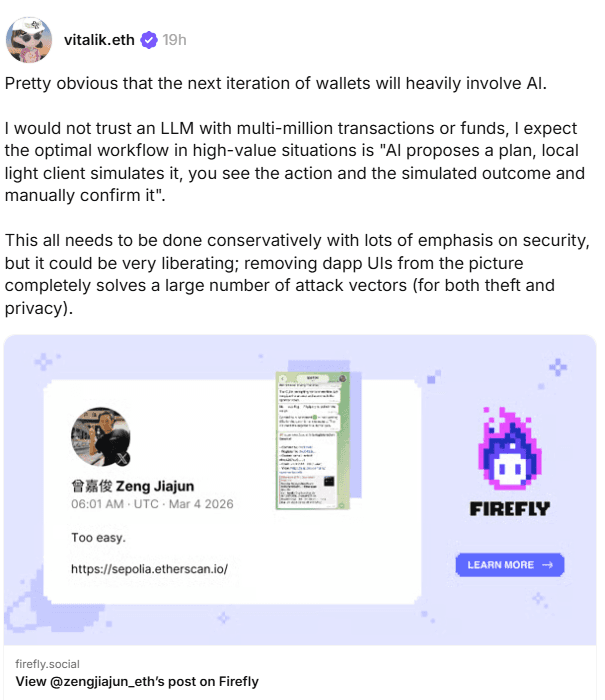
In comments published on his Farcaster account on March 6, Buterin outlined a specific technical workflow for how AI should function inside future wallets. His vision is not about handing AI the keys to a user's funds. It is about using AI as a proposal engine, with deterministic checks and human confirmation sitting on top of it.
"Pretty obvious that the next iteration of wallets will heavily involve AI," Buterin wrote. For routine tasks, he sees AI handling much of the heavy lifting. For high-value transactions, he proposed a three-step process:
- AI proposes a plan
- A local light client simulates the execution of that plan
- The user reviews both the intended action and the simulated outcome before manually confirming
A local light client, in this context, is a piece of software that verifies blockchain data without downloading the full chain. It can simulate what a transaction will actually do before it is broadcast to the network. Pairing that with an AI layer means users could see a plain-language description of what they are about to approve alongside a technical preview of its on-chain effects.
Why Removing DApp Interfaces Matters for Security
One of the more technically significant parts of Buterin's argument involves decentralized application (DApp) interfaces. Most crypto users interact with DApps through browser-based frontends, which have historically been a major attack surface. Frontend hijacks, malicious script injections, and fake approval buttons have drained hundreds of millions of dollars from users over the past several years.
Buterin argues that AI-powered wallets could remove the need for those interfaces entirely. If a user simply tells their wallet what they want to do in plain language, and the wallet's AI layer assembles and simulates the transaction directly, there is no third-party website to compromise.
"Removing DApp UIs from the picture completely solves a large number of attack vectors, for both theft and privacy," he said.
Why Buterin Does Not Trust AI With High-Value Transactions
Buterin's enthusiasm for AI wallets comes with a firm technical boundary. Large language models (LLMs), the underlying technology in tools like ChatGPT and Claude, generate responses based on statistical patterns rather than deterministic logic. They can hallucinate facts, misinterpret instructions, or be manipulated through carefully crafted inputs, a technique known as prompt injection.
For those reasons, Buterin said he would not trust an LLM with multi-million dollar transactions or fund management. The three-step workflow he described is designed specifically to prevent that kind of unchecked AI authority. Each layer adds an independent check: AI interpretation, deterministic simulation, and explicit human sign-off.
This layered approach reflects a principle that runs throughout Ethereum's design: security through redundancy. Rather than trusting any single system to get it right, the goal is to make catastrophic mistakes that require multiple simultaneous failures.
What AI Wallets Could Handle Automatically
For lower-stakes operations, Buterin sees more room for automation. An AI-enabled wallet could reasonably handle tasks such as:
- Monitoring transaction patterns for unusual activity
- Suggesting optimal gas fees based on current network conditions
- Routing token swaps through the most efficient available paths
- Flagging suspicious contract interactions before a user approves them
These are tasks where a mistake is recoverable, and where automation genuinely reduces complexity for non-technical users.
How This Fits Into Buterin's Broader Ethereum Rethink
The AI wallet comments are part of a wider push from Buterin to modernize how Ethereum is built and used. He has called for developers to move away from old dependencies and build apps that take advantage of newer Ethereum features, including privacy-preserving tools like Railgun wallets, which use zero-knowledge proofs to shield transaction details on-chain.
Ethereum currently has about 8,800 active developers, trailing Solana's 10,831. Buterin has acknowledged the network went through a relatively slow period and is now calling for a more ambitious wave of development.
In February, he also outlined a plan to rebuild core Ethereum infrastructure as a bolt-on extension to the existing network, targeting censorship resistance, zero-knowledge proof compatibility, and a leaner consensus layer, all without shutting down the chain.
He pointed to the 2022 Merge, Ethereum's switch from proof-of-work to proof-of-stake, as evidence the network can absorb major changes while staying live. His estimated timeline for the current upgrade cycle is roughly five years, potentially shorter if AI-assisted coding accelerates development.
The Ethereum Foundation separately published a document called Strawmap, last February, a non-binding technical direction for Ethereum Layer 1 upgrades through the end of the decade. It was produced by EF Architecture team members including Justin Drake, Ansgar Dietrichs, Barnabé Monnot, and Francesco D'Amato, and is intended as a discussion tool for researchers and client developers rather than an official commitment.
What Ethereum AI Wallets Can Do Today vs. What Buterin Proposes
Current crypto wallets, including hardware wallets and browser extensions like MetaMask, already offer some transaction simulation features. Some wallets display a plain-language summary of what a transaction will do before the user signs it. What Buterin is describing goes further: a wallet that actively interprets user intent in natural language, assembles the required contract interactions, simulates the full outcome, and presents both the plan and the result for human review.
That workflow does not exist in a fully integrated form today, but the individual components do. AI transaction assistants, local simulation tools, and intent-based transaction frameworks are all active areas of development across the Ethereum ecosystem.
Resources
Vitalik Buterin on Farcaster: Post on March 5
Justin Drake: Strawmap overview
Vitalik Buterin: Public response to Strawmap
strawmap.org: Roadmap documentation
Vitalik Buterin on X: Post on Feb. 20
Report by The Block: Vitalik Buterin is building a 'cypherpunk principled non-ugly Ethereum' as devs officially add FOCIL to upgrade roadmap
Report by Crypto Briefing: Vitalik Buterin plans bolt-on cypherpunk layer to upgrade existing Ethereum
Read Next...


Frequently Asked Questions
Why does Vitalik Buterin want AI in crypto wallets?
Buterin argues that AI could simplify complex crypto transactions by interpreting plain-language instructions, assembling the required on-chain actions, and removing the need for DApp browser interfaces that have historically been exploited by hackers. He also sees AI as a tool for automating low-risk wallet operations like fee optimization and suspicious activity detection.
Why won't Buterin trust AI with large crypto transactions?
Large language models generate responses probabilistically, not deterministically, meaning they can make errors, hallucinate information, or be manipulated through adversarial inputs. For high-value transactions, Buterin proposes a three-layer workflow: AI proposes a plan, a local light client simulates the execution, and the user manually reviews and confirms both before anything is broadcast to the blockchain.
What is a local light client and why does it matter for AI wallets?
A local light client is software that verifies blockchain data and simulates transaction outcomes without downloading the full blockchain. In Buterin's proposed workflow, it acts as an independent check on whatever the AI suggests. Before a user confirms a transaction, they can see exactly what will happen on-chain, reducing the risk of AI errors or manipulation causing irreversible fund loss.
Disclaimer
Disclaimer: The views expressed in this article do not necessarily represent the views of BSCN. The information provided in this article is for educational and entertainment purposes only and should not be construed as investment advice, or advice of any kind. BSCN assumes no responsibility for any investment decisions made based on the information provided in this article. If you believe that the article should be amended, please reach out to the BSCN team by emailing [email protected].
Author
 Soumen Datta
Soumen has been a crypto researcher since 2020 and holds a master’s in Physics. His writing and research has been published by publications such as CryptoSlate and DailyCoin, as well as BSCN. His areas of focus include Bitcoin, DeFi, and high-potential altcoins like Ethereum, Solana, XRP, and Chainlink. He combines analytical depth with journalistic clarity to deliver insights for both newcomers and seasoned crypto readers.
(Advertisement)
Latest News
July 24, 2026
Analysis: Ondo Finance's 2026 In Numbers
July 24, 2026

Is Circle Planning to Launch a Korean Won Stablecoin?
July 24, 2026
What Is Ripple Mint?
July 23, 2026

Can Injective's New Mint Platform Bring Institutions to INJ?
July 23, 2026
What is RippleX & Why Does it Matter for XRP Ledger?
July 23, 2026

What Is Dfinity's Caffeine?
July 22, 2026
How Much Funding Has Canton Developer Digital Asset Raised?
July 22, 2026

What is Aptos' AIP-146 and Is It Good News for APT?
(Advertisement)

Crypto Project & Token Reviews
Project & Token Reviews
Comprehensive reviews of crypto's most interesting projects and assets
Learn about the hottest projects & tokens

Latest Crypto Articles
Get up to date with the latest crypto news stories and events