Deepdive
(Advertisement)


TON vs Solana: Two High-Throughput Blockchains Compared

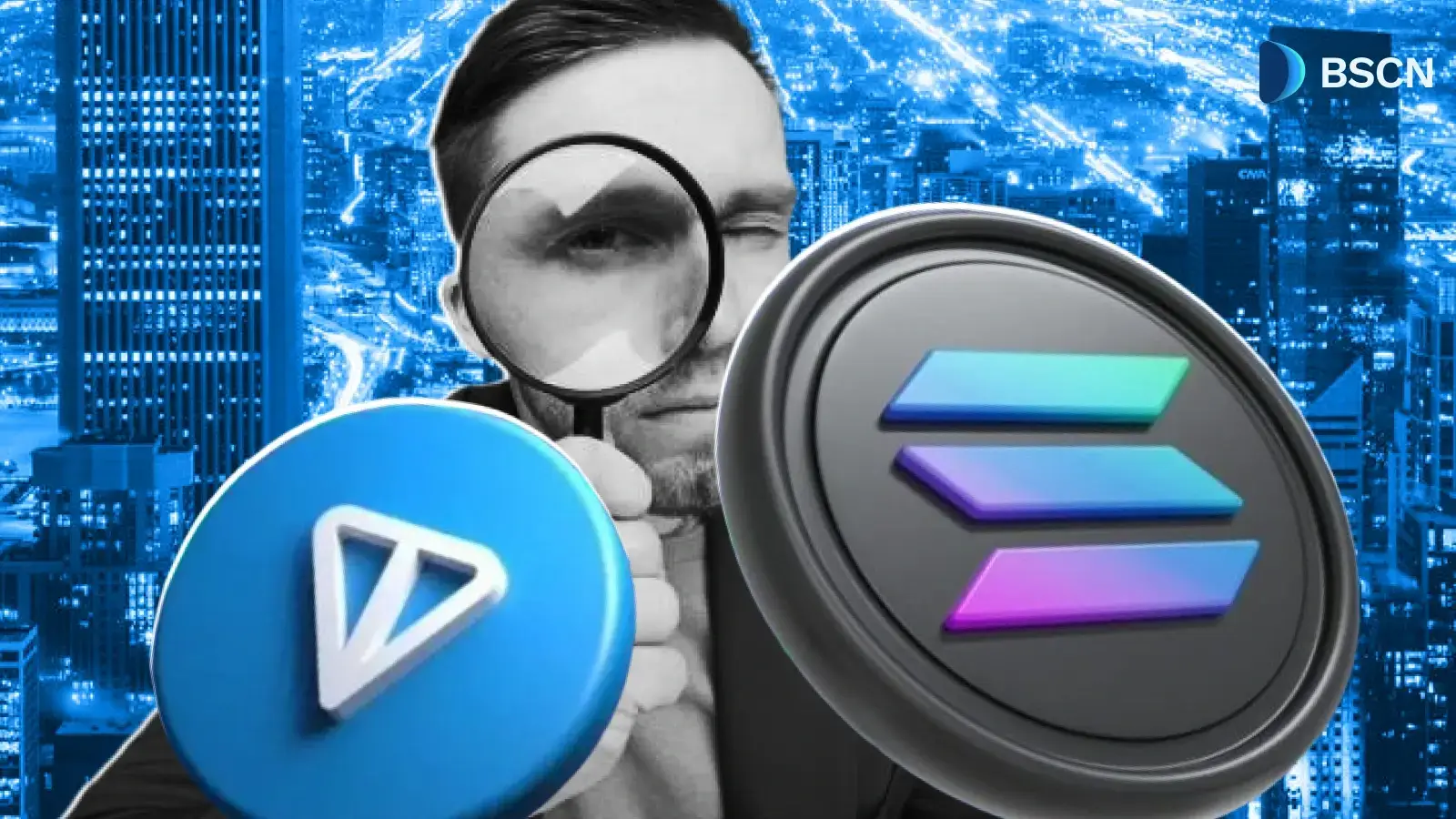
TON and Solana are both fast Layer 1 blockchains, but they work very differently. Compare their architecture, TPS, tokenomics, and real-world use cases in this 2026 breakdown.

Soumen Datta
May 26, 2026
(Advertisement)
Table of Contents
Both TON and Solana are built for high throughput, but they take different technical paths to get there. TON uses dynamic infinite sharding and a deep Telegram integration to serve consumer-scale payments, while Solana combines Proof of History with a growing multi-client validator network to support DeFi, high-frequency trading, and institutional applications.
As of May 2026, both networks have completed or are rolling out major upgrades that sharpen the differences between them.
What Are TON and Solana?
The Open Network (TON) was originally developed by Telegram founders Pavel and Nikolai Durov, then handed to an independent foundation. In May 2026, Telegram stepped back in, becoming the network's largest validator by staking 2.2 million TON. Through native Telegram wallet and Mini App integrations, TON has a direct distribution channel into a platform with over 1 billion monthly active users.
Solana launched in 2020 as a single-chain, high-performance blockchain aimed at developers building decentralized applications (dApps). It has since grown into one of the largest ecosystems in crypto, with a well-established DeFi market, NFT infrastructure, and increasing institutional involvement.
How Does TON's Architecture Work?
TON describes itself as a "blockchain of blockchains," and the structure reflects that.
The network runs on three layers: a masterchain that stores validator sets and protocol rules, workchains that handle specific transaction types, and shardchains that split and merge automatically based on load. This is called dynamic infinite sharding, and it gives TON a theoretical throughput ceiling of over 100,000 TPS without causing network-wide congestion.
The Catchain 2.0 Upgrade
In April 2026, TON activated Catchain 2.0, a full revision of its Byzantine Fault Tolerant (BFT) consensus protocol. The upgrade implemented QUIC, a modern networking standard developed by Google, to speed up communication between validators. Block times dropped from 2.5 seconds to approximately 400 milliseconds, and transaction finality settled at around one second. Fees were cut by roughly sixfold to about $0.0005 per transaction.
How Does Solana Handle Speed?
Solana uses a combination of Proof of History (PoH) and Proof of Stake (PoS) to process transactions at high speed.
Proof of History is a cryptographic timestamping method. It assigns a verifiable sequence to every transaction before consensus runs, letting validators process transactions in parallel rather than waiting for coordination.
Under its current Agave validator client, Solana has a theoretical ceiling of 65,000 TPS. In real-world conditions during 2026, production throughput has ranged between roughly 1,100 and 5,500 TPS depending on network activity.
Two Big Upgrades Changing the Picture
Firedancer, a new validator client built from scratch by Jump Crypto in the C programming language, launched on Solana mainnet in December 2025. In controlled testing, it handled over one million TPS on standard hardware, confirmed by Jump Trading's Chief Scientist at Breakpoint 2024.
By Q1 2026, about 25% of staked SOL ran on Firedancer or Frankendancer, a hybrid variant. Analysts at BlockEden.xyz project that broad Firedancer adoption could push real-world TPS toward 10,000 or more.
The second upgrade, Alpenglow, targets finality of approximately 150 milliseconds, down from current levels of 400 to 800 milliseconds. It replaces Tower BFT with a two-phase protocol called Votor and Rotor, which requires fewer round-trips between validators to reach agreement. Alpenglow passed a validator governance vote in September 2025 with 98.27% approval and is expected to go live on mainnet in 2026.
How Do They Compare on Speed and Throughput?
Both chains are targeting sub-second finality in 2026. TON's Catchain 2.0 reportedly delivers it today, settling transactions in roughly one second. Solana's Alpenglow, once live, is projected to reach around 150 milliseconds, which would put it ahead on raw latency. On throughput, TON's sharded architecture has a higher theoretical ceiling. Solana's real-world production TPS is currently higher and more consistently measurable.
Tokenomics and Market Position
As of late May 2026, TON (Toncoin) trades at approximately $1.9 with a market cap of around $5.1 billion, ranking #19 by market cap. The TON Believers Fund releases roughly 36.59 million TON per month through October 2028, which creates regular sell-side supply pressure.
SOL trades at approximately $85, with a market cap near $49 billion, ranking #7. US-listed spot Solana ETFs have surpassed $1 billion in assets under management, a sign of growing institutional positioning.
Developer Ecosystems and Smart Contracts
TON uses FunC and Tact as its primary smart contract languages, developed through TON Studio. FunC is the lower-level language; Tact is a more developer-friendly alternative built on top of it. The developer community is smaller than Solana's but has grown alongside the MTONGA (Make TON Great Again) roadmap launched by Pavel Durov in April 2026.
Solana supports Rust and C, has extensive SDK tooling, years of production deployment experience, and a larger pool of third-party integrations and DeFi liquidity.
What Are the Main Risks?
Both networks carry real structural risks, though they stem from very different sources. TON's vulnerabilities are tied to governance and regulatory history, while Solana's centre on hardware barriers and a turbulent early track record.
TON: Validator Concentration and Regulatory History
TON's biggest concern is concentration. According to reporting by Crypto Briefing (May 2026), Telegram becoming the largest validator on a blockchain it effectively controls creates a single point of failure, raising decentralization and security concerns.
CryptoPolitan noted that the shift concentrates validator power in ways that could influence DeFi integrations, exchange listings, and broader market perception. Tron Weekly added that focusing validator and development power in a single corporate entity raises questions about governance fairness and the potential for increased regulatory scrutiny.
It is worth noting that Pavel Durov disputes this framing. In his May 5, 2026 post on X, Durov argued that a strong central player can attract other large validators, which balances rather than concentrates power, pointing to the 20%-plus staking APR as an incentive for new validators to join.
The SEC and the Gram Token Case
There is also regulatory history from the SEC's 2019 lawsuit over the Gram token, which settled in June 2020. The SEC filed its emergency action against Telegram Group on October 11, 2019, and the court-approved settlement, announced by the SEC on June 26, 2020, required Telegram to return more than $1.2 billion to investors and pay an $18.5 million civil penalty.
As Unchained reported in May 2026, the current TON network was subsequently built and run by an independent community with the Swiss-based TON Foundation acting as coordinator, making it legally and operationally distinct from the original Gram project.
Solana: Hardware Barriers and the Outage Record
Solana's primary risk is validator centralization. Running a full validator requires high-spec hardware, which limits who can participate. An AInvest analysis from March 2026 confirmed that baseline hardware costs, requiring 512GB or more of RAM along with enterprise-grade NVMe storage, already favor large, well-funded operators.
Updated validator requirements that took effect on May 1, 2026, per a guide published by The Good Shell, have added stricter data center concentration limits and anti-censorship rules that raise operational costs further, with the daily validator count having already dropped from 2,560 in 2023.
How Stable Is the Solana Network Today?
On the outage record, multiple sources including Helius, MEXC, LeveX, and 24/7 Wall St. put the confirmed total at seven major network outages since launch in 2020, five caused by software bugs and two by transaction spam. The network has not recorded a confirmed major outage since February 6, 2024.
According to the Solana Foundation's June 2025 Network Health Report, as cited by MEXC, Solana had gone over 16 consecutive months without a major confirmed outage as of mid-2025, the longest stability streak in the network's history.
Conclusion
TON and Solana are both capable, fast Layer 1 networks with meaningfully different strengths. TON provides a direct path to over 1 billion Telegram users, competitive fees, and a recently upgraded consensus layer, but carries governance concentration risk. Solana has a larger developer ecosystem, stronger institutional traction, and two significant protocol upgrades in progress that target lower finality and higher throughput. The right choice depends on use case: consumer payments and Telegram-native applications favor TON; DeFi, institutional integrations, and developer tooling favor Solana.
Resources
- TON Foundation via FinanceFeeds – TON Blockchain Activates Catchain 2.0: Sub-Second Finality Goes Live
- Messari – Understanding TON: Architecture, Validator Roles, and the Catchain 2.0 Roadmap
- DEXTools – Toncoin in 2026: Telegram Economy, Sharding Model, and Catchain 2.0
- BlockEden.xyz – Solana's 1M TPS Vision: How Firedancer and Alpenglow Are Rewriting Blockchain Performance
- CoinMarketCap – Toncoin Latest Updates: TON Believers Fund, TON Pay 2.0, MTONGA Roadmap
- CryptoNews – Solana Network Performance, Revenue, and Ecosystem Metrics 2025-2026
- SEC.gov – SEC Files Emergency Action Against Telegram Group (October 2019)
- SEC.gov – Telegram Settles SEC Charges: $1.2 Billion Returned to Investors (June 2020)
Read Next...
Frequently Asked Questions
Is TON faster than Solana in 2026?
After the Catchain 2.0 upgrade in April 2026, TON delivers transaction finality in approximately one second with 400ms block times. Solana currently settles transactions in 400 to 800 milliseconds, and its upcoming Alpenglow upgrade is targeting around 150ms finality. Once Alpenglow goes live on mainnet, Solana is projected to be faster on raw latency, though TON's dynamic sharding gives it a higher theoretical TPS ceiling.
What is the difference between TON and Solana's consensus mechanisms?
TON uses a Byzantine Fault Tolerant protocol called Catchain, upgraded to version 2.0 in April 2026, across a sharded architecture. Solana uses Proof of History paired with Proof of Stake, with its upcoming Alpenglow upgrade set to replace the Tower BFT finality layer with a faster two-phase protocol called Votor and Rotor.
Which blockchain is better for developers, TON or Solana?
Solana has a more established developer environment with Rust and C support, extensive SDKs, and more years of production use. TON's tooling (FunC, Tact, TON Studio) is improving, and its Telegram distribution channel is a strong incentive for consumer app developers. Developers building payment apps or Telegram Mini Apps will find TON's ecosystem more directly useful; those building DeFi or high-frequency trading infrastructure will find Solana better supported.
Disclaimer
Disclaimer: The views expressed in this article do not necessarily represent the views of BSCN. The information provided in this article is for educational and entertainment purposes only and should not be construed as investment advice, or advice of any kind. BSCN assumes no responsibility for any investment decisions made based on the information provided in this article. If you believe that the article should be amended, please reach out to the BSCN team by emailing [email protected].
Author
 Soumen Datta
Soumen has been a crypto researcher since 2020 and holds a master’s in Physics. His writing and research has been published by publications such as CryptoSlate and DailyCoin, as well as BSCN. His areas of focus include Bitcoin, DeFi, and high-potential altcoins like Ethereum, Solana, XRP, and Chainlink. He combines analytical depth with journalistic clarity to deliver insights for both newcomers and seasoned crypto readers.
(Advertisement)
Latest News
July 24, 2026
Analysis: Ondo Finance's 2026 In Numbers
July 24, 2026
Is Circle Planning to Launch a Korean Won Stablecoin?
July 24, 2026
What Is Ripple Mint?
July 23, 2026
Can Injective's New Mint Platform Bring Institutions to INJ?
July 23, 2026
What is RippleX & Why Does it Matter for XRP Ledger?
July 23, 2026
What Is Dfinity's Caffeine?
July 22, 2026
How Much Funding Has Canton Developer Digital Asset Raised?
July 22, 2026
What is Aptos' AIP-146 and Is It Good News for APT?
(Advertisement)

Crypto Project & Token Reviews
Project & Token Reviews
Comprehensive reviews of crypto's most interesting projects and assets
Learn about the hottest projects & tokens

Latest Crypto Articles
Get up to date with the latest crypto news stories and events