Deepdive
(Advertisement)


Dogecoin as a Payment Method: Where DOGE Is Accepted Today?

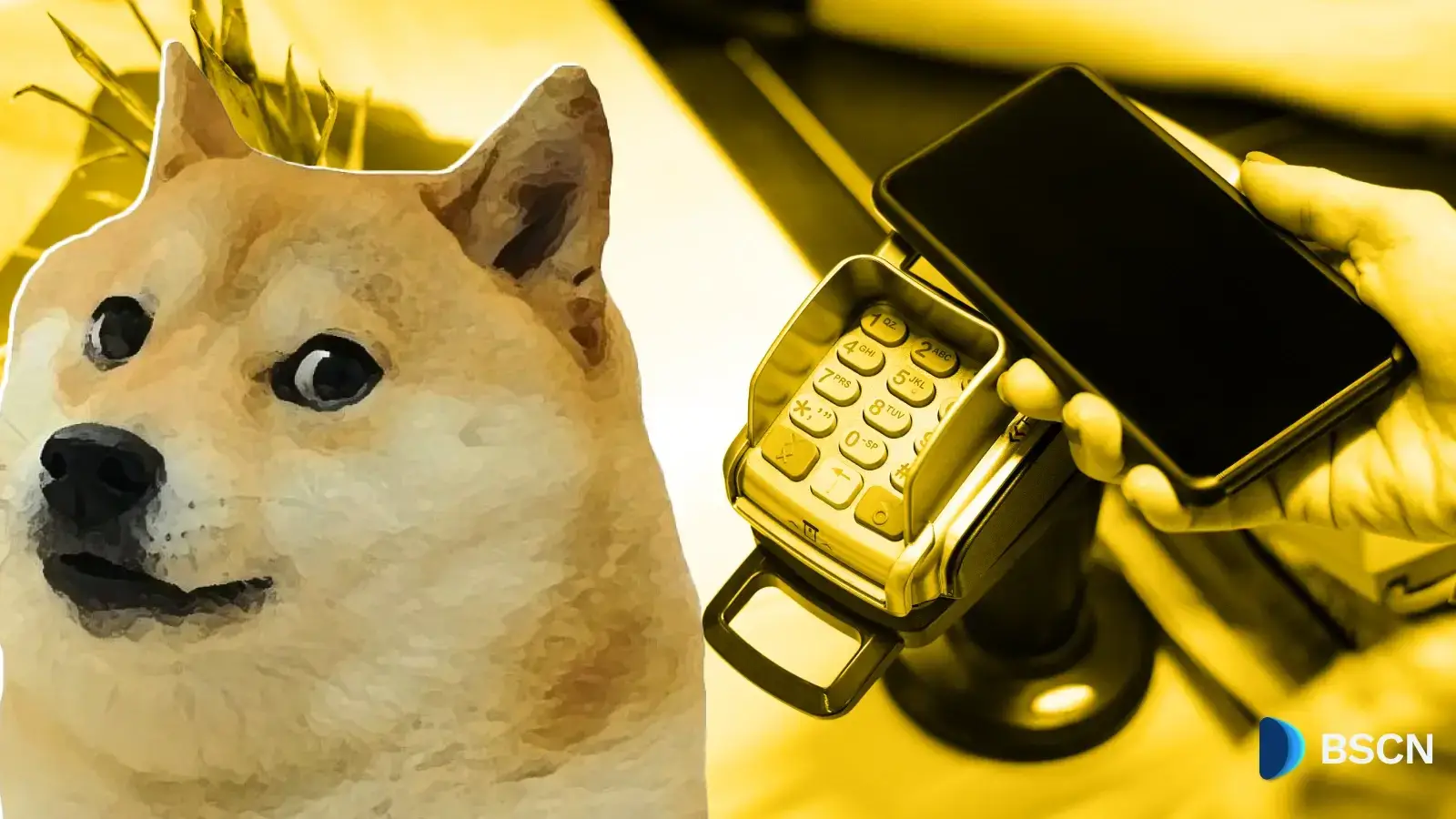
Dogecoin is accepted at Tesla, AMC, Newegg, and 2,200+ merchants in 2026. Here's where DOGE is actually used as payment and what its adoption looks like today.

Soumen Datta
June 1, 2026

(Advertisement)
Table of Contents
Dogecoin is accepted as a real payment method at over 2,200 merchants globally as of mid-2026, covering electronics retailers, movie chains, sports franchises, and online services.
Dogecoin facilitates faster and cheaper microtransactions compared to many leading cryptocurrencies, making it a practical candidate for retail payment adoption. Its "inflationary but predictable" supply model encourages spending rather than hoarding, a key characteristic of a functional currency. For a memecoin that started as a joke in 2013, the payment infrastructure it has built since then is more concrete than most realize.
What Is Dogecoin and Why Does It Matter for Payments?
Dogecoin (DOGE) was created by Billy Markus, an IBM software engineer from Portland, Oregon, and Jackson Palmer, an Adobe marketing professional from Sydney, Australia. It launched officially on December 6, 2013. The official launch was on December 6, 2013, as a fork of Luckycoin, which was itself a fork of Litecoin. The two creators built it as a lighthearted alternative to Bitcoin, and it was never intended to be a store of value.
With infinite supply, adding roughly 5 billion coins yearly via one-minute blocks, low fees of approximately $0.01 per transaction, and 33 transactions per second, it is optimized for tipping, microtransactions, and social payments rather than scarcity-driven value.
Unlike Bitcoin, which has a hard cap of 21 million coins, Dogecoin is intentionally abundant, with 10,000 new coins mined every minute and no maximum supply. That unlimited supply means DOGE is structurally inflationary, but the inflation rate falls as a percentage of total supply each year. For payments, this design fits the use case: a coin built to move quickly and cheaply rather than sit in a wallet.
Dogecoin's network fees are often significantly lower than those of Bitcoin or Ethereum, especially during peak times, making it practical for smaller, everyday purchases. The blockchain features quicker block times, meaning transactions confirm faster than many other major cryptocurrencies.
Where Is Dogecoin Actually Accepted Today?
The clearest place to start is with confirmed, operational payment integrations rather than speculative ones.
Tesla remains the most high-profile DOGE merchant. Tesla's own support page says customers can use Dogecoin to buy eligible products in the Tesla Shop, warning that it only accepts Dogecoin for select items and that crypto payments are irreversible. This is real merchant adoption, though limited to merchandise and certain items, not vehicle purchases. Drivers can also pay using Dogecoin to charge their EVs at many Tesla Supercharger stations.
Beyond Tesla, the bulk of DOGE merchant access runs through BitPay, a payment processor that converts crypto to fiat for merchants so they never need to hold digital assets directly. BitPay enables DOGE payments for merchants including Newegg, AMC Theatres, the Dallas Mavericks, and airBaltic.
Breaking those down specifically:
- Newegg: Accepts DOGE to buy laptops and desktop computers from brands including HP, Lenovo, Acer, LG, and MSI.
- AMC Theatres: AMC's partnership with BitPay has enabled customers to use Dogecoin to buy tickets and concessions, including popcorn, by choosing BitPay as a payment option at checkout.
- Dallas Mavericks: One of the earliest and best-known DOGE merchant cases in professional sports, still listed in BitPay's merchant directory.
- airBaltic: The Latvian airline accepts DOGE through BitPay for flight bookings, one of the few travel-sector examples of direct crypto payment integration.
The broader merchant directory sits at over 2,200 businesses as of May 2026, spanning internet services, hosting providers, VPN services, crypto services, charity organizations, and online shops.
How Do Payment Processors Make This Work?
Several factors hinder direct crypto adoption by merchants, including price volatility, the technical infrastructure required to manage a corporate crypto wallet securely, and complex accounting and tax implications. Payment processors solve these problems by handling the crypto and paying merchants in a stable fiat currency.
This is why BitPay's role is central to Dogecoin's merchant story. A merchant using BitPay never actually holds DOGE. The processor accepts it on the merchant's behalf, converts it to fiat, and settles in the merchant's local currency.
Based on 2026 market data, most merchants now use auto-convert settings that lock in the exchange rate at the moment of the transaction, ensuring that if a customer buys a $50 item with DOGE, the merchant receives exactly $50 regardless of subsequent price movements.
DOGE now accounts for 6% of BitPay transactions, a figure that reflects both retail interest and the infrastructure built around it over the past several years.
The Such App: Dogecoin's Own Payment Infrastructure
One significant development that was not covered in earlier reporting on DOGE's payment story is the Such app. House of Doge and Brag House (Nasdaq: TBH) launched the Such Beta on May 25, 2026, the first live deployment of House of Doge's integrated payments and commerce infrastructure.
The Such Beta launches with three foundational capabilities: a Hustles commerce engine enabling users to sell goods and services directly for Dogecoin via invoicing and in-person QR payments; a self-custodial wallet supporting multi-account management, send and receive functionality, and fiat on-ramp access; and real-time blockchain transaction tracking.
The app is reportedly the first native Dogecoin payments product built by the official corporate arm of the Dogecoin Foundation, aimed directly at small merchants and individual vendors. Where BitPay works as an intermediary for established businesses, Such is designed to let a freelancer, local vendor, or small retailer accept DOGE payments without any technical setup beyond downloading the app.
What Does the Regulatory Picture Look Like in 2026?
On March 17, 2026, the U.S. Securities and Exchange Commission and Commodity Futures Trading Commission jointly finalized a rule classifying 16 crypto assets as digital commodities, and Dogecoin was on that list alongside Bitcoin, Ethereum, Solana, and XRP.
Digital commodities are defined as crypto assets deriving their value from the programmatic operation of a functional crypto system and from supply-and-demand dynamics, rather than from expectations of profit based on others' managerial efforts. In plain terms, DOGE is now treated more like a traded commodity under U.S. law than a stock, which removes the risk of exchange delistings tied to securities compliance.
It is worth noting the precise sequence of events here. The 21Shares Dogecoin ETF (TDOG) actually launched on Nasdaq on January 22, 2026, before the commodity classification took effect. TDOG provides investors with secure and straightforward access to DOGE, holding the asset on a 1:1 basis in institutional-grade custody, and began trading on Nasdaq on January 22, 2026. 21Shares is the only ETF provider endorsed by the House of Doge.
The March 17 commodity classification then provided further regulatory footing for existing institutional DOGE products and opened the door for additional ones.
What DOGE Looks Like in the Market Right Now
As of June 2026, DOGE is trading at approximately $0.10 with a market cap of around $16.97 billion. Dogecoin's all-time high was $0.7376, reached on May 8, 2021. The all-time high coincided with Elon Musk's appearance as host on Saturday Night Live, which triggered a price spike followed by a sharp correction. The coin has since stabilized into a much lower range, though its regulatory status and growing institutional infrastructure have provided a floor well above its pre-2021 levels.
What About X Money and DOGE Integration?
This is the most discussed and most misreported part of Dogecoin's 2026 story.
Elon Musk announced that X would launch its payments feature, X Money, in April 2026, offering peer-to-peer transfers, bank deposits, a debit card, and cashback rewards in partnership with Visa, licensed in more than 40 U.S. states. No mention of Dogecoin or any crypto functionality was included in the announcement.
X Money launched publicly in April 2026 as a fiat-only product. The announcement deflated months of speculation that Dogecoin would be the first crypto asset integrated into X Money. As of June 2026, DOGE integration into X Money has not been officially confirmed by Elon Musk or X. The platform launched without any crypto layer, and no public timeline for adding one has been communicated.
DOGE is widely expected by analysts to serve as one of the first crypto payment rails integrated into X Money if and when crypto support is added, but the thesis breaks if the integration is delayed or DOGE is not selected as a launch payment rail, as the catalyst is widely expected but not officially confirmed.
Conclusion
Dogecoin's payment adoption in 2026 is real, documented, and growing, but it remains selective and narrow compared to mainstream payment networks. Tesla, AMC, Newegg, the Dallas Mavericks, and a network of over 2,200 merchants accept DOGE, mostly through BitPay's fiat-conversion infrastructure.
The May 2026 launch of the Such app beta by House of Doge introduces the first native payment tool built specifically for DOGE-to-merchant transactions without intermediaries. The March 2026 SEC and CFTC commodity classification removed the main regulatory barrier to institutional participation.
The 21Shares TDOG ETF, which began trading on Nasdaq in January 2026, confirmed that institutional access was already ahead of the regulatory timeline. What DOGE has today is a functional, narrow payment network with established merchant names, low fees, and a clear legal status. What it does not yet have is confirmed integration into any major fintech platform at scale.
Resources
- Switchere – Who Accepts Dogecoin? A Practical Guide to Spending Your Crypto
- Prestmit – Who Accepts Dogecoin? A List of Companies That Accept Dogecoin Payments 2026
- Cryptwerk – 2,500+ Companies and Stores Where You Can Pay With Dogecoin
- Bitcoin.com – What Is Dogecoin (DOGE)? A 2026 Guide to How It Works, Mining, Supply, and Use Cases
- CoinPedia – SEC CFTC Crypto Commodity List 2026: All 16 Digital Assets Named and What It Means
- CoinDesk – Elon Musk Announces X Money Launch Date for April
- Ropes and Gray – SEC and CFTC Issue Landmark Joint Guidance on Classification of Crypto Assets
- GlobeNewswire – 21shares Announces Launch of the 21shares Dogecoin ETF (TDOG) on Nasdaq
- GlobeNewswire – Such App Beta Launch: House of Doge's Scalable Direct-to-Consumer Platform
- The Block – Dogecoin Foundation-Backed Team Plans Such DOGE Payments App for 2026
- CoinMarketCap – Dogecoin (DOGE) Live Price and Market Data
- KuCoin – DOGE Payment Adoption by Merchants and Businesses 2026
Read Next...




Frequently Asked Questions
Where can I spend Dogecoin in 2026?
DOGE is accepted at Tesla's online shop for select merchandise and at many Supercharger stations, AMC Theatres for tickets and concessions, Newegg for electronics, the Dallas Mavericks for fan purchases, and airBaltic for flights, all primarily via BitPay. The House of Doge's Such app, which launched in beta on May 25, 2026, also lets individual sellers and small businesses accept DOGE directly via QR payments. A broader directory of over 2,200 merchants spanning hosting, VPN services, and online retail accepts DOGE as of mid-2026.
Is Dogecoin a legitimate payment method or just a memecoin?
Both descriptions are accurate at the same time. DOGE started as a memecoin in December 2013 and that community identity remains part of it. At the same time, it is now classified as a digital commodity by the SEC and CFTC, it has a live spot ETF on Nasdaq (TDOG, launched January 22, 2026), and it processes real transactions at major brands via BitPay. The memecoin label and functional payment infrastructure are not mutually exclusive.
Does X (formerly Twitter) accept Dogecoin payments?
Not as of June 2026. X Money launched in April 2026 as a fiat-only product similar to Venmo. DOGE integration has not been confirmed by X or Elon Musk in any official capacity. X Tips allows users to link third-party payment services, but there is no native DOGE payment functionality built into the platform at this time.
Disclaimer
Disclaimer: The views expressed in this article do not necessarily represent the views of BSCN. The information provided in this article is for educational and entertainment purposes only and should not be construed as investment advice, or advice of any kind. BSCN assumes no responsibility for any investment decisions made based on the information provided in this article. If you believe that the article should be amended, please reach out to the BSCN team by emailing [email protected].
Author
 Soumen Datta
Soumen has been a crypto researcher since 2020 and holds a master’s in Physics. His writing and research has been published by publications such as CryptoSlate and DailyCoin, as well as BSCN. His areas of focus include Bitcoin, DeFi, and high-potential altcoins like Ethereum, Solana, XRP, and Chainlink. He combines analytical depth with journalistic clarity to deliver insights for both newcomers and seasoned crypto readers.
(Advertisement)
Latest News
July 10, 2026

How Do PancakeSwap's CAKE Token Burns Actually Work?
July 10, 2026

Report: Ripple & The XRP Ecosystem in H1 2026
July 10, 2026

How Is Cardano Advancing Financial Inclusion in Developing Countries?
July 10, 2026

Why Was Sui Built From Scratch Instead of Forking an Existing Blockchain?
July 9, 2026

Trust Wallet Adds Native Support for Robinhood Chain, Opening Stock Tokens to 220 Million Users
July 9, 2026
Robinhood Chain Explodes Post-Mainnet Launch
July 9, 2026

Is Avalanche AVAX Bringing Hyundai On Chain?
July 9, 2026

Stop Tokenizing Assets You Don't Control
(Advertisement)

Crypto Project & Token Reviews
Project & Token Reviews
Comprehensive reviews of crypto's most interesting projects and assets
Learn about the hottest projects & tokens

Latest Crypto Articles
Get up to date with the latest crypto news stories and events