

Trump Slams Legacy Media Outlets For Reporting "Fake News" On The Iran Conflict

President Trump has renewed his attacks on The New York Times, The Wall Street Journal, and CNN over their coverage of the US military campaign against Iran, as the Strait of Hormuz remains a flashpoint for global energy trade.
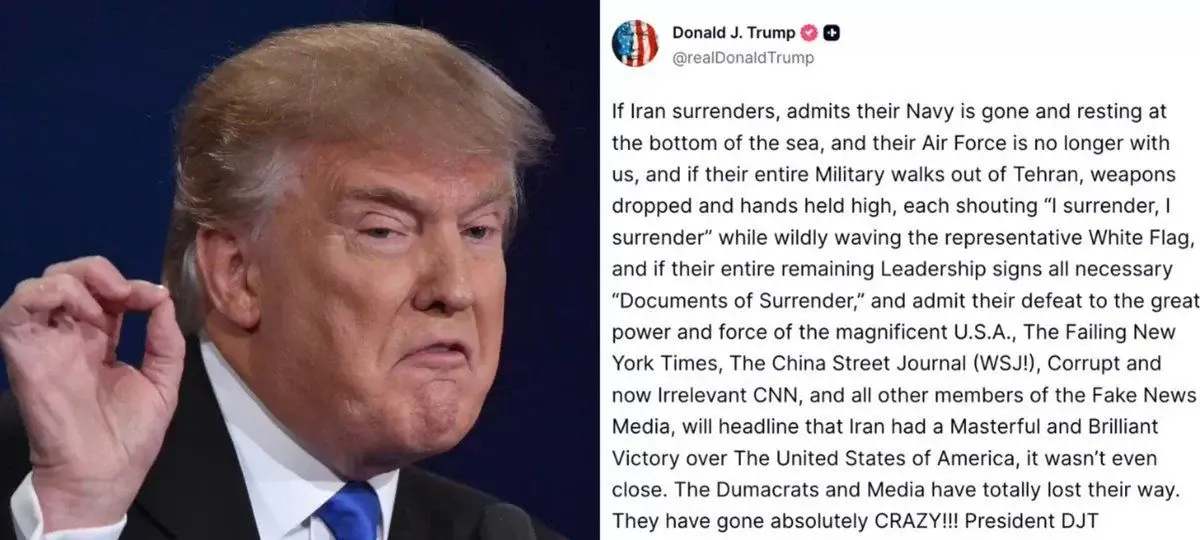
President Donald Trump has intensified his rhetorical campaign against mainstream media outlets, singling out The New York Times, The Wall Street Journal, and CNN for what he calls biased and misleading coverage of the US military campaign against Iran.
Trump has argued that no amount of battlefield success would be credited to the United States by these outlets. He claims that even a total Iranian capitulation would be framed as a victory for Tehran. Aboard Air Force One, Trump told a New York Times reporter: "I had a total military victory, but the fake news, guys like you, write incorrectly," calling the newspaper's chief Washington correspondent a "fake guy" and labelling the Times and CNN "the worst."
The Strait of Hormuz and the Battle Over the Narrative
The backdrop to Trump's media war is a conflict that has had serious consequences for global energy markets. Shipping traffic through the Strait of Hormuz, a major maritime chokepoint for world energy trade, has been largely blocked by Iran since 28 February 2026, when the United States and Israel launched an air war against Iran. Around 20% of global petroleum and 20% of liquefied natural gas passes through the strait each year.
Trump has said that the US has "knocked out" Iran's navy, air force, antiaircraft systems, radar, and "all of their leaders," while also claiming 85 percent of missile manufacturing capabilities had been eliminated. However, reporting from the Times noted that while the Iranian supreme leader was "clearly gone," Tehran's nuclear stockpile remained untouched, and US intelligence assessments suggested that more than half of Iran's missiles and launchers had survived the attacks.
The administration's media offensive has been broad. Trump has used words like "criminal" and "unpatriotic" to assail media companies, his FCC chairman has threatened broadcasters' licenses, and Defense Secretary Pete Hegseth has insulted news outlets from the Pentagon briefing podium.
Press Freedom Concerns and Pushback
The New York Times defended its reporting, saying its journalists "have been working carefully to provide the public with the fullest possible understanding of the reality of the military action in Iran." Spokesman Charlie Stadtlander added: "Reporting isn't treason."
Analysts have suggested the ferocity of the administration's media attacks may reflect anxiety about the war's unusually low public approval ratings, or about how the conflict is actually going. The closure of the strait has disrupted global trade, causing oil and fertiliser prices to soar and prompting fears of a global recession and a food emergency.
Negotiations mediated by Pakistan have so far failed to produce a breakthrough, and the situation in the Strait of Hormuz remains unresolved as of mid-May 2026.
Sources:
The Hill: Trump calls NYT reporter "treasonous" on Iran coverage
Wikipedia: 2026 Strait of Hormuz crisis
UK House of Commons Library: Reopening the Strait of Hormuz
Latest News




Read More...

(Advertisement)
Author
 UC Hope
UC holds a bachelor’s degree in Physics and has been a crypto researcher since 2020. UC was a professional writer before entering the cryptocurrency industry, but was drawn to blockchain technology by its high potential. UC has written for the likes of Cryptopolitan, as well as BSCN. He has a wide area of expertise, covering centralized and decentralized finance, as well as altcoins.