Deepdive
(Advertisement)


How Does Zcash Hide Transaction Details While Bitcoin Makes Them Public?

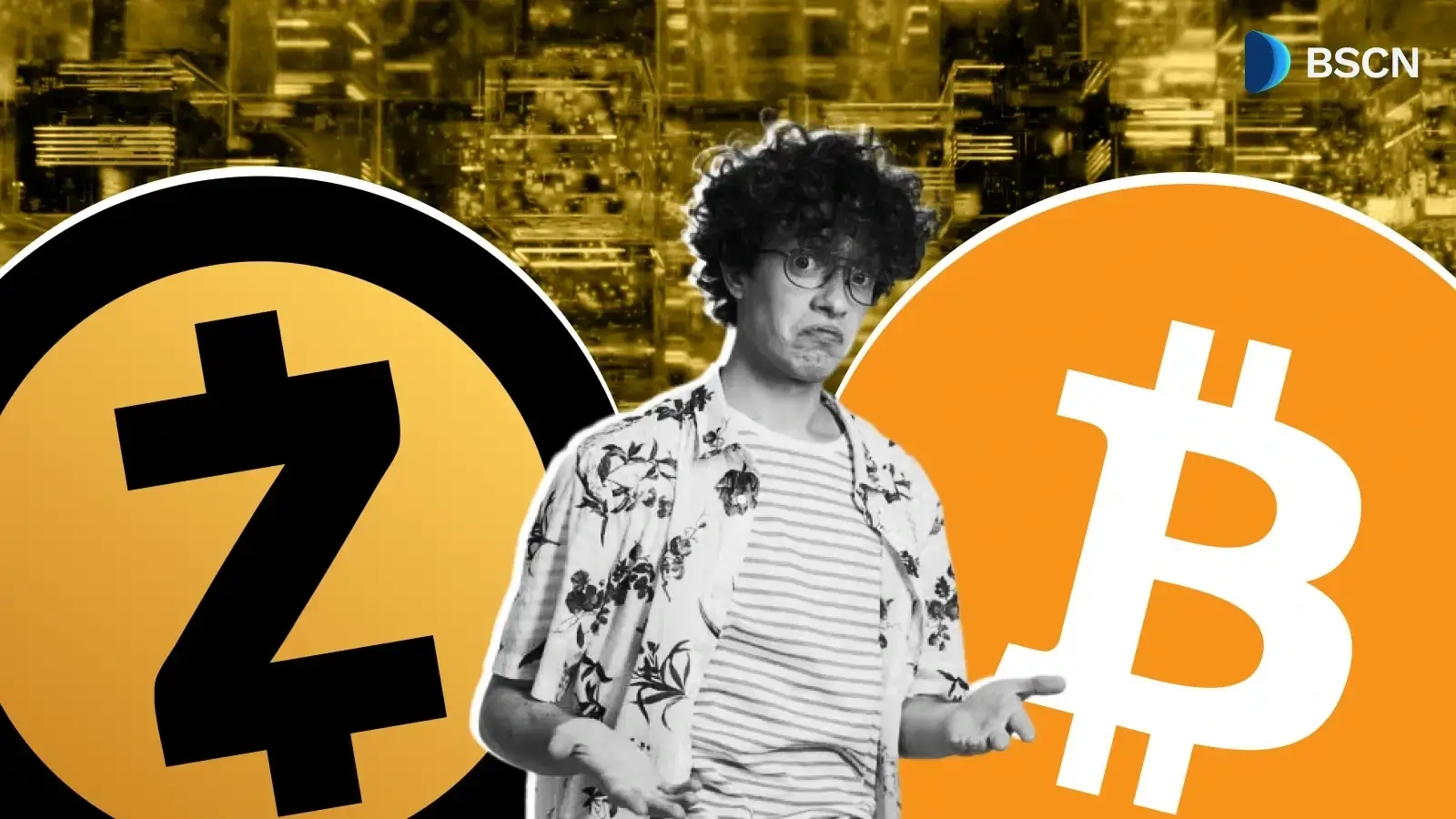
Zcash hides sender, receiver, and amount using zk-SNARKs. Bitcoin records every transaction in the open. Here's how the two chains really compare.

Soumen Datta
July 3, 2026

(Advertisement)
Table of Contents
Zcash hides transaction details by using a cryptographic method called zk-SNARKs, which lets the network confirm a transaction is valid without showing who sent it, who received it, or how much moved. Bitcoin does the opposite.
Every Bitcoin transaction, including the wallet addresses and the exact amount, sits on a public ledger that anyone can view with a block explorer. That single design choice is the biggest technical difference between the two oldest privacy-relevant cryptocurrencies in the market.
Both networks share a lot of DNA. Zcash actually launched in 2016 as a fork of Bitcoin's codebase, and it kept Bitcoin's fixed supply cap of 21 million coins along with a similar halving schedule. But the two chains diverge completely on one question: who gets to see your money move.
What Makes Bitcoin's Ledger Fully Public?
Bitcoin was never designed to be anonymous. It was designed to be verifiable. Every node on the network needs to see the same data to agree that a transaction is real, so Bitcoin's ledger records the sending address, the receiving address, and the exact amount for every single transfer, forever.
This is often called "pseudonymous," not anonymous. Wallet addresses are not tied to real names by default, but they don't need to be. Blockchain analysis firms and law enforcement agencies have spent years building tools that link addresses to identities through exchange records, IP data, and spending patterns. Once one address in a cluster is identified, the rest of that person's transaction history often becomes traceable too.
A few practical consequences follow from this:
- Anyone can look up a wallet's full balance and transaction history on a block explorer.
- Payroll, donations, or business payments made in BTC are visible to competitors, employers, or anyone curious enough to check.
- Coins themselves are not interchangeable in a privacy sense, since a coin's full history can be traced, which is the opposite of what economists call fungibility.
How Does Zcash Actually Hide Transaction Data?
Zcash gives users a choice between two address types, and that choice determines how much the network reveals.
Transparent Addresses Work Like Bitcoin
Zcash transparent addresses, known as t-addresses, function exactly like Bitcoin addresses. The sender, the receiver, and the amount are all visible on the public chain. Zcash includes this option for exchange compatibility and for cases where a business needs an auditable trail.
Shielded Addresses Use Zero-Knowledge Proofs
Shielded addresses, known as z-addresses, are where Zcash's privacy actually happens. They rely on zk-SNARKs, short for Zero-Knowledge Succinct Non-Interactive Arguments of Knowledge.
In plain terms, a zk-SNARK lets a Zcash node mathematically confirm that a transaction follows every network rule, meaning no one is spending coins they don't have and no coins are being created out of thin air, without ever learning the sender, the receiver, or the amount involved. The transaction is still recorded on the public blockchain, but the details inside it stay encrypted.
Zcash's shielded technology has gone through three generations since 2016:
- Sprout, the original 2016 pool, proved the concept but required heavy computing power, which made mobile use impractical.
- Sapling, launched in 2018, cut proof generation time dramatically and made shielded transactions usable on phones.
- Orchard, Zcash's current shielded pool, runs on the Halo 2 proving system. Halo 2 removed the need for a trusted setup ceremony and added recursive proofs, which improved both security and efficiency.
Zcash also added Unified Addresses, a single address format that can receive funds across the transparent pool, Sapling, or Orchard without the user needing to manage separate address types.
Selective Disclosure: Privacy That Isn't All-or-Nothing
One feature sets Zcash apart from a strictly anonymous coin like Monero: selective disclosure. A Zcash user can share a "viewing key" that lets a specific third party, such as an auditor, a business partner, or a regulator, see the details of a shielded transaction without exposing that data to the public. This lets someone prove income or compliance on demand while keeping the transaction hidden from everyone else. Bitcoin has no equivalent mechanism, since its ledger is either fully visible to everyone or not usable at all.
Adoption Numbers Tell the Real Story
Shielded transaction usage has grown sharply. The share of ZEC supply held in shielded addresses grew from about 8% in early 2024 to roughly 30% by mid-2026, representing about five million ZEC moved into shielded addresses by holders making individual decisions to prioritize privacy. Wallet-level changes have pushed this further, as some wallets have made shielded transactions the default instead of an opt-in choice, which grows the anonymity set that protects every shielded user.
Bitcoin, by contrast, offers no built-in path to this kind of privacy. Any confidentiality on Bitcoin has to come from third-party mixing services, which carry their own legal and technical risks and do not change what the base protocol records.
Trust Is Not the Same as Cryptography
Zcash's math has held up, but 2026 tested the ecosystem's trust in other ways. In January 2026, Josh Swihart, then CEO of the Electric Coin Company, said his entire team was "constructively discharged" following a governance dispute with Bootstrap, the nonprofit that oversees the company. Zcash's developers said the protocol itself was unaffected, but ZEC still dropped roughly 18% in the following 24 hours.
Then, on May 29, 2026, independent security researcher Taylor Hornby disclosed a critical vulnerability in the Orchard shielded pool, found using Anthropic's Claude Opus 4.8. The bug had existed since Orchard launched in May 2022 and could have let an attacker generate unlimited counterfeit ZEC that would have been indistinguishable from legitimate coins.
Hornby built a working proof-of-concept in a private test environment and reported it immediately rather than using it on the live network. Developers disabled Orchard with an emergency soft fork on June 1–2, then deployed the NU6.2 hard fork on June 3 with a corrected circuit.
Because Orchard's privacy properties hide transaction details by design, developers said there was no cryptographic way to confirm whether the bug had ever been exploited before the fix, though they assessed exploitation as unlikely. The disclosure still triggered a sharp sell-off, with ZEC falling from around $578 to a low near $250 before beginning to recover.
As of July 3, 2026, ZEC is trading near $453, up on the week as privacy coins broadly rotate back into favor. Zcash's answer to the trust question is an upgrade called Ironwood, targeted for around July 21, 2026.
Ironwood introduces a new shielded pool and routes existing Orchard funds through Zcash's turnstile mechanism, so any node can independently verify that the amount of ZEC moving into the new pool never exceeds what should exist, closing the audit gap the Orchard bug exposed.
The upgrade also adds formal verification of the underlying zero-knowledge circuit and independent audits. The cryptographic design of zk-SNARKs was never in question during any of this. What got tested was the software implementation and the team running it, which is a separate risk from the privacy technology itself.
What This Means for Users
Bitcoin's transparency is a feature for some use cases, since anyone can independently verify total supply and audit the chain without trusting a third party. But that same transparency means every payment, salary, or donation made in BTC is permanently visible to anyone who looks.
Zcash gives users a choice. Transparent addresses behave like Bitcoin for cases that need an open trail. Shielded addresses, protected by zk-SNARKs, hide the sender, receiver, and amount while still letting the network verify the transaction is valid. Selective disclosure through viewing keys adds a middle ground that Bitcoin simply does not have.
Resources
- Report by crypto.news: Why 30% of Zcash Supply Is Now in the Shielded Pool
- Resource Page by Decrypt: What Is Zcash (ZEC)? The Privacy Coin Using Zero-Knowledge Proofs
- Report by CoinDesk: Zcash Developer Team Behind ECC Quits After Governance Clash With Bootstrap Board
- Report by The Block: Zcash Selloff Extends Past 50% Amid Bug Disclosure as Liquidations Top $100 Million
- Report by The Block: Zcash Finalizes Ironwood Upgrade Plan, Targets July Activation
- Data by CoinMarketcap: Zcash (ZEC) Price USD Today
Read Next...
Frequently Asked Questions
Does Zcash hide all transactions by default?
No. Zcash is optional privacy, not mandatory privacy. Users choose between transparent addresses, which work like Bitcoin, and shielded addresses, which use zk-SNARKs to hide transaction details. As of mid-2026, roughly 30% of the ZEC supply sits in shielded addresses.
Can Bitcoin transactions ever be made private?
Not at the protocol level. Bitcoin's base layer always records the sender, receiver, and amount publicly. Any privacy on Bitcoin comes from third-party mixing tools built on top of the network, not from Bitcoin's own code.
What is a zk-SNARK in simple terms?
A zk-SNARK is a cryptographic proof that lets someone show a statement is true, such as "I have enough funds for this transaction," without revealing any of the underlying details, such as the account balance or the parties involved. Zcash was the first cryptocurrency to deploy zk-SNARKs on a live mainnet, in 2016.
Disclaimer
Disclaimer: The views expressed in this article do not necessarily represent the views of BSCN. The information provided in this article is for educational and entertainment purposes only and should not be construed as investment advice, or advice of any kind. BSCN assumes no responsibility for any investment decisions made based on the information provided in this article. If you believe that the article should be amended, please reach out to the BSCN team by emailing [email protected].
Author
 Soumen Datta
Soumen has been a crypto researcher since 2020 and holds a master’s in Physics. His writing and research has been published by publications such as CryptoSlate and DailyCoin, as well as BSCN. His areas of focus include Bitcoin, DeFi, and high-potential altcoins like Ethereum, Solana, XRP, and Chainlink. He combines analytical depth with journalistic clarity to deliver insights for both newcomers and seasoned crypto readers.
(Advertisement)
Latest News
2h : 47m ago
Can Injective's New Mint Platform Bring Institutions to INJ?
4h : 4m ago
What is RippleX & Why Does it Matter for XRP Ledger?
10h : 12m ago
What Is Dfinity's Caffeine?
July 22, 2026
How Much Funding Has Canton Developer Digital Asset Raised?
July 22, 2026
What is Aptos' AIP-146 and Is It Good News for APT?
July 22, 2026
What Happens to Unverified Pi Balances If Users Miss the Deadline?
July 22, 2026
What Is in Trump's CLARITY Act Ethics Deal?
July 21, 2026

Pudgy Penguins to Reach Millions with Target Placement
(Advertisement)

Crypto Project & Token Reviews
Project & Token Reviews
Comprehensive reviews of crypto's most interesting projects and assets
Learn about the hottest projects & tokens

Latest Crypto Articles
Get up to date with the latest crypto news stories and events