News
(Advertisement)


VeChain Completes StarGate Upgrade: A New Era for Staking and Rewards


VeChain's StarGate upgrade brings a new staking dashboard, dynamic VTHO rewards, and improved tracking. Here's what VET holders need to know.

Crypto Rich
January 21, 2026

(Advertisement)
Table of Contents
VeChain has completed its StarGate dashboard upgrade, bringing a polished new interface and improved tracking tools to the VeChainThor staking experience. Announced on January 19, 2026, this update builds on the Hayabusa mainnet launch from December 2025, which introduced the core DPoS mechanics and dynamic VTHO rewards system.
For anyone holding VET, this upgrade is worth paying attention to. Staking is now more accessible, rewards are tied to actual network usage, and a new dashboard provides full visibility into everything happening on-chain.
What Is StarGate?
StarGate is VeChain's next-generation staking platform built to make network participation more inclusive. The underlying Hayabusa upgrade went live on mainnet in early December 2025, transitioning VeChain from its legacy model to a Delegated Proof of Stake (DPoS) system powered by 96 active validators.
Here's how it works: stake your VET tokens to help secure the network, delegate to a validator of your choice, and earn VTHO in return. VTHO is the gas token that powers all transactions on VeChainThor.
A few things make StarGate different from typical staking setups.
The entry barrier is low. Users can begin staking with just 10,000 VET, roughly $200 at current prices. This is a significant drop from the higher thresholds required in VeChain's older systems, opening staking to a broader audience.
Staking positions are represented as NFTs. When you stake, you mint a Delegator NFT that tracks your position. Unstaking is as simple as burning that NFT, giving users flexibility without lengthy lock-up periods.
Validator selection puts users in control. The platform offers a roster of institutional-grade validators including Meria, Keyrock, Draper Dragon, and Fenbushi Capital. Delegators choose where to place their stake, distributing power and rewards based on validator performance.
Early participants also benefited from bonus incentives. VeChain allocated a $15 million VTHO bonus pool (5.48 billion VTHO) to boost yields during the first six months after launch. That bonus period has since concluded, but standard staking rewards continue.
With the latest dashboard upgrade, StarGate now serves as the polished, user-friendly hub for all staking activity on VeChainThor.
How Does the Upgrade Change Tokenomics?
The most significant shift is how VTHO gets issued. Previously, VTHO generation followed a fixed inflation model. Now, issuance is dynamic and tied directly to network demand.
This creates healthier economics for the ecosystem. When network activity rises, so does VTHO generation. When activity drops, issuance decreases. The result is reduced inflation and rewards that better reflect real usage.
The reward split favors delegators. They receive up to 70% of staking rewards, while validators take the remaining 30%. This balanced structure encourages broader participation while still compensating validators for their infrastructure costs.
Early results back this up. Since StarGate's initial launch, over 9 billion VET has been staked on the platform. During certain periods, VET's price saw a 20% uplift, suggesting the market has responded positively to improved tokenomics.
What Does This Mean for Decentralization?
More staking activity means a more resilient network. The shift from passive node holding to active delegation through StarGate promotes broader user involvement in consensus.
With 96 active validators and billions in locked value, VeChainThor now has a more distributed security model. This reduces centralization risks that can plague proof-of-stake networks where a small number of large players dominate validation.
The upgrade also supports VeChain's real-world applications. Staked VET helps secure platforms like VeBetter, an X-to-Earn ecosystem designed to reward sustainable habits. As more users stake, these applications gain a stronger foundation.
What Can You Do With the New Dashboard?
The upgraded staking dashboard at app.stargate.vechain.org brings transparency to every aspect of staking. It is built for live monitoring and gives users tools to manage assets and maximize returns.
The overview section displays key metrics at a glance. Users can see Total Value Locked, toggle between VET and USD values, and check VTHO issuance statistics. A breakdown shows how stake is distributed across validator stake, delegated stake, and undelegated stake.
Historical graphs track active stake over time, with lines showing VTHO issuance before and after Hayabusa for context.
A searchable validator list ranks all 96 validators by stake. Each entry shows the average APY, the number of delegations, the time until the next reward cycle, and the reliability scores. At the time of writing, top validators like BetterSwap and Keyrock show APYs between roughly 5% and 8%. These figures shift based on stake size and network conditions, so checking the dashboard regularly makes sense.
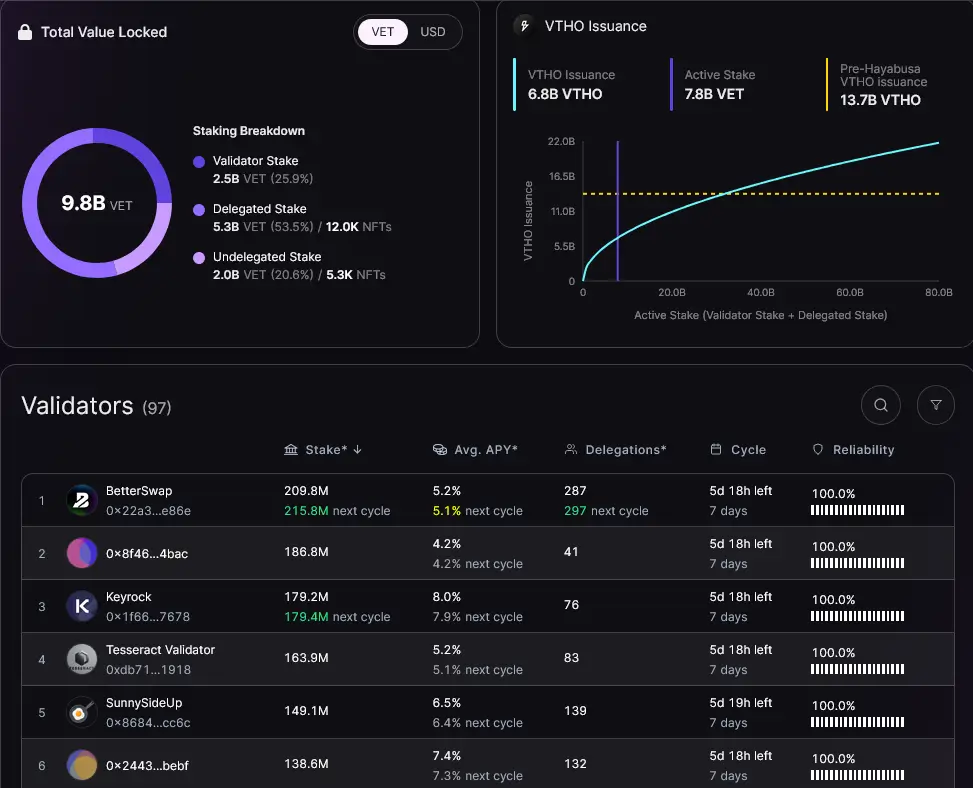
From the dashboard, users can connect a VeWorld wallet, stake VET to mint a Delegator NFT, switch validators, track performance, and monitor reliability to avoid slashing risks. Legacy node holders can also migrate their positions to the new system, though they should note the migration deadline of March 15, 2026.
Rewards are paid out every seven-day cycle, and users can watch staking activity as it happens to make informed decisions about when and where to delegate.
Community feedback on X has highlighted the cleaner interface, live tracking, and potential for improved yields compared to the old system.
Why Does This Matter for VeChain's Future?
The StarGate upgrade positions VeChain as a more mature blockchain platform. By combining enterprise-grade infrastructure with accessible staking tools, it appeals to both retail holders and institutional players.
Billions of VET are currently in active stake, with institutional validators adding credibility to the network. That kind of participation strengthens VeChain's position in supply chain management, sustainability tracking, and other enterprise use cases.
The Renaissance roadmap does not stop here. VeChain has already signaled that the next phase, called Interstellar, will bring additional features to the ecosystem.
For VET holders looking to put their tokens to work, StarGate offers a clear path to earning VTHO while contributing to network security.
To get started, visit the official VeChain website at vechain.org or follow @vechainofficial on X for the latest updates.
Sources:
- VeChain Official - Primary source for VeChain ecosystem and roadmap information
- StarGate Dashboard - Official staking platform with live metrics and validator information
- VeChain on X - Official announcements including the January 19, 2026 dashboard upgrade
Read Next...



Frequently Asked Questions
What is the minimum amount of VET needed to stake on StarGate?
Users can start staking with as little as 10,000 VET, which equals roughly $200 at current prices. This low threshold makes staking accessible to everyday holders rather than just large investors.
How do staking rewards work on VeChain's StarGate?
Delegators earn VTHO rewards paid out every seven-day cycle. The reward split gives delegators up to 70% while validators receive 30%. APY varies based on which validator you choose, total stake amounts, and network activity.
What is a Delegator NFT?
When you stake VET on StarGate, you mint a Delegator NFT that represents your staking position. This NFT tracks your stake and rewards. To unstake, you simply burn the NFT, which provides flexibility without long lock-up periods.
Disclaimer
Disclaimer: The views expressed in this article do not necessarily represent the views of BSCN. The information provided in this article is for educational and entertainment purposes only and should not be construed as investment advice, or advice of any kind. BSCN assumes no responsibility for any investment decisions made based on the information provided in this article. If you believe that the article should be amended, please reach out to the BSCN team by emailing [email protected].
Author
 Crypto Rich
Rich has been researching cryptocurrency and blockchain technology for eight years and has served as a senior analyst at BSCN since its founding in 2020. He focuses on fundamental analysis of early-stage crypto projects and tokens and has published in-depth research reports on over 200 emerging protocols. Rich also writes about broader technology and scientific trends and maintains active involvement in the crypto community through X/Twitter Spaces, and leading industry events.
(Advertisement)
Latest News
2h : 2m ago
What Happens to Unverified Pi Balances If Users Miss the Deadline?
5h : 47m ago

What Is in Trump's CLARITY Act Ethics Deal?
July 21, 2026

Pudgy Penguins to Reach Millions with Target Placement
July 21, 2026

What is the GENIUS Act and Why Does it Matter?
July 21, 2026

What Is Jimothy Memecoin?
July 21, 2026
What Is the Cardano Van Rossem Upgrade?
July 20, 2026

How Does Pump.Fun Make Money?
July 20, 2026

A Closer Look at Avalanche's 2026 Fundamentals
(Advertisement)

Crypto Project & Token Reviews
Project & Token Reviews
Comprehensive reviews of crypto's most interesting projects and assets
Learn about the hottest projects & tokens

Latest Crypto Articles
Get up to date with the latest crypto news stories and events