Deepdive
(Advertisement)


What Makes Dogecoin Different From Bitcoin Despite Sharing the Same Codebase

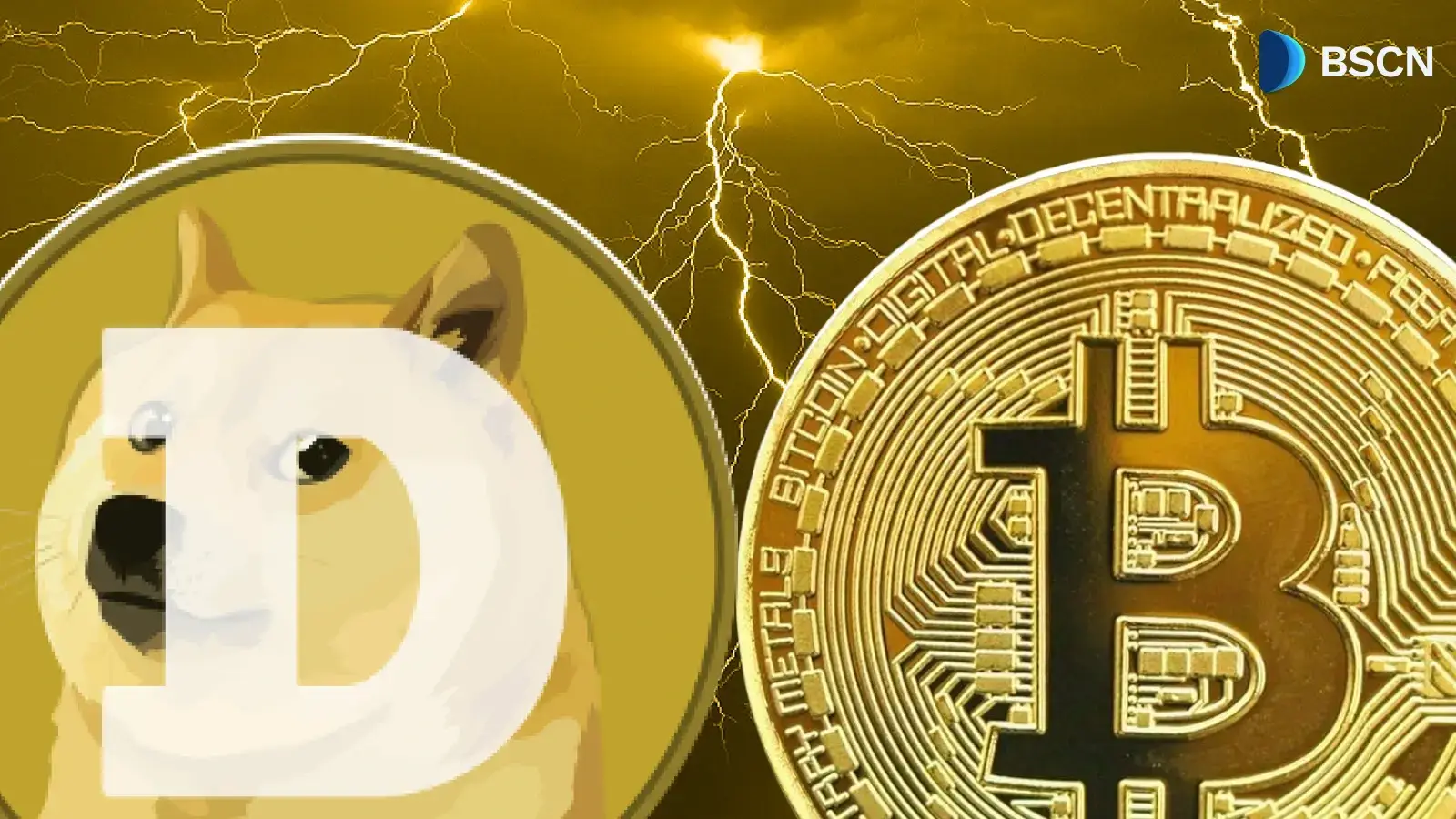
Dogecoin shares Bitcoin's roots but differs in mining algorithm, supply model, block speed and market purpose. Here's what makes DOGE technically distinct from BTC.

Soumen Datta
May 21, 2026

(Advertisement)
Table of Contents
Dogecoin and Bitcoin share the same foundational DNA, but they are built for very different purposes and work in meaningfully different ways.
Bitcoin was designed as a scarce, decentralized store of value. Dogecoin was built for fast, cheap transactions and everyday spending, with no upper limit on how many coins can ever exist. The two coins diverge on their mining algorithm, block time, supply model, and market positioning, despite Dogecoin tracing its origins back to Bitcoin's open-source code.
How Dogecoin Traces Its Origins Back to Bitcoin
Dogecoin is not a direct Bitcoin fork. It is a fork of Litecoin, which itself was forked from Bitcoin in 2011. Billy Markus and Jackson Palmer created Dogecoin in 2013 as a lighthearted alternative to Bitcoin, inspired by the popular Shiba Inu "Doge" internet meme. That chain of forks means Dogecoin inherits some of Bitcoin's structure, including its proof-of-work consensus model, but it diverges sharply in the technical choices made along the way.
How Do the Mining Algorithms Differ?
The most fundamental technical split between the two coins is the hashing algorithm. Bitcoin uses SHA-256 (Secure Hash Algorithm 256-bit), a computationally demanding process that requires specialized ASIC hardware to mine profitably. Dogecoin uses Scrypt, a memory-intensive algorithm originally chosen to make mining more accessible to a wider range of participants.
How Merged Mining Strengthened Dogecoin's Network
Because Dogecoin and Litecoin both use Scrypt, the two blockchains can be mined simultaneously through a process called Auxiliary Proof of Work, or AuxPoW. Dogecoin enabled this in September 2014.
Miners secure both networks at once without expending extra energy, which significantly improved Dogecoin's network security. Today, the majority of Dogecoin blocks are produced through merged mining. In 2025, industrial setups typically use hardware like the Bitmain Antminer L9, which delivers between 16 and 17 gigahashes per second, with dominant pools including ViaBTC, F2Pool, and AntPool.
Block Time and Transaction Speed
Bitcoin produces a new block approximately every 10 minutes. Dogecoin targets a one-minute block time, making it roughly 10 times faster for initial transaction confirmations. Each block on the Dogecoin network carries a fixed reward of 10,000 DOGE, generating around 5.26 billion new coins per year.
For small payments and tips, the speed difference matters in practice. A low-value DOGE transfer typically confirms within a minute at a cost of a fraction of a cent. The same transaction on Bitcoin takes longer and costs more to reach the same confirmation threshold.
Does Dogecoin Have a Supply Cap Like Bitcoin?
No, and this is the sharpest difference from Bitcoin. Bitcoin's supply is hard-capped at 21 million coins, a built-in scarcity that underpins its store-of-value argument. Dogecoin has no cap.
Once the circulating supply crossed 100 billion, annual issuance was fixed at 5 billion DOGE per year. The supply has since grown to approximately 170 billion, and that same annual issuance now represents a smaller percentage of the total each year, creating an inflation rate that declines over time. That rate currently sits at approximately 3.9% annually and continues to fall as the overall supply grows.
Dogecoin also has no halving mechanism. Bitcoin's block reward halves roughly every four years, progressively slowing new issuance. Dogecoin's 10,000 DOGE block reward is fixed permanently, a design choice intended to keep DOGE circulating as a spending currency rather than encouraging long-term hoarding.
How the Market Views Each Coin Differently
Bitcoin is increasingly treated as a macro asset, with price movements tied to institutional portfolios and broader economic conditions.
Dogecoin trades primarily as a speculative memecoin and social token. In September 2025, DOGE received its first U.S. spot ETF, opening a regulated access point for institutional buyers. The Digital Asset Market Clarity Act, which advanced through the Senate Banking Committee in May 2026 with a bipartisan 15-to-9 vote, classifies DOGE as a digital commodity alongside Bitcoin and Ethereum, removing regulatory ambiguity that had kept certain buyers sidelined.
As of May 2026, DOGE trades at approximately $0.105, with a market cap of around $17.88 billion and a circulating supply of roughly 170 billion tokens.
Conclusion
Dogecoin and Bitcoin share a common ancestor but operate as structurally different networks. Bitcoin uses SHA-256, produces a block every 10 minutes, and caps supply at 21 million coins. Dogecoin uses Scrypt, confirms transactions in roughly one minute, and issues 5 billion new coins per year with no upper limit. Merged mining with Litecoin provides Dogecoin's security layer. Its first U.S. spot ETF in September 2025 and its commodity classification under the Digital Asset Market Clarity Act mark a shift in institutional access, but its inflationary tokenomics and memecoin market profile remain fundamentally different from Bitcoin's design.
Resources
Bitcoin.com – What Is Dogecoin (DOGE)? A 2026 Guide to How It Works, Mining, Supply and Use Cases
OKX Learn – Dogecoin Algorithm Explained: Mining, Security and Scrypt
Trezor Knowledge Base – What Is Dogecoin (DOGE)?
Cube Exchange – What Is Dogecoin?
Coinbase – Dogecoin (DOGE) Price, Market Cap and Latest Data
Coin Edition – Dogecoin Price Prediction May 2026: Whale Holdings Hit All-Time High as DOGE Breaks Above Every EMA
CryptoRank – Dogecoin vs Bitcoin: Key Technical Differences
Cryptopolitan – Dogecoin vs Bitcoin: Key Technical Differences Explained
Read Next...


Frequently Asked Questions
Is Dogecoin built on the same code as Bitcoin?
Dogecoin is not a direct Bitcoin fork. It is a fork of Litecoin, which was itself forked from Bitcoin's codebase. The two coins share structural similarities but differ in hashing algorithm, block time, and supply model.
Why does Dogecoin have no supply cap while Bitcoin does?
Dogecoin's founders deliberately chose an uncapped supply to encourage spending. After reaching 100 billion coins in circulation, issuance was fixed at 5 billion DOGE per year, creating predictable annual inflation rather than the scarcity built into Bitcoin's 21 million hard cap.
What is merged mining and how does it affect Dogecoin?
Merged mining, or AuxPoW, allows miners to secure both Dogecoin and Litecoin simultaneously using Scrypt hardware with no additional energy cost. Dogecoin enabled this in 2014, and it now accounts for the majority of blocks produced on the network, boosting security by sharing Litecoin's mining base.
Disclaimer
Disclaimer: The views expressed in this article do not necessarily represent the views of BSCN. The information provided in this article is for educational and entertainment purposes only and should not be construed as investment advice, or advice of any kind. BSCN assumes no responsibility for any investment decisions made based on the information provided in this article. If you believe that the article should be amended, please reach out to the BSCN team by emailing [email protected].
Author
 Soumen Datta
Soumen has been a crypto researcher since 2020 and holds a master’s in Physics. His writing and research has been published by publications such as CryptoSlate and DailyCoin, as well as BSCN. His areas of focus include Bitcoin, DeFi, and high-potential altcoins like Ethereum, Solana, XRP, and Chainlink. He combines analytical depth with journalistic clarity to deliver insights for both newcomers and seasoned crypto readers.
(Advertisement)
Latest News
4h : 8m ago
How Does Pump.Fun Make Money?
5h : 10m ago

A Closer Look at Avalanche's 2026 Fundamentals
8h : 15m ago
How Does Chainlink Verify That Tokenized Gold Is Backed by Real Gold?
July 17, 2026

What is the Nakamoto Coefficient & Why Does it Matter?
July 17, 2026

How to Trade on Robinhood Chain, Crypto's Busiest New Memecoin Market
July 17, 2026
Insights from CoinGecko's Q2 Crypto Report
July 17, 2026
Why Is Sui's Approach to Storing Data On Chain Different From Most Blockchains?
July 17, 2026

Why Does XRP Move Faster Than Bitcoin, And What Makes It Possible?
(Advertisement)

Crypto Project & Token Reviews
Project & Token Reviews
Comprehensive reviews of crypto's most interesting projects and assets
Learn about the hottest projects & tokens

Latest Crypto Articles
Get up to date with the latest crypto news stories and events