News
(Advertisement)


A City on The Moon: Elon Musk's Lunar Plans Explained

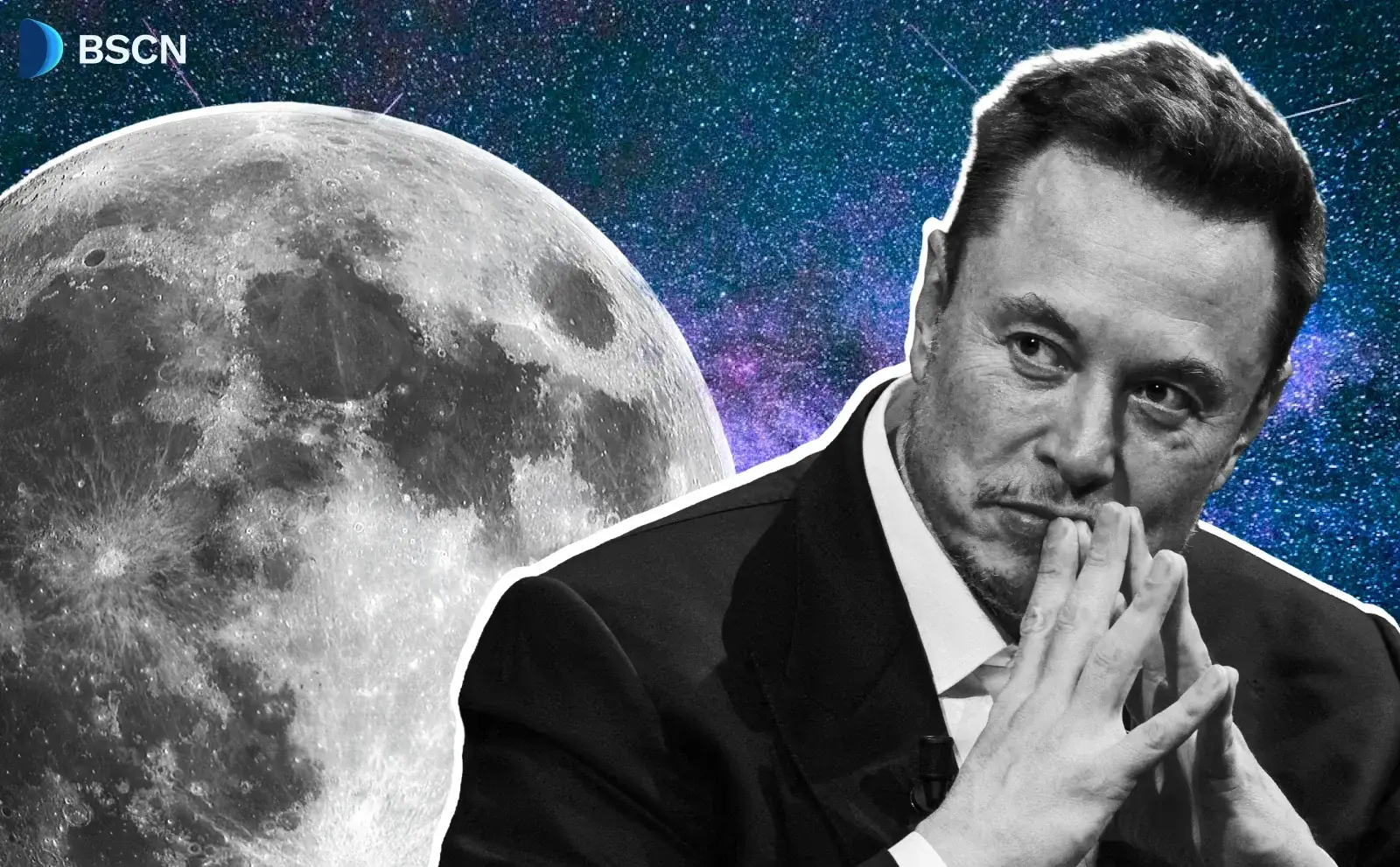
Elon Musk says SpaceX is now building a self-growing city on the Moon. Here's what that means, why Mars got bumped, and the timeline to watch.

Crypto Rich
February 9, 2026

(Advertisement)
Table of Contents
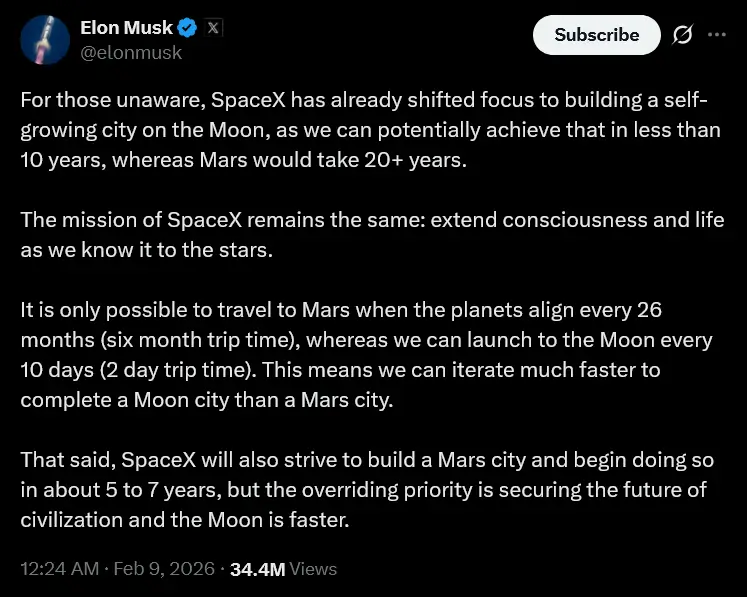
SpaceX is no longer chasing Mars first. Elon Musk confirmed on X that the company has shifted its priority to building a "self-growing city" on the Moon, a goal he says is reachable in under 10 years. Mars, the dream that defined SpaceX for over two decades, is not abandoned but deprioritized for speed.
The announcement dropped on February 9 and already has over 34 million views. It marks the biggest public pivot in SpaceX history, and there are real numbers behind the decision.
Why Did SpaceX Pick the Moon Over Mars?
It comes down to math. Musk explained that Mars missions only work when the planets align every 26 months. Each trip takes about six months one way. That means slow iteration and long gaps between supply runs.
The Moon is a different story. SpaceX can launch every 10 days with a two-day travel time. That cadence allows rapid testing, quick resupply, and faster construction. If something breaks, you fix it in days, not years.
Musk put it bluntly: "The overriding priority is securing the future of civilization and the Moon is faster."
Mars is not dead though. Musk said SpaceX will start building a Mars city in five to seven years. But the lunar base comes first.
What Is a Self-Growing City?
Musk has not laid out a full blueprint, but the term "self-growing" points to a settlement designed to expand on its own. Think robotic construction, local resource harvesting, and minimal dependence on Earth shipments.
The Moon's surface is covered in regolith, a loose material that can potentially be processed into oxygen, building materials, and even rocket fuel. Pair that with autonomous systems and AI, and you get a base that scales without needing a constant stream of cargo from home.
The timing here matters. Just days before this announcement, SpaceX announced its merger with xAI, the AI company behind Grok. The combined entity is valued at roughly $1 trillion. Analysts see a direct link between xAI's capabilities and the autonomous infrastructure needed for a self-sustaining lunar city.
What Is the Actual Timeline?
According to Reuters, SpaceX has told investors it is targeting an uncrewed Moon landing by March 2027. Crewed missions could follow by 2029 based on investor guidance, though Musk himself has only committed to the broader "under 10 years" window.
That still depends on Starship. The rocket SpaceX needs for both Moon and Mars has not yet reached orbit or completed an operational flight. The vehicle has gone through multiple test launches with mixed results, and it remains the key bottleneck for NASA's Artemis III mission, which recently slipped to no earlier than 2028.
Musk has a history of aggressive timelines. In 2020, he said SpaceX would land humans on Mars by 2026. That clearly did not happen. So while the vision is bold, the execution still has to catch up.
Where Does NASA Fit In?
SpaceX holds a $4 billion NASA contract under the Artemis program to build a crewed lunar lander using Starship. But Musk revealed that NASA now accounts for less than 5% of SpaceX revenue, with Starlink generating the bulk.
That financial independence gives SpaceX room to move fast without waiting on government schedules. Meanwhile, competition is heating up. Blue Origin also holds a NASA contract for a separate lunar lander and recently paused its space tourism flights to focus on Moon development. China is racing to put astronauts on the lunar surface this decade as well.
No human has set foot on the Moon since Apollo 17 in 1972. If Musk delivers even half of what he is promising, that drought ends soon.
Follow Elon Musk and SpaceX on X for updates.
Sources:
- Newsweek — Coverage of Musk's X announcement and NASA Artemis context
- CNN — Reporting on the priority shift, Mars timeline, and Starship status
- Business Insider via Yahoo News — Background on Musk's 2020 Mars predictions and xAI merger details
- Scientific American — Analysis of Starship development challenges and Artemis delays
- Technology.org — WSJ investor reporting, xAI merger valuation, and NASA revenue breakdown
- Elon Musk on X — Original announcement post, February 9, 2026 (timestamped early UTC; reported as Sunday evening US time)
Read Next...



Disclaimer
Disclaimer: The views expressed in this article do not necessarily represent the views of BSCN. The information provided in this article is for educational and entertainment purposes only and should not be construed as investment advice, or advice of any kind. BSCN assumes no responsibility for any investment decisions made based on the information provided in this article. If you believe that the article should be amended, please reach out to the BSCN team by emailing [email protected].
Author
 Crypto Rich
Rich has been researching cryptocurrency and blockchain technology for eight years and has served as a senior analyst at BSCN since its founding in 2020. He focuses on fundamental analysis of early-stage crypto projects and tokens and has published in-depth research reports on over 200 emerging protocols. Rich also writes about broader technology and scientific trends and maintains active involvement in the crypto community through X/Twitter Spaces, and leading industry events.
(Advertisement)
Latest News
0h : 56m ago
What Is the Cardano Van Rossem Upgrade?
July 20, 2026

How Does Pump.Fun Make Money?
July 20, 2026
A Closer Look at Avalanche's 2026 Fundamentals
July 20, 2026
How Does Chainlink Verify That Tokenized Gold Is Backed by Real Gold?
July 17, 2026

What is the Nakamoto Coefficient & Why Does it Matter?
July 17, 2026

How to Trade on Robinhood Chain, Crypto's Busiest New Memecoin Market
July 17, 2026

Insights from CoinGecko's Q2 Crypto Report
July 17, 2026
Why Is Sui's Approach to Storing Data On Chain Different From Most Blockchains?
(Advertisement)

Crypto Project & Token Reviews
Project & Token Reviews
Comprehensive reviews of crypto's most interesting projects and assets
Learn about the hottest projects & tokens

Latest Crypto Articles
Get up to date with the latest crypto news stories and events