News
(Advertisement)


Summary: Elon Musk's Comments at WEF's Davos 2026

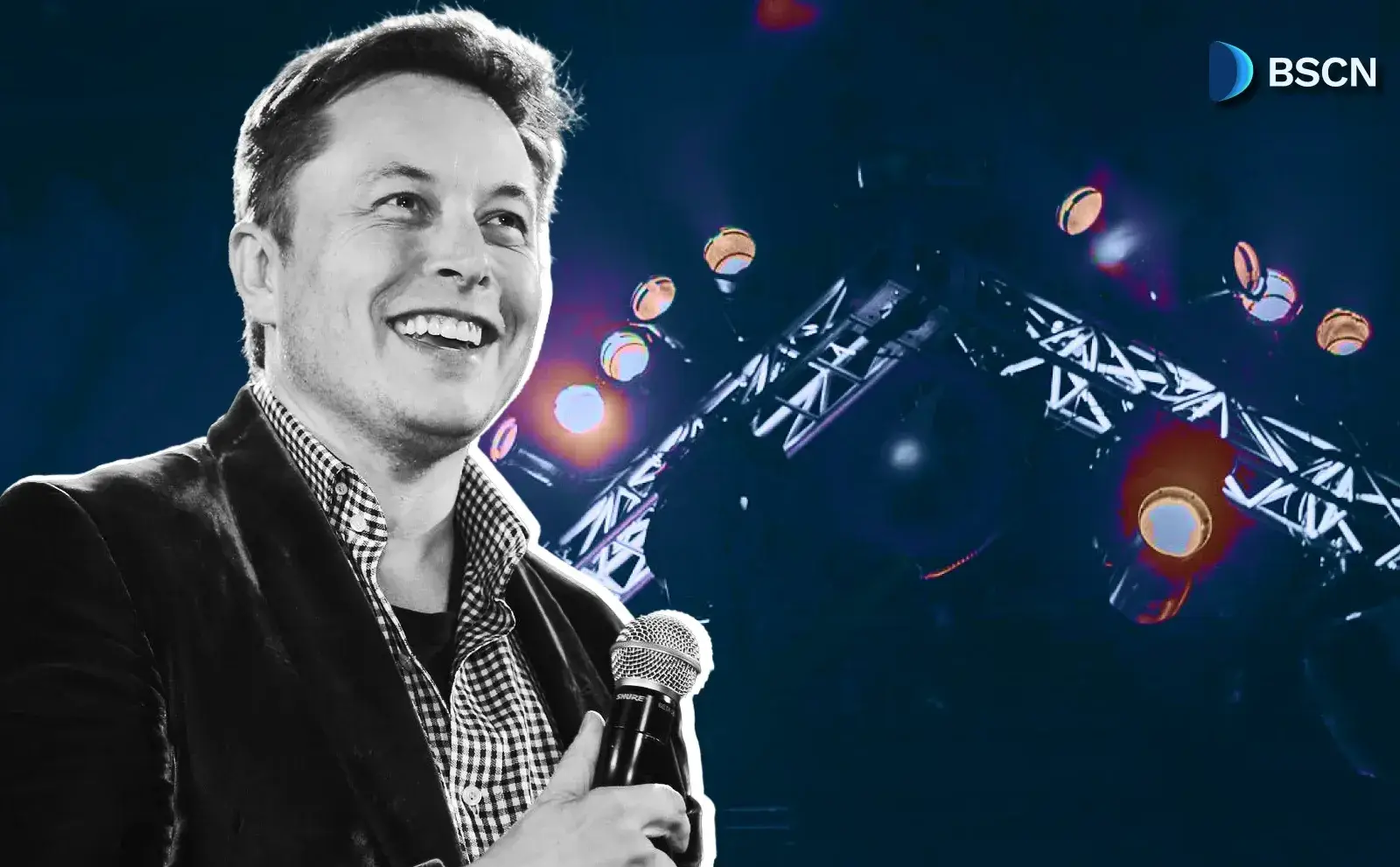
Elon Musk made his WEF debut at Davos 2026, predicting AI will surpass humanity by 2030 and robots will outnumber people. Here's what he said

Crypto Rich
January 23, 2026

(Advertisement)
Table of Contents
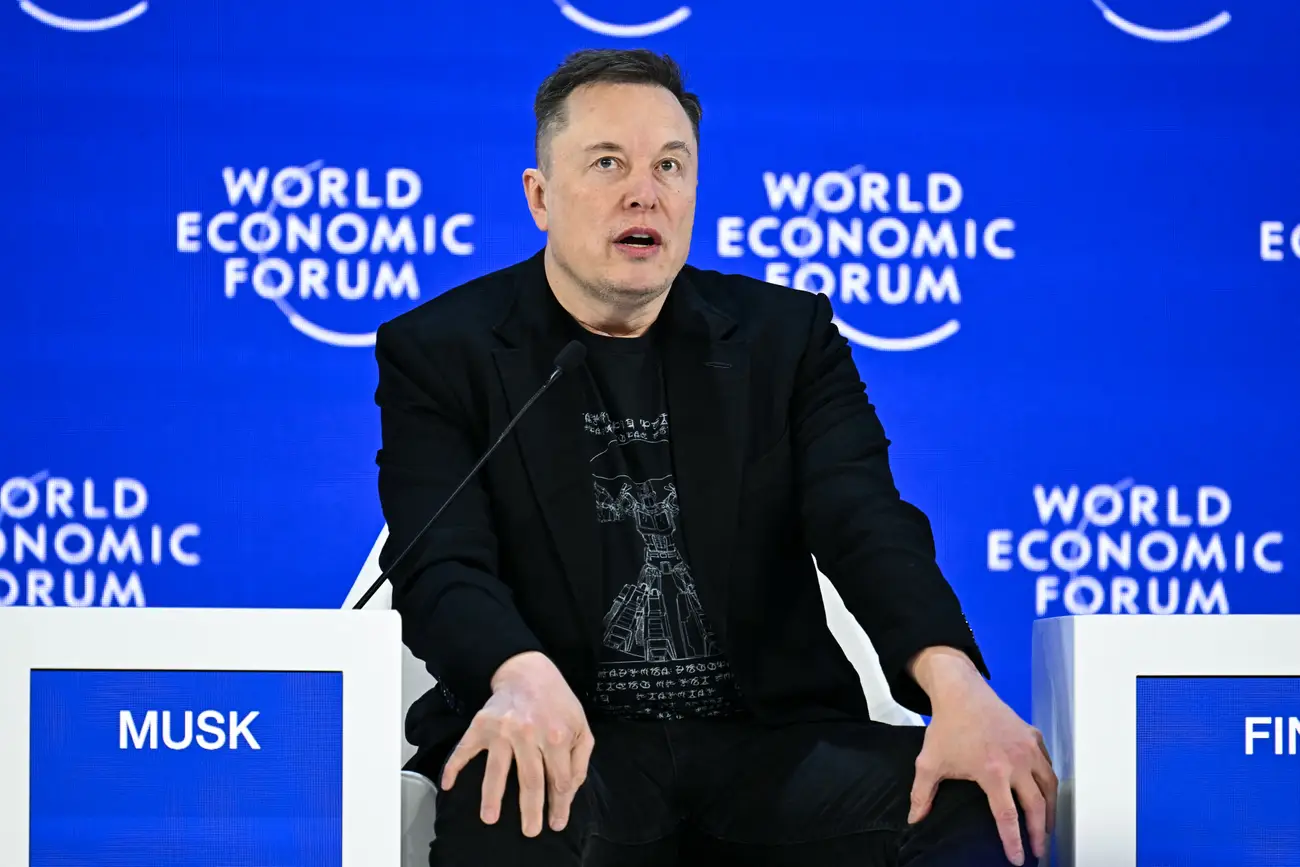
Elon Musk appeared at the World Economic Forum in Davos on January 22, 2026, marking his first-ever attendance at an event he has long criticized as elitist. In a 30-minute conversation with BlackRock CEO Larry Fink, Musk laid out his vision for a future defined by AI abundance, humanoid robots, and humanity spreading across the solar system.
Crypto didn't come up. Instead, Musk focused on familiar territory: artificial intelligence timelines, Tesla's Optimus robots, energy constraints, and SpaceX's mission to make life multi-planetary. The tone was optimistic throughout, with Musk positioning technology as the solution to poverty, aging populations, and existential risk.
What Did Musk Say About AI and Robots?
Musk delivered some of his boldest predictions yet on artificial intelligence. He stated AI will surpass any single human's intelligence by late 2026 or early 2027. By 2030 or 2031, he expects AI to exceed all of humanity's collective intelligence.
Tesla's Optimus humanoid robots are progressing faster than many anticipated. According to Musk, Optimus will handle simple factory tasks by the end of 2026. More complex industrial work should follow within 12 months. Public sales could begin by late 2027.
Musk painted a picture where robots eventually outnumber humans and become "ubiquitous." He suggested every household could own one for tasks like elder care, watching pets, or supervising children. This addresses a real problem in aging societies struggling with caretaker shortages.
"With robotics and AI, this is really the path to abundance for all," Musk said.
He acknowledged the risks. Referencing the Terminator films, Musk stressed the need for strong safety measures. But he framed the overall trajectory as overwhelmingly positive, with AI and robots ending scarcity and dramatically expanding global economic output.
Tesla's Full Self-Driving technology, Musk claimed, is now a "solved problem." He expects robotaxis to be widespread across the United States by the end of 2026. Musk hopes European and Chinese regulatory approvals follow soon after.
Why Is Energy the Main Bottleneck?
Musk identified electrical power as the primary constraint on AI scaling. Chip production is already outpacing grid capacity in some regions. The US could soon manufacture more AI chips than it can actually power.
His proposed solution involves massive solar deployment. A solar array measuring 100 by 100 miles in a US desert corner could power the entire country, Musk noted. For Europe, smaller installations in Spain or Sicily would suffice.
However, high US tariffs on Chinese solar panels are slowing progress. Musk mentioned plans for Tesla and SpaceX to build significant US-manufactured solar capacity to close that gap.
Looking further ahead, Musk floated the idea of space-based solar-powered AI data centers. Without atmospheric interference and with constant sunlight, these facilities would operate roughly five times more efficiently than ground-based alternatives. Musk sees this becoming the cheapest compute location within two to three years.
What About Space Exploration?
Musk reiterated his core SpaceX mission: making humanity multi-planetary to preserve consciousness against extinction-level risks. He described life as a "tiny candle in a vast darkness" that needs protection.
Supporting this view, Musk pointed out that despite SpaceX operating over 9,000 satellites, there have been no close encounters with extraterrestrial life. Consciousness may be far rarer in the universe than most assume.
On the hardware side, Starship's full reusability should arrive this year. Musk estimated this will reduce space access costs by a factor of 100, similar to the difference between reusable and disposable aircraft.
His personal goal remains unchanged: establish Moon and Mars bases, and eventually "die on Mars, just not on impact."
What Was the Overall Tone?
Musk opened with characteristic humor, including a joke about "peace" versus "piece" summits, referencing geopolitical tensions over Greenland and Venezuela. But the session stayed focused on engineering and optimism rather than political controversy.
He shared the philosophy driving his work: a curiosity about how the universe began and whether humanity is alone. Inspired by science fiction as a child, Musk has spent decades trying to turn stories like Star Trek into reality.
On aging, Musk called it a "very solvable problem" through biological engineering. But he noted that death serves a purpose by preventing societies from becoming ossified.
His parting message emphasized optimism as a life strategy. Better to be an optimist and occasionally wrong, Musk argued, than a pessimist and right.
For anyone following AI, robotics, or space developments, Musk's Davos debut offered a clear picture of where he thinks we're headed. No new bombshells emerged, but the appearance itself signaled a shift from WEF critic to engaged participant.
Watch the full session on the official WEF YouTube channel. Follow Elon Musk on X (@elonmusk) for his latest takes.
Sources:
- Reuters - Breaking news coverage of Musk's January 22, 2026 Davos appearance
- World Economic Forum - Official session page and livestream recording (video)
- Fortune - Analysis of Musk's AI and robotics predictions
- Business Insider - Coverage of key quotes and energy comments
- Euronews - European perspective on Musk's solar deployment remarks
- Yahoo Finance - Reporting on Tesla Optimus timeline and FSD claims
Read Next...

Frequently Asked Questions
When did Elon Musk predict AI will surpass human intelligence?
Musk stated AI will exceed any single human's intelligence by late 2026 or early 2027. He expects AI to surpass all of humanity's combined intelligence by around 2030 or 2031.
When will Tesla's Optimus robots be available to buy?
According to Musk at Davos 2026, Optimus will perform simple factory tasks by end of 2026, handle complex work within 12 months after that, and potentially go on sale to the public by late 2027.
What did Elon Musk say about energy at Davos?
Musk identified electrical power as the main bottleneck for scaling AI. He proposed large-scale solar deployment and mentioned plans for space-based solar-powered AI data centers that could operate five times more efficiently than ground facilities.
Disclaimer
Disclaimer: The views expressed in this article do not necessarily represent the views of BSCN. The information provided in this article is for educational and entertainment purposes only and should not be construed as investment advice, or advice of any kind. BSCN assumes no responsibility for any investment decisions made based on the information provided in this article. If you believe that the article should be amended, please reach out to the BSCN team by emailing [email protected].
Author
 Crypto Rich
Rich has been researching cryptocurrency and blockchain technology for eight years and has served as a senior analyst at BSCN since its founding in 2020. He focuses on fundamental analysis of early-stage crypto projects and tokens and has published in-depth research reports on over 200 emerging protocols. Rich also writes about broader technology and scientific trends and maintains active involvement in the crypto community through X/Twitter Spaces, and leading industry events.
(Advertisement)
Latest News
1h : 22m ago
Grayscale Picks Its Most Promising Tokenization Blockchains
3h : 19m ago

Crypto's Top Five Centralized Exchanges
4h : 24m ago
How Is Polygon Trying to Connect Every Blockchain Into a Single Network?
8h : 54m ago
What Does It Really Mean To Host A Website On The Internet Computer?
July 15, 2026
REAL Joins Blockchain for Europe to Shape EU Tokenisation Rules
July 15, 2026
Which Crypto Companies and Protocols Make The Most Money?
July 15, 2026

How SBI Built Japan's Largest Crypto Business
July 15, 2026
Elon Musk And Dogecoin: How One Man Shaped A Memecoin’s Price And Reputation
(Advertisement)

Crypto Project & Token Reviews
Project & Token Reviews
Comprehensive reviews of crypto's most interesting projects and assets
Learn about the hottest projects & tokens

Latest Crypto Articles
Get up to date with the latest crypto news stories and events