Deepdive
(Advertisement)


Ripple vs SWIFT: How the Two Systems Compare for Cross-Border Payment

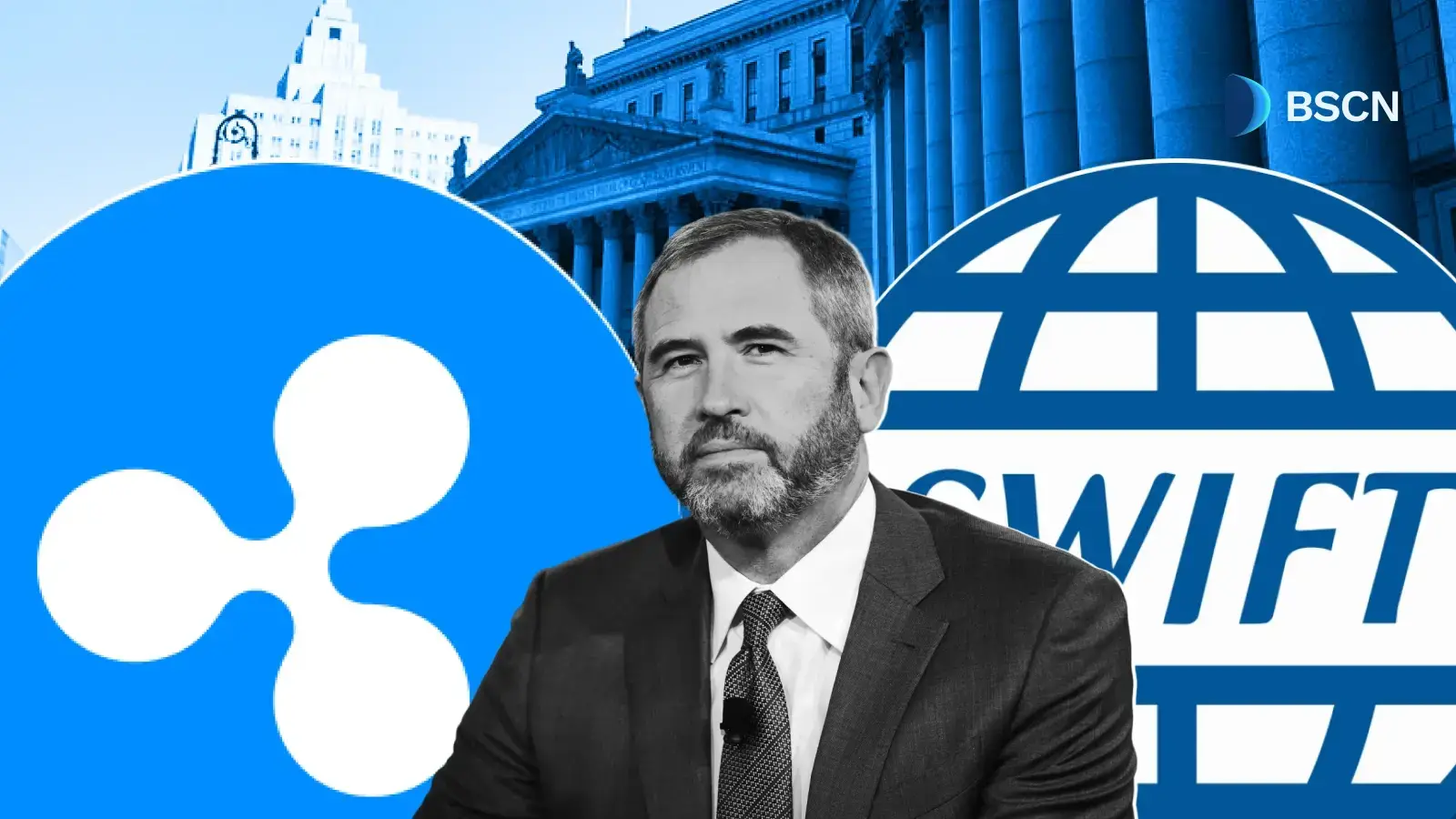
Ripple settles cross-border payments in seconds for fractions of a cent. SWIFT connects 11,500+ banks but relies on slower, costlier messaging rails. Here's how they compare.

Soumen Datta
May 25, 2026

(Advertisement)
Table of Contents
Ripple settles international transactions in 3 to 5 seconds at an average cost of $0.0002 per transaction. SWIFT, by contrast, can take 1 to 5 business days and charge between $26 and $50 per transfer. Those numbers explain why the debate between these two systems matters to anyone moving money across borders.
What Is SWIFT and How Does It Work?
SWIFT — the Society for Worldwide Interbank Financial Telecommunication — has been the backbone of global banking since 1973. It connects over 11,500 financial institutions across more than 200 countries and processes roughly $5 trillion in interbank value transfers every day.
The important detail most people miss: SWIFT does not actually move money. It sends payment instructions. The actual funds are shuffled between banks using nostro and vostro accounts, which tie up an estimated $27 trillion in parked liquidity before the transaction is settled.
The Correspondent Banking Problem
Each hop through a correspondent bank adds time, cost, and a potential point of failure. A payment from Japan to Brazil might route through three or four intermediaries before arriving, with each one taking a fee and adding delay. SWIFT's GPI (Global Payments Innovation) system, launched in 2017, improved this. Today, nearly 60% of GPI payments are credited to beneficiaries within 30 minutes, and 100% within 24 hours. But the underlying architecture has not fundamentally changed.
How Does Ripple's System Work?
Ripple is a blockchain fintech company built around the XRP Ledger (XRPL). Its core product, RippleNet, allows financial institutions to send payments directly between each other without relying on a chain of correspondent banks. The key mechanism is On-Demand Liquidity, or ODL — a term worth unpacking.
What Is On-Demand Liquidity (ODL)?
Instead of pre-funding accounts in dozens of countries, a bank using ODL converts the source currency into XRP on a crypto exchange. Those XRP tokens move through the XRP Ledger in 3 to 5 seconds. On the other side, a local exchange converts the XRP into the destination currency, which is delivered to the recipient. No pre-funded accounts. No correspondent banks taking fees.
XRP's average transaction fee of $0.0002 reduces infrastructure expenses significantly compared to traditional systems. RippleNet's ability to eliminate pre-funded accounts has already saved institutions $550 million annually, while ODL slashes liquidity costs by 65%.
Which Banks Are Already Using Ripple?
Ripple's network is not theoretical. Real institutions are running live payments on it today. A few notable examples:
- Axis Bank (India) was the first Indian bank to go live on Ripple's network, prioritizing corridors like the UAE.
- Qatar National Bank sends money via the XRPL, with ChinaBank converting it to Philippine pesos at the receiving end.
- Banco Rendimento (Brazil) uses Ripple's ODL to improve remittance flows across Latin America.
- Zand Bank, the UAE's first fully digital bank, was announced as one of Ripple's first UAE clients in May 2025, using Ripple Payments for cross-border transfers after Ripple secured its Dubai Financial Services Authority license.
Is SWIFT Adapting to Blockchain?
Yes, and it is doing so methodically. SWIFT completed its full migration to the ISO 20022 messaging standard on November 22, 2025. ISO 20022 delivers richer, more structured payment data and is compatible with blockchain-based systems — the same standard that XRP Ledger is aligned with, which matters for future interoperability.
SWIFT has tested connections between its ISO 20022 framework and several blockchain networks, including Ripple for interbank settlements, Stellar for cross-border transfers, and Algorand for asset tokenization. Murthy Maddali, Managing Director at Techwave, noted that ISO 20022 "facilitates improved compliance with AML and GDPR through enriched data," and that "automation reduces costs and errors while accelerating processing speed."
SWIFT's blockchain shared-ledger project is targeting an MVP with 40-plus banks in the first half of 2026, having run successful trials involving USDC, tokenized deposits, and tokenized bonds. The goal is not to hand the rails over to a competitor — it is to extend existing SWIFT infrastructure into the digital asset space.
Where Does XRP Stand Right Now?
XRP is currently trading at approximately $1.27, with a market cap of around $83.71 billion and a 24-hour trading volume of $1.31 billion. Despite price weakness, institutional interest has not dried up. XRP ETFs recently recorded a single-day inflow of $25.8 million — the largest since January 2026 — with fresh wallet creation and fund inflows suggesting some institutional rotation into XRP even as broader crypto markets remain soft.
Regulatory clarity has been a major shift. As of early 2026, Ripple publicly holds 75-plus regulatory licenses and registrations worldwide, including Major Payment Institution approval from Singapore, a license from the Dubai Financial Services Authority in the UAE, and Electronic Money Institution authorizations in the UK and EU.
At the XRP APEX 2025 event in Singapore, Ripple CEO Brad Garlinghouse said he expects XRP to handle 14% of SWIFT's cross-border payment volume within five years, noting: "If you're driving all the liquidity, it is good for XRP."
Conclusion
SWIFT remains the institutional standard for large-value interbank transfers, processing over $120 trillion annually with the trust and compliance frameworks of over 11,500 institutions behind it. Ripple delivers technically faster, cheaper settlement that is already operational in specific corridors, particularly in emerging market remittances and high-frequency, low-value cross-border transfers. The two systems are increasingly complementary rather than purely competitive, with SWIFT integrating blockchain elements and Ripple expanding its regulatory footprint globally. Where a financial institution lands in this debate comes down to one question: does it prioritize the established compliance depth of SWIFT, or the speed and capital efficiency of a blockchain-based settlement network?
Resources
- Financial Planning Association – How Ripple (XRP) Is Building a Bridge to the Future of Cross-Border Transactions
- The Crypto Basic – XRP vs SWIFT: How Cross-Border Payments Compare
- PYMNTS – Ripple CEO: XRP Could Account for 14% of SWIFT's Cross-Border Payments Volume
- Finance Magnates – SWIFT's ISO 20022 Cutover and Blockchain Connections
- Yahoo Finance – SWIFT Blockchain Pivot Puts XRP Back in Cross-Border Spotlight
- CCN – 10 Global Banks Using Ripple's XRPL for Faster Cross-Border Payments
Read Next...




Frequently Asked Questions
Is Ripple faster than SWIFT?
Yes. Ripple's XRP Ledger settles transactions in 3 to 5 seconds. SWIFT transfers typically take 1 to 5 business days, though its GPI upgrade has credited nearly 60% of payments within 30 minutes on supported corridors.
Does SWIFT use XRP or blockchain?
SWIFT does not use XRP in its core network. It has run experimental trials connecting its ISO 20022 messaging rails to several blockchain networks, including XRP, but bank participation is optional and the shared-ledger program is still in development as of mid-2026.
What is On-Demand Liquidity (ODL)?
ODL is Ripple's solution to the pre-funding problem in cross-border payments. Instead of banks parking cash in foreign accounts in advance, ODL uses XRP as a bridge asset to convert and settle funds in real time, freeing up capital that would otherwise sit idle in nostro and vostro accounts.
Disclaimer
Disclaimer: The views expressed in this article do not necessarily represent the views of BSCN. The information provided in this article is for educational and entertainment purposes only and should not be construed as investment advice, or advice of any kind. BSCN assumes no responsibility for any investment decisions made based on the information provided in this article. If you believe that the article should be amended, please reach out to the BSCN team by emailing [email protected].
Author
 Soumen Datta
Soumen has been a crypto researcher since 2020 and holds a master’s in Physics. His writing and research has been published by publications such as CryptoSlate and DailyCoin, as well as BSCN. His areas of focus include Bitcoin, DeFi, and high-potential altcoins like Ethereum, Solana, XRP, and Chainlink. He combines analytical depth with journalistic clarity to deliver insights for both newcomers and seasoned crypto readers.
(Advertisement)
Latest News
5h : 0m ago

Analysis: Ondo Finance's 2026 In Numbers
6h : 41m ago

Is Circle Planning to Launch a Korean Won Stablecoin?
8h : 42m ago

What Is Ripple Mint?
July 23, 2026
Can Injective's New Mint Platform Bring Institutions to INJ?
July 23, 2026

What is RippleX & Why Does it Matter for XRP Ledger?
July 23, 2026

What Is Dfinity's Caffeine?
July 22, 2026

How Much Funding Has Canton Developer Digital Asset Raised?
July 22, 2026

What is Aptos' AIP-146 and Is It Good News for APT?
(Advertisement)

Crypto Project & Token Reviews
Project & Token Reviews
Comprehensive reviews of crypto's most interesting projects and assets
Learn about the hottest projects & tokens

Latest Crypto Articles
Get up to date with the latest crypto news stories and events