News
(Advertisement)


CLARITY Act Stablecoin Yield Text Is Finally Public: What It Says and What It Means

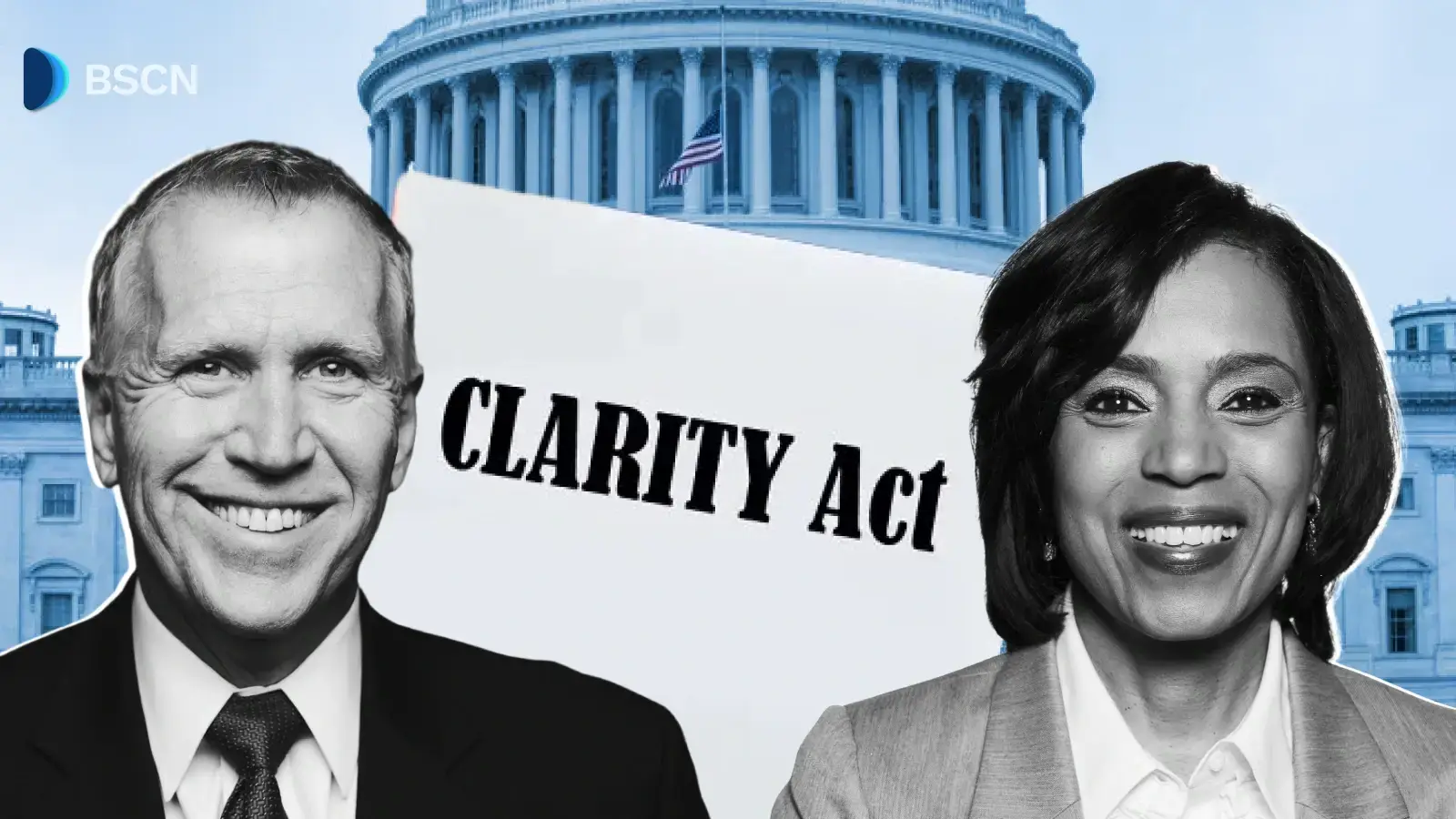
The CLARITY Act's stablecoin yield compromise bans passive, bank-like returns on stablecoins while allowing activity-based rewards. Here's what the final text actually says.

Soumen Datta
May 4, 2026

(Advertisement)
Table of Contents
The final stablecoin yield language in the CLARITY Act is now public, and it draws a clear line: crypto platforms can no longer offer passive, bank-style returns just for holding stablecoins. Rewards tied to actual on-chain activity, like payments or transfers, remain permitted.
Senators Thom Tillis (R-N.C.) and Angela Alsobrooks (D-Md.) finalized the compromise text on Friday evening, ending months of back-and-forth that had stalled the broader Digital Asset Market Clarity Act. Punchbowl News first reported the agreement and the text was also shared on X.
The final rewards text in the CLARITY Act is now public.
— Faryar Shirzad 🛡️ (@faryarshirzad) May 1, 2026
We’ve been clear throughout this process: much of this debate was based on imagined risks, not real evidence, nor was it based on a real understanding of how crypto actually works.
Nevertheless, the crypto industry showed… https://t.co/XoQ7Zp1Y39
The deal is significant because it removes one of the last major roadblocks to a Senate Banking Committee markup, now targeted for May.
What Does The New Stablecoin Yield Language Actually Say?
The new section, codified as Section 404 of the bill, prohibits what the legislation calls "covered parties" from paying any form of interest or yield to U.S. customers in two specific scenarios:
- Solely in connection with holding stablecoins
- In any way that is "economically or functionally equivalent to the payment of interest or yield on an interest-bearing bank deposit"
In plain terms: a crypto exchange cannot reward users simply for parking stablecoins in their account, the same way a bank pays interest on a savings balance.
The bill defines "covered parties" as digital asset service providers and their affiliates. It excludes permitted stablecoin issuers and registered foreign issuers, which are already barred from paying direct interest under the GENIUS Act, the stablecoin law President Donald Trump signed on July 18, 2025.
What Is The GENIUS Act, And Why Does It Matter Here?
The GENIUS Act established the first federal framework for payment stablecoin issuers in the United States. It set reserve requirements, redemption obligations, and anti-money laundering rules for issuers. It also prohibited stablecoin issuers from paying interest directly to holders.
However, the GENIUS Act left a gap: it did not explicitly address what exchanges or third-party affiliates could do with stablecoin rewards programs. Banks flagged this gap and pushed hard for it to be closed in the CLARITY Act. The new yield language is the answer to that push.
What Rewards Are Still Allowed?
The prohibition does not apply to rewards tied to what the text calls "bona fide activities or bona fide transactions." These are incentives linked to real platform usage, not just holding an asset.
The text directs the Securities and Exchange Commission, the Commodity Futures Trading Commission, and the Treasury Secretary to jointly publish rules within one year defining a non-exhaustive list of permitted activities. That list is expected to include:
- Payments and transfers
- Market-making
- Staking and governance participation
- Loyalty programs
In a notable concession to crypto firms, the bill also states that permitted activity-based rewards "may be calculated by reference to a balance, duration, tenure, or any combination of the foregoing." That language gives platforms flexibility to factor in how much a user holds and for how long, as long as the underlying reward connects to a qualifying activity.
One industry source described this as a shift from a "buy and hold" model to a "buy and use" model, though how exactly that plays out in practice will depend heavily on the rulemaking process.
Why Was Coinbase At The Center Of This Fight?
Coinbase had the most commercial exposure of any single company in this negotiation. The exchange reported $1.35 billion in stablecoin revenue in 2025, much of it tied to distribution payments from its USDC partnership with Circle.
The exchange had pulled its support from an earlier version of the yield language, which contributed to the Senate Banking Committee canceling a planned January markup at the last minute. A second draft released in late March also failed, sending Circle's stock down roughly 20% in a single trading session.
Coinbase CEO Brian Armstrong posted, "Mark it up," on X after the Friday agreement. Chief Policy Officer Faryar Shirzad said the industry had protected "the ability for Americans to earn rewards, based on real usage of crypto platforms and networks."
Chief Legal Officer Paul Grewal added that the final language preserves activity-based rewards and "should not be the basis of any objection," arguing that much of the earlier debate was driven by concerns about how crypto rewards programs work that did not match the reality of how they actually function.
After months in rooms at the WH and Senate, this much is clear: a lot of the public debate overstated the risks and ignored the substance. This outcome preserves activity-based rewards tied to real participation on crypto platforms and networks, which is what the bank lobby said… https://t.co/9l56B8A1gY
— Paul Grewal (@iampaulgrewal) May 1, 2026
How Will Violations Be Penalized?
Beyond the yield prohibition, the new text includes several enforcement mechanisms:
- Civil monetary penalties of up to $5 million per violation, assessed by the Treasury Department
- A ban on representing stablecoins as investment products, as FDIC-insured, or as backed by the full faith and credit of the United States
- Anti-evasion language to prevent firms from routing restricted rewards through affiliates
The Treasury and CFTC must also issue rules within one year of enactment, and the Federal Reserve, OCC, FDIC, NCUA, and Treasury must jointly report to Congress within two years on how stablecoin adoption affects Treasury yields and bank deposit volumes.
Does Everyone Support The Compromise?
Not entirely. Ji Kim of the Crypto Council for Innovation warned the restrictions go "far beyond" what the GENIUS Act required and could limit consumer incentives. He also raised concerns about U.S. competitiveness, given that most global crypto activity already happens in markets outside the country.
Corey Frayer of the Consumer Federation of America noted that the rulemaking language gives regulators some latitude in defining what counts as a qualifying activity, which could either open or close doors depending on how agencies interpret it.
The Blockchain Association and the Digital Chamber both welcomed the text's release, calling it a step toward the broader CLARITY Act markup.
What Happens Next With The CLARITY Act?
The stablecoin yield deal does not mean the CLARITY Act is close to passing. Several other provisions remain unresolved, including rules around tokenomics, decentralized finance protections, and software developer liability.
Senate Banking Committee Chairman Tim Scott has said the bill will need unified Republican support before it can advance to a markup. With that support now more plausible, a markup session in May has become the near-term target.
Even after a markup, the bill would still need to clear the full Senate and then be reconciled with any House legislation before it could become law.
Conclusion
The finalized CLARITY Act stablecoin yield text bans passive, bank-equivalent returns on stablecoin holdings while protecting rewards tied to real platform usage. It assigns rulemaking authority to the SEC, CFTC, and Treasury, sets civil penalties of up to $5 million per violation, and requires a congressional report on stablecoin adoption within two years. The Senate Banking Committee markup, now targeted for May, remains the immediate next step, though several provisions of the broader CLARITY Act are still being negotiated.
Resources
Report by Punchbowl news: Vault: Tillis-Alsobrooks cinch deal on stablecoin yield
Report by Forbes: Tillis-Alsobrooks Reach Compromise On Stablecoin Yield In Clarity Act
Report by CoinDesk: Clarity Act text lets crypto firms offer stablecoin rewards while shielding bank yield
Report by The Block: Coinbase says deal reached on Clarity Act stablecoin yield, clearing path to long-stalled Senate markup
Read Next...





Frequently Asked Questions
What does the CLARITY Act stablecoin yield ban actually prohibit?
The ban prevents crypto exchanges and their affiliates from paying any return to U.S. customers that functions like interest on a bank deposit, specifically returns paid just for holding stablecoins. Rewards tied to actual platform activity, such as making payments or transfers, are not prohibited.
How is this different from what the GENIUS Act already required?
The GENIUS Act banned stablecoin issuers from paying direct interest on stablecoins but did not cover what exchanges or third-party affiliates could offer through rewards programs. The new CLARITY Act language closes that gap by applying the restriction to a broader set of "covered parties," including exchanges and their affiliates.
What are "activity-based rewards" and why do they matter?
Activity-based rewards are incentives tied to real user behavior on a platform, like making transactions or using governance features, rather than just holding an asset. The compromise preserves these because they are seen as fundamentally different from deposit interest. The SEC, CFTC, and Treasury will issue joint rules within one year defining which specific activities qualify.
Disclaimer
Disclaimer: The views expressed in this article do not necessarily represent the views of BSCN. The information provided in this article is for educational and entertainment purposes only and should not be construed as investment advice, or advice of any kind. BSCN assumes no responsibility for any investment decisions made based on the information provided in this article. If you believe that the article should be amended, please reach out to the BSCN team by emailing [email protected].
Author
 Soumen Datta
Soumen has been a crypto researcher since 2020 and holds a master’s in Physics. His writing and research has been published by publications such as CryptoSlate and DailyCoin, as well as BSCN. His areas of focus include Bitcoin, DeFi, and high-potential altcoins like Ethereum, Solana, XRP, and Chainlink. He combines analytical depth with journalistic clarity to deliver insights for both newcomers and seasoned crypto readers.
(Advertisement)
Latest News
6h : 40m ago

Can Injective's New Mint Platform Bring Institutions to INJ?
7h : 57m ago

What is RippleX & Why Does it Matter for XRP Ledger?
14h : 5m ago

What Is Dfinity's Caffeine?
July 22, 2026

How Much Funding Has Canton Developer Digital Asset Raised?
July 22, 2026

What is Aptos' AIP-146 and Is It Good News for APT?
July 22, 2026

What Happens to Unverified Pi Balances If Users Miss the Deadline?
July 22, 2026
What Is in Trump's CLARITY Act Ethics Deal?
July 21, 2026

Pudgy Penguins to Reach Millions with Target Placement
(Advertisement)

Crypto Project & Token Reviews
Project & Token Reviews
Comprehensive reviews of crypto's most interesting projects and assets
Learn about the hottest projects & tokens

Latest Crypto Articles
Get up to date with the latest crypto news stories and events