News
(Advertisement)


The Dollar Is at Its Most Shorted Level Since 2012. Why Isn't Bitcoin Rallying?

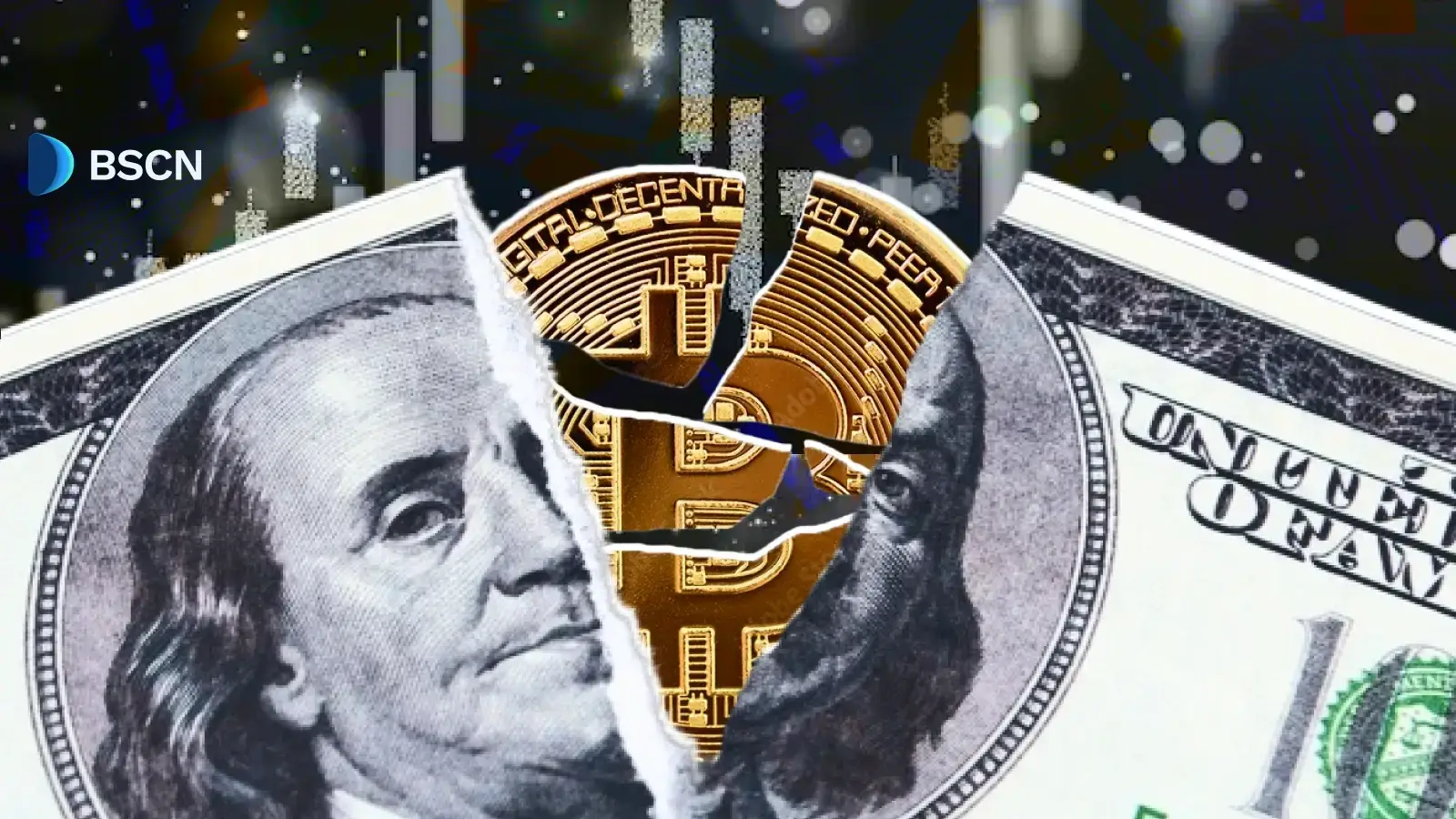
The U.S. dollar is at its most bearish level since 2012, yet Bitcoin is down 21% in 2026. Here's why the historic BTC-dollar relationship has flipped.

Soumen Datta
February 17, 2026

(Advertisement)
Table of Contents
Wall Street is shorting the U.S. dollar at the highest levels since at least 2012, according to Bank of America's latest FX and rates sentiment survey. Historically, that kind of dollar weakness would be a tailwind for Bitcoin. Instead, BTC is down 24% year-to-date, sitting near multi-month lows. The relationship that crypto traders relied on for years has quietly broken down, and the reasons matter.
The Dollar Index (DXY), which tracks the greenback against a basket of six major currencies, was trading around 97.15 on February 17, up slightly on the day but on course for a weekly loss of around 0.6%. It has fallen more than 9.5% since the start of 2025 and is hovering near a four-year low, having briefly dipped below 95.51 in late January.
What Does Record Dollar Bearishness Actually Mean?
BofA's February survey, conducted between February 6 and 11 among 42 fund managers overseeing $702 billion in assets, found that investor positioning in the dollar has dropped to levels "not previously recorded within our time sample," which goes back to January 2012. In plain terms, institutions are holding less dollar exposure than at any point in over 14 years.
This is not a retail or hedge fund phenomenon. The selling is being led by so-called real money investors: pension funds, sovereign wealth funds, and long-term institutional allocators.
Caroline Houdril, a multi-asset fund manager at Schroders, told the Financial Times that her firm is "seeing increased repatriation flows as foreign U.S. dollar holders move capital back to their home currency." That kind of structural selling tends to be persistent rather than reactive.
Options data from CME Group confirms the shift. Bets against the dollar have now outstripped bullish positions on the greenback, reversing the posture of the fourth quarter of 2025. Bets on further dollar depreciation versus the euro, measured through risk reversals, have reached levels only previously seen during the Covid-19 pandemic and after the April 2025 tariff shock.
Why Investors Are Fleeing the Dollar
Several pressures are hitting the dollar at the same time:
- The U.S.-Europe interest rate spread has narrowed to approximately 0.25 percentage points, after the Federal Reserve cut rates by 75 basis points since mid-2025 while the European Central Bank held a tighter stance for longer.
- Net outflows from U.S. Treasuries reached an estimated $18 billion in January alone, with another $22 billion leaving U.S. equities.
- The Swiss franc has surged to an 11-year high, gaining 3.5% against the dollar in the first six weeks of 2026.
- Gold is trading near record highs as investors rotate into defensive assets.
Iain Stealey, international chief investment officer for global fixed income, currency, and commodities at JPMorgan Asset Management, put it simply: "We see an environment where the Fed keeps cutting and the carry advantage erodes away over time." The carry trade, where investors borrow in low-rate currencies to buy higher-yielding ones, had long favored the dollar. That advantage is shrinking.
Why Isn't Bitcoin Benefiting from a Weak Dollar?
This is the question most crypto traders are asking right now. Since Bitcoin's inception, it has mostly moved in the opposite direction to the DXY. A softer dollar makes BTC cheaper to buy for foreign investors and loosens global financial conditions, which typically benefits risk assets. When the DXY fell from 102 to around 89 during 2020 to 2021, Bitcoin went on one of its biggest bull runs.
The current environment looks nothing like that.
The DXY has dropped over 10% since mid-2025. Bitcoin has fallen 6% across all of 2025 and is now down 21% in 2026. Their 90-day correlation hit 0.60 on February 17, the highest since April 2025, according to TradingView data. That means both assets are now moving in the same direction more often than not, a near-reversal of the historical pattern.
Bitcoin Is Trading Like a Tech Stock
The most credible explanation is that Bitcoin has become closely tied to equity markets, particularly technology stocks. According to ByteTree Research, Bitcoin's 30-day rolling correlation with the iShares Expanded Tech Software ETF (IGV) reached 0.73 in early February 2026. The IGV is down roughly 20% year-to-date, and Bitcoin has tracked it down alongside.
"There can be no doubt that bitcoin has been caught up in the technology selloff," ByteTree noted. "At its heart, bitcoin is an internet stock."
The shift is partly a product of who is now in the market. When spot Bitcoin ETFs launched and institutional capital flooded in, the asset's price-setting power moved away from long-term holders who view BTC as digital gold and toward institutional allocators who treat it as a high-beta technology play. When AI stocks collapsed in late January and early February 2026, triggering what analysts called a "software-mageddon" that wiped roughly $1 trillion from the S&P 500 software and services index, Bitcoin was dragged down with them.
Strategy (formerly MicroStrategy), the largest corporate Bitcoin holder, reported a $12.4 billion Q4 loss driven by impairment charges on its BTC holdings. Bitcoin ETFs have also seen several consecutive months of net outflows totaling billions of dollars.
Ray Youssef, CEO of crypto app NoOnes, described the current environment as a "protracted reassessment of risks," adding that while short-covering rallies of 20% to 30% are possible, they are likely to be "bull traps" rather than the start of a recovery.
Could a Dollar Short Squeeze Pull Bitcoin Higher?
There is one scenario where the broken correlation could actually work in Bitcoin's favor. When investors pile into extreme bearish positions on any asset, an unexpected bounce forces mass buybacks to limit losses. This is called a short squeeze, and it can drive sharp, fast price moves.
"Record short positioning raises the risk of volatility in major USD pairs; downside may extend on weak U.S. data, but crowded trade dynamics increase the potential for sharp short-covering rallies," said InvestingLive Chief Asia-Pacific Currency Analyst Eamonn Sheridan.
If the dollar bounces hard on stronger-than-expected U.S. economic data, and BTC continues to move with it rather than against it, that squeeze could lift crypto prices alongside the greenback. BofA analysts noted that most survey responses were submitted before the January U.S. jobs report, which significantly exceeded expectations, and that resilient economic data "might ease some of the bearishness" on the dollar.
Whether that data-driven relief translates into a sustained dollar recovery, and by extension a Bitcoin recovery, depends largely on how sticky the institutional rotation out of U.S. assets turns out to be.
Conclusion
The dollar is under pressure from structural capital outflows, a narrowing interest rate advantage, and eroding confidence in U.S. policy stability. Bitcoin, which historically thrived in that environment, is instead tracking technology stocks lower as institutional ownership has changed how the asset responds to macro signals. The classic BTC-dollar seesaw still exists in theory. In practice, the last 14 months of data suggest it is no longer reliable as a trading framework in the current cycle.
Resources
Bitcoin on CoinMarketCap: Bitcoin price action
Report by Financial Times: Fund managers take most bearish stance on dollar for a decade
Report by European Business Magazine: Fund Managers Turn Most Bearish on the Dollar in Over a Decade as Policy Chaos Erodes Confidence
Report by CNBC: The ‘strongest currency on earth’ just hit an 11-year high — and it’s stirring up trouble in Switzerland
Report by CoinDesk: BofA survey flags dollar bearish bets at over a decade high. Here's what it means for bitcoin
Bytetree report: The Technology Bear Market
Read Next...



Frequently Asked Questions
Why is Bitcoin falling when the dollar is weak in 2026?
Bitcoin is currently moving in the same direction as the U.S. dollar rather than against it, with a 90-day correlation of 0.60 as of mid-February 2026. This is because Bitcoin is now largely traded by institutional investors who treat it as a risk asset similar to technology stocks. When tech equities sold off in early 2026, Bitcoin followed, regardless of dollar weakness.
What does "record underweight dollar positioning" mean?
Underweight positioning means fund managers are holding less dollar exposure than their standard benchmarks suggest they should. Bank of America's February 2026 survey found this underweight position is at its most extreme level since at least January 2012, meaning institutions are more bearish on the dollar today than at any point in over 14 years of recorded data.
Could a dollar short squeeze help Bitcoin recover?
Yes, potentially. Because Bitcoin is now positively correlated with the dollar, a sharp unexpected dollar rebound triggered by crowded short positions being unwound could drag Bitcoin higher alongside it. However, analysts caution that any resulting rally may be a short-term technical move rather than a structural shift in trend.
Disclaimer
Disclaimer: The views expressed in this article do not necessarily represent the views of BSCN. The information provided in this article is for educational and entertainment purposes only and should not be construed as investment advice, or advice of any kind. BSCN assumes no responsibility for any investment decisions made based on the information provided in this article. If you believe that the article should be amended, please reach out to the BSCN team by emailing [email protected].
Author
 Soumen Datta
Soumen has been a crypto researcher since 2020 and holds a master’s in Physics. His writing and research has been published by publications such as CryptoSlate and DailyCoin, as well as BSCN. His areas of focus include Bitcoin, DeFi, and high-potential altcoins like Ethereum, Solana, XRP, and Chainlink. He combines analytical depth with journalistic clarity to deliver insights for both newcomers and seasoned crypto readers.
(Advertisement)
Latest News
July 10, 2026

How Do PancakeSwap's CAKE Token Burns Actually Work?
July 10, 2026

Report: Ripple & The XRP Ecosystem in H1 2026
July 10, 2026

How Is Cardano Advancing Financial Inclusion in Developing Countries?
July 10, 2026

Why Was Sui Built From Scratch Instead of Forking an Existing Blockchain?
July 9, 2026

Trust Wallet Adds Native Support for Robinhood Chain, Opening Stock Tokens to 220 Million Users
July 9, 2026
Robinhood Chain Explodes Post-Mainnet Launch
July 9, 2026

Is Avalanche AVAX Bringing Hyundai On Chain?
July 9, 2026

Stop Tokenizing Assets You Don't Control
(Advertisement)

Crypto Project & Token Reviews
Project & Token Reviews
Comprehensive reviews of crypto's most interesting projects and assets
Learn about the hottest projects & tokens

Latest Crypto Articles
Get up to date with the latest crypto news stories and events