News
(Advertisement)


Binance Goes to Legal War With the Wall Street Journal, Here’s Why

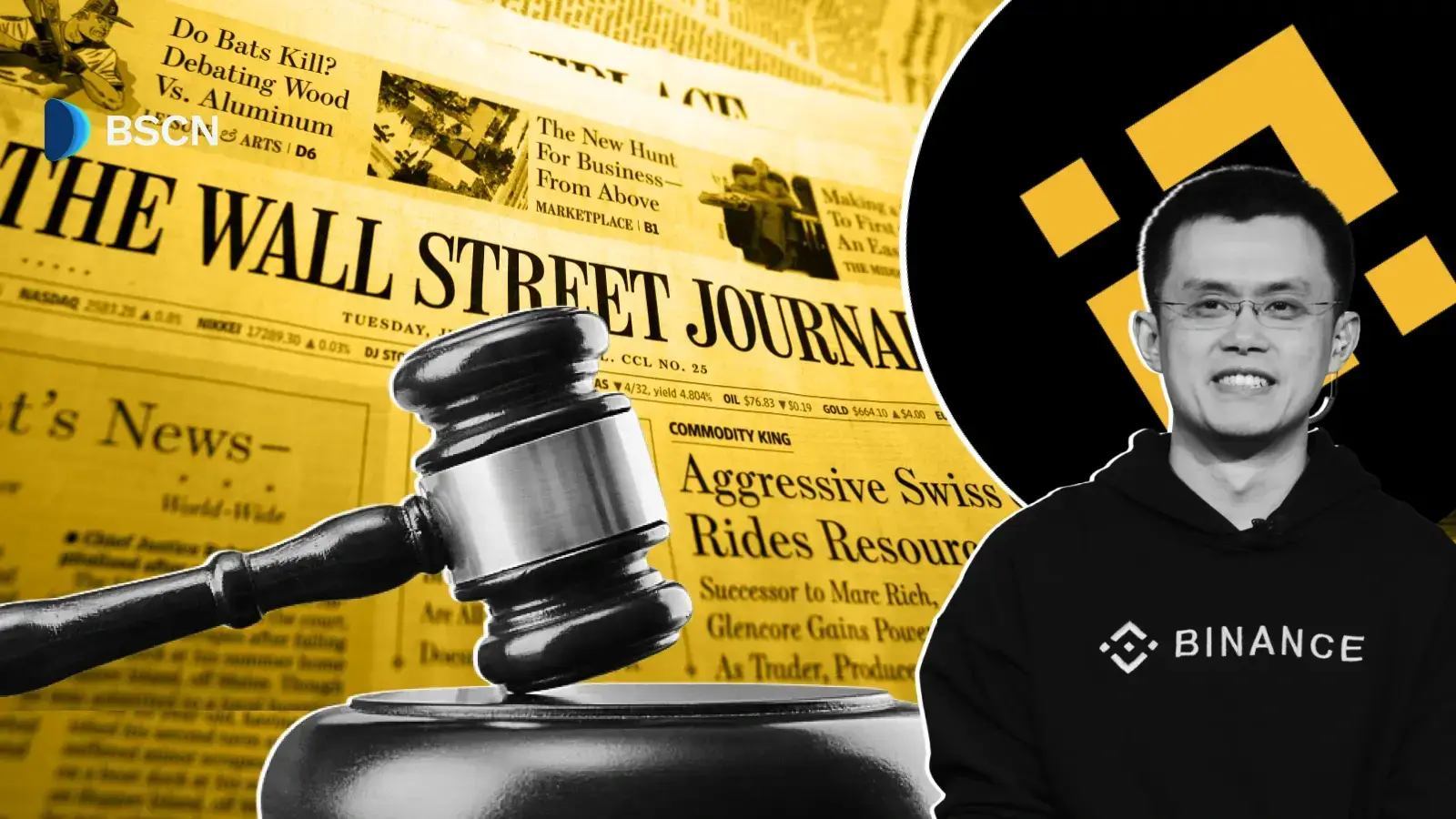
Binance has filed a defamation lawsuit against the Wall Street Journal over a February 2026 article. Here is what the lawsuit claims and what it means for crypto.

Soumen Datta
March 12, 2026

(Advertisement)
Table of Contents
What Is the Binance Lawsuit Against the Wall Street Journal?
Binance filed a defamation lawsuit against The Wall Street Journal (WSJ) on March 11, 2026, over an article the outlet published on February 23, 2026. The crypto exchange says the article contained false statements that damaged its reputation, triggered government inquiries, and caused real business harm. Binance is pressing for a jury trial.
The lawsuit is a significant move for one of the world's largest crypto exchanges, which serves over 300 million users globally. Defamation lawsuits in the media industry are rare and hard to win, which makes Binance's decision to file a notable signal of how seriously the company is treating the matter.
What Did the Wall Street Journal Report Say?
The February 23 article, published alongside coverage from Fortune and The New York Times, alleged that Binance fired compliance staff who flagged approximately $1 billion in crypto flowing through the exchange to sanctioned entities with ties to Iran. Those entities reportedly included the Islamic Revolutionary Guard Corps and the Houthis, two groups under heavy US sanctions.
The reports caused immediate political fallout. Connecticut Senator Richard Blumenthal, the ranking member of the Senate's Permanent Subcommittee on Investigations, cited the coverage when he formally opened a US Senate investigation into Binance. He called Binance "a repeat offender" and accused the platform of serving as a tool for the Iranian regime and its allies to bypass international financial restrictions.
The Wall Street Journal also reported on March 11 that the Department of Justice is investigating Iran's use of Binance to evade sanctions. Binance has said it is "not aware of any investigations."
What Does Binance's Lawsuit Actually Claim?
Binance's legal team has pushed back on four specific claims that appeared across the coverage.
The company disputes the allegation that it moved $1.7 billion to Iran-linked entities. Binance says the funds did not originate on, or end up on, its platform. According to the company, the transactions passed through several independent intermediaries before any portion reached addresses later connected to Iran.
Binance also denies that compliance staff were fired for raising concerns about the transactions. The company says those employees were dismissed for breaching internal data protection and confidentiality policies, not for doing their jobs.
The exchange further denies that internal investigations were stopped or suppressed. It says reviews continued and concluded with the removal of accounts tied to suspicious activity.
Finally, Binance disputes the claim that investigators were denied access to a customer account called "Blessed Trust." The company says investigators had immediate access and those permissions were renewed multiple times.
The lawsuit alleges the WSJ acted with "hatred" and "ill will," and that the outlet rushed out a "clickbait" version of the story to beat competing outlets to publication. Binance also alleges the WSJ gave the company an unreasonable deadline to respond to 27 questions, and then disregarded its response anyway.
Why Did Binance Only Sue the WSJ and Not Fortune or the New York Times?
This is a question many in the industry are asking. A Binance spokesperson confirmed to DL News that the company has not filed similar lawsuits against Fortune or The New York Times, which ran comparable reporting. The spokesperson declined to explain the reasoning behind that decision.
How Strong Is Binance's Compliance Program?
Binance's Global Head of Litigation, Dugan Bliss, stated that the lawsuit is meant to "defend ourselves against misinformation, hold The Wall Street Journal accountable for prioritizing clicks over journalistic integrity, and address the significant reputational harm and business consequences that have resulted."
To support its case, Binance pointed to measurable outcomes from its compliance program:
- Sanctions-related exposure dropped 96.8% as a share of total exchange volume, from 0.284% in January 2024 to 0.009% in July 2025.
- Direct exposure to four major Iranian crypto exchanges fell 97.3%, from $4.19 million in January 2024 to $110,000 in January 2026.
- In 2025, Binance processed more than 71,000 law enforcement requests globally.
- The exchange supported the freezing and recovery of hundreds of millions of dollars tied to illicit activity in 2025.
More than 1,500 Binance employees, roughly a quarter of its global workforce, support compliance, investigations, and risk functions. Binance also holds regulatory licenses in more than 20 jurisdictions and was the first crypto exchange to receive full authorization under Abu Dhabi Global Market's Financial Services Regulatory Authority framework.
The Shadow of the 2023 Settlement
The lawsuit lands against a complicated backdrop. In 2023, Binance agreed to a $4.3 billion settlement with US authorities over failures in its anti-money laundering and counter-terrorism financing controls. Then-CEO Changpeng Zhao pleaded guilty and stepped down. He served four months in prison in 2024. As part of the settlement, Binance agreed to oversight from two independent compliance monitors.
The new round of reporting this year, and the Senate inquiry it prompted, has put renewed pressure on Binance's claim that it has fundamentally reformed its compliance operations.
Conclusion
Binance's lawsuit against the Wall Street Journal is one of the more aggressive public moves the exchange has made since its 2023 settlement. Whether the case succeeds in court or not, it puts a spotlight on how Binance intends to handle criticism going forward: not quietly, and not without a fight.
With a Senate investigation open, a reported DOJ inquiry in the background, and two independent compliance monitors still overseeing operations, the legal and regulatory pressure on the world's largest crypto exchange is far from over.
Resources
Blog article by Binance: Binance Files Lawsuit Against The Wall Street Journal Over False and Defamatory Reporting
Report by WSJ 1: Binance Fired Staff Who Flagged $1 Billion Moving to Sanctioned Iran Entities
Report by WSJ 2: Justice Department Probes Iran’s Use of Binance to Evade Sanctions
Report by DL News: Binance files defamation lawsuit against Wall Street Journal, demands jury trial
Read Next...



Frequently Asked Questions
What is Binance suing the Wall Street Journal for?
Binance filed a defamation lawsuit over an article published February 23, 2026, which the exchange says contained false statements about its compliance program and employee firings. Binance claims the reporting triggered government investigations and caused reputational and business harm.
Did Binance really fire compliance staff for flagging Iran-linked transactions?
Binance denies this. The company says the employees in question were dismissed for breaching internal data protection and confidentiality policies, not for raising compliance concerns.
What does Binance's compliance data show?
Binance says sanctions-related exposure fell 96.8% as a share of total exchange volume between January 2024 and July 2025, and that it processed over 71,000 law enforcement requests in 2025 alone. The company employs more than 1,500 people in compliance-related roles.
Disclaimer
Disclaimer: The views expressed in this article do not necessarily represent the views of BSCN. The information provided in this article is for educational and entertainment purposes only and should not be construed as investment advice, or advice of any kind. BSCN assumes no responsibility for any investment decisions made based on the information provided in this article. If you believe that the article should be amended, please reach out to the BSCN team by emailing [email protected].
Author
 Soumen Datta
Soumen has been a crypto researcher since 2020 and holds a master’s in Physics. His writing and research has been published by publications such as CryptoSlate and DailyCoin, as well as BSCN. His areas of focus include Bitcoin, DeFi, and high-potential altcoins like Ethereum, Solana, XRP, and Chainlink. He combines analytical depth with journalistic clarity to deliver insights for both newcomers and seasoned crypto readers.
(Advertisement)
Latest News
July 22, 2026
How Much Funding Has Canton Developer Digital Asset Raised?
July 22, 2026

What is Aptos' AIP-146 and Is It Good News for APT?
July 22, 2026

What Happens to Unverified Pi Balances If Users Miss the Deadline?
July 22, 2026
What Is in Trump's CLARITY Act Ethics Deal?
July 21, 2026

Pudgy Penguins to Reach Millions with Target Placement
July 21, 2026
What is the GENIUS Act and Why Does it Matter?
July 21, 2026

What Is Jimothy Memecoin?
July 21, 2026
What Is the Cardano Van Rossem Upgrade?
(Advertisement)

Crypto Project & Token Reviews
Project & Token Reviews
Comprehensive reviews of crypto's most interesting projects and assets
Learn about the hottest projects & tokens

Latest Crypto Articles
Get up to date with the latest crypto news stories and events