News
(Advertisement)


Binance Chooses Greece for European Home

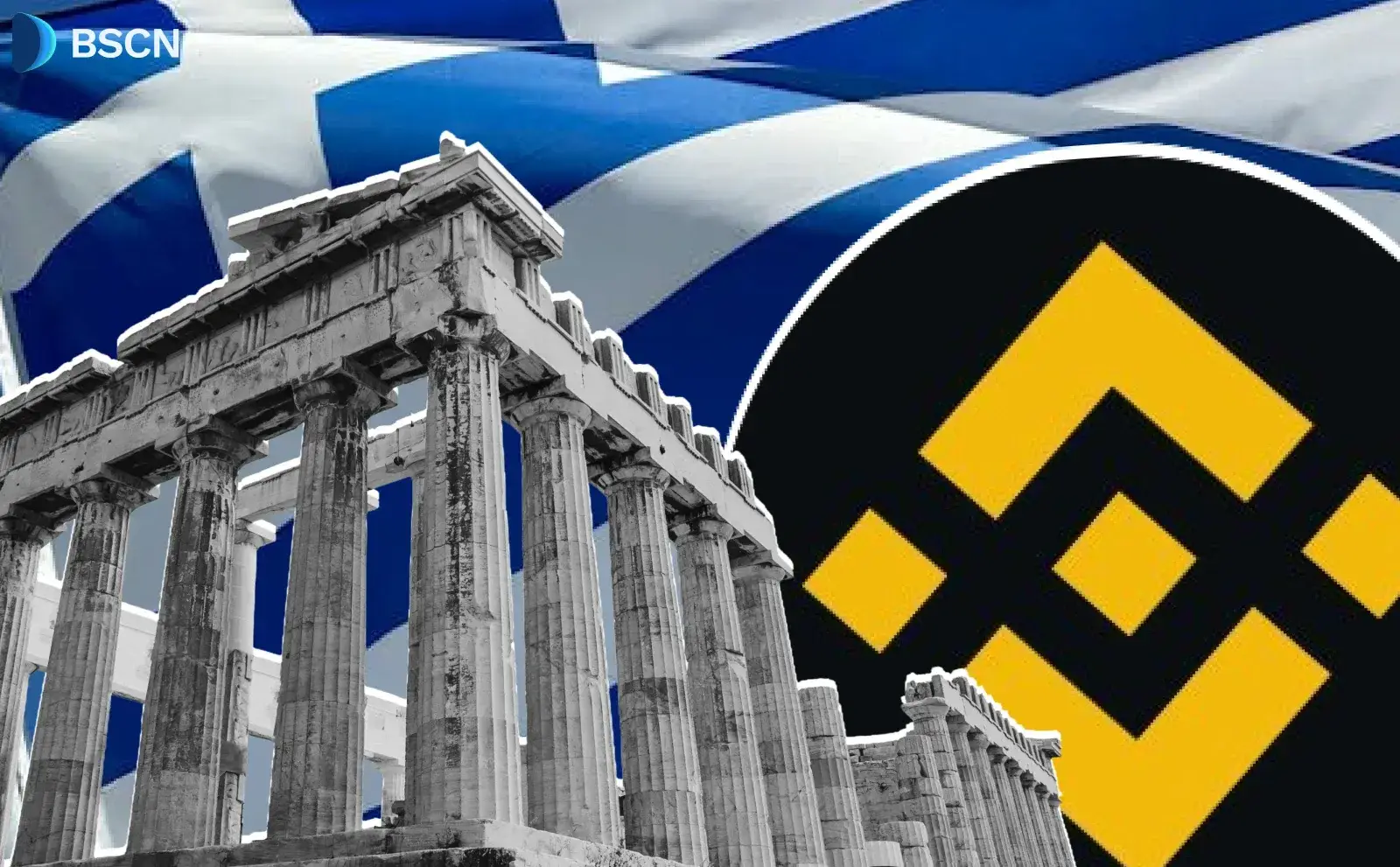
Binance picks Greece as its EU regulatory base under MiCA, skipping traditional hubs like Germany. Co-CEO Teng explains the unconventional choice.

Crypto Rich
February 26, 2026
(Advertisement)
Table of Contents
Binance has chosen Greece as its regulatory base for the European Union, filing for a MiCA license with the Hellenic Capital Market Commission (HCMC) ahead of the July 1, 2026 deadline. The world's largest crypto exchange bypassed traditional financial hubs like Germany and the Netherlands in favor of a country that hasn't yet issued a single MiCA license.
That's a bold bet on an untested regulatory partner.
Why Greece Over Germany or the Netherlands?
Co-CEO Richard Teng explained the thinking at the GFTN Forum in Tokyo this week. Since the MiCA license is standardized across Europe, he said Binance looked beyond the paperwork. Talent, safety, and security were the deciding factors.
Germany has already granted 45 MiCA licenses. The Netherlands sits at 22. Greece? Zero. For an exchange with roughly 300 million users and $44 billion in Bitcoin sitting in customer wallets, that's an unconventional pick.
But there's logic underneath it. Entering a less crowded regulatory environment could mean faster processing and a closer working relationship with the regulator. Binance isn't just filing an application. The exchange set up a holding company called Binary Greece, incorporated for an indefinite duration. That signals something more permanent than a quick licensing play.
What's the Fast-Track Process?
The HCMC has reportedly put Binance's application on an accelerated review, pulling in global advisory firms like Ernst & Young, KPMG, PwC, and Deloitte to help evaluate the proposal. That's a serious roster for a country reviewing its first major MiCA application.
If approved, Binance would be able to "passport" its services across all 27 EU member states from a single Greek license. Trading, custody, marketing, the works. Any crypto firm operating in the EU without a MiCA license after July 1 risks losing access to the entire market.
What About Binance's Regulatory Baggage?
This European push comes against a messy backdrop. Founder Changpeng Zhao (CZ) pleaded guilty to violating U.S. money-laundering laws, resulting in a $4.3 billion fine and nearly four months in prison. He was later pardoned by President Donald Trump.
Teng took over as CEO in November 2023, bringing decades of regulatory experience from Singapore's Monetary Authority and Abu Dhabi's financial regulator. His stated mission: making Binance the most regulated crypto exchange on the planet. In December, Binance appointed co-founder Yi He as co-CEO alongside Teng.
The exchange has also been dealing with fresh scrutiny. Reports this week alleged Binance investigators found evidence of $1.7 billion in crypto transfers involving sanctioned Iranian and Russian actors. Teng called the coverage misleading and threatened legal action against the Wall Street Journal, saying the investigators in question were dismissed for breaching data handling policies, not for flagging suspect transfers.
How Does Greece Fit the Bigger Picture?
To understand why Greece, you need to understand what happened in France.
The France Fallout
Binance originally bet on Paris as its European gateway. In May 2022, the exchange secured a Digital Asset Service Provider (DASP) registration with France's Autorité des Marchés Financiers (AMF). It was their first regulatory approval in the EU, and at the time, the move positioned France as Binance's continental base. The company was simultaneously pursuing registrations in Switzerland, Sweden, Spain, the Netherlands, Portugal, and Austria.
Then the relationship strained. In 2023, French authorities opened investigations into Binance over suspected illegal provision of digital asset services and aggravated money laundering. By 2024, ownership restructuring was needed to comply with EU standards, including rules around majority shareholders with criminal records. And in late 2025, French regulators launched anti-money laundering checks on over 100 registered crypto entities as part of the transition from national frameworks to MiCA. Binance was among them.
Why Greece Makes Sense Now
That France chapter puts the Greece pivot in sharper focus. Binance's global regulatory home remains in Abu Dhabi, but the Greek base is where Binance chose to pursue its EU-wide license. The exchange had already pulled license applications in Germany and Austria, exited the Netherlands after failing to get approval, and faced sustained regulatory pressure in France. Greece offers what Paris no longer could: a jurisdiction where Binance can build a regulatory relationship without inherited baggage.
The ESMA Wild Card
There's a wrinkle, though. Some EU countries, led by France, have been pushing to centralize crypto supervision under ESMA (the European Securities and Markets Authority). If that happens, the advantage of picking any specific country as your base could shrink. For now, MiCA's national licensing framework holds.
What Happens Next?
The crypto community is watching closely. If Greece approves Binance, it becomes the exchange's gateway into the EU's unified crypto market and puts Athens on the map as a serious regulatory destination for digital assets.
If it doesn't? The clock is ticking toward July 1, and Binance would need a plan B.
Sources:
- Reuters Original reporting on Teng's comments at the GFTN Forum in Tokyo, including Greece licensing data and Binance stats
- Reuters Reporting on Binance's May 2022 DASP registration in France with the AMF
- Fortune Detailed coverage of the MiCA filing, fast-track process, and advisory firms involved
- Bloomberg Reporting on French AML reviews of 100+ registered crypto entities during MiCA transition
- Finance Magnates Coverage of Binance ownership restructuring to meet EU compliance standards
- Invezz Coverage of sanctions allegations and Teng's response
Read Next...


Disclaimer
Disclaimer: The views expressed in this article do not necessarily represent the views of BSCN. The information provided in this article is for educational and entertainment purposes only and should not be construed as investment advice, or advice of any kind. BSCN assumes no responsibility for any investment decisions made based on the information provided in this article. If you believe that the article should be amended, please reach out to the BSCN team by emailing [email protected].
Author
 Crypto Rich
Rich has been researching cryptocurrency and blockchain technology for eight years and has served as a senior analyst at BSCN since its founding in 2020. He focuses on fundamental analysis of early-stage crypto projects and tokens and has published in-depth research reports on over 200 emerging protocols. Rich also writes about broader technology and scientific trends and maintains active involvement in the crypto community through X/Twitter Spaces, and leading industry events.
(Advertisement)
Latest News
July 17, 2026

What is the Nakamoto Coefficient & Why Does it Matter?
July 17, 2026

How to Trade on Robinhood Chain, Crypto's Busiest New Memecoin Market
July 17, 2026
Insights from CoinGecko's Q2 Crypto Report
July 17, 2026
Why Is Sui's Approach to Storing Data On Chain Different From Most Blockchains?
July 17, 2026
Why Does XRP Move Faster Than Bitcoin, And What Makes It Possible?
July 17, 2026

Top 8 Prediction Markets in Crypto Today
July 16, 2026
Grayscale Picks Its Most Promising Tokenization Blockchains
July 16, 2026

Crypto's Top Five Centralized Exchanges
(Advertisement)

Crypto Project & Token Reviews
Project & Token Reviews
Comprehensive reviews of crypto's most interesting projects and assets
Learn about the hottest projects & tokens

Latest Crypto Articles
Get up to date with the latest crypto news stories and events