WEB3
(Advertisement)


DEUS Token Explained: How XMAQUINA Is Bringing Private Robotics Markets Onchain

Private robotics equity has been limited to institutions. XMAQUINA brings it onchain through a DAO structure, with DEUS coordinating access, markets, and governance.

BSCN
May 11, 2026

(Advertisement)
Humanoid robotics companies are raising billions. Figure AI closed a round valuing it at $39 billion. Apptronik raised $935 million. 1X Technologies, Agility Robotics, and NEURA Robotics are all scaling fast, with combined valuations exceeding $85 billion across the sector in 2025 alone. But for most people, these companies remain completely off-limits. They sit behind private market walls, accessible only to venture capital firms and institutional allocators willing to write large checks and wait years for liquidity.
XMAQUINA is building something structurally different: an onchain system that acquires real equity in private robotics companies, creates tradable markets around those positions, and coordinates the entire operation through a single token. That token is DEUS.
DEUS as the Coordination Layer
DEUS is not a passive governance token bolted onto an investment DAO. It is the base asset that the entire XMAQUINA system is built around.
It serves three core functions. First, it is the governance layer. Holders who stake DEUS receive xDEUS through a vote-escrowed model inspired by Curve's veCRV system. The longer you lock, the more governance weight you carry. Every treasury deployment, portfolio allocation, and protocol parameter change requires explicit onchain approval from xDEUS holders. No capital moves without a vote.
Staking and active governance participation is also directly incentivized: the DAO may distribute up to 40% of realized value to active xDEUS holders through multiplier-weighted governance rewards, meaning those who show up and vote are first in line when the ecosystem generates returns.
Second, DEUS is the base pairing asset across all onchain markets within the Robotics Capital Markets (RCM) Protocol. When the DAO acquires equity in a robotics company, that position is held through a Special Purpose Vehicle (SPV), and a corresponding SubDAO token is issued. That SubDAO token is paired with DEUS in a liquidity pool, meaning every market in the ecosystem trades against DEUS. As more positions are added and more markets go live, DEUS sits at the center of an expanding network of trading activity.
Third, it is the coordination mechanism for how capital flows through the system. Protocol fees, exit proceeds, and incubation outcomes all route back to the DAO treasury, where xDEUS holders govern what happens next.
The Flywheel
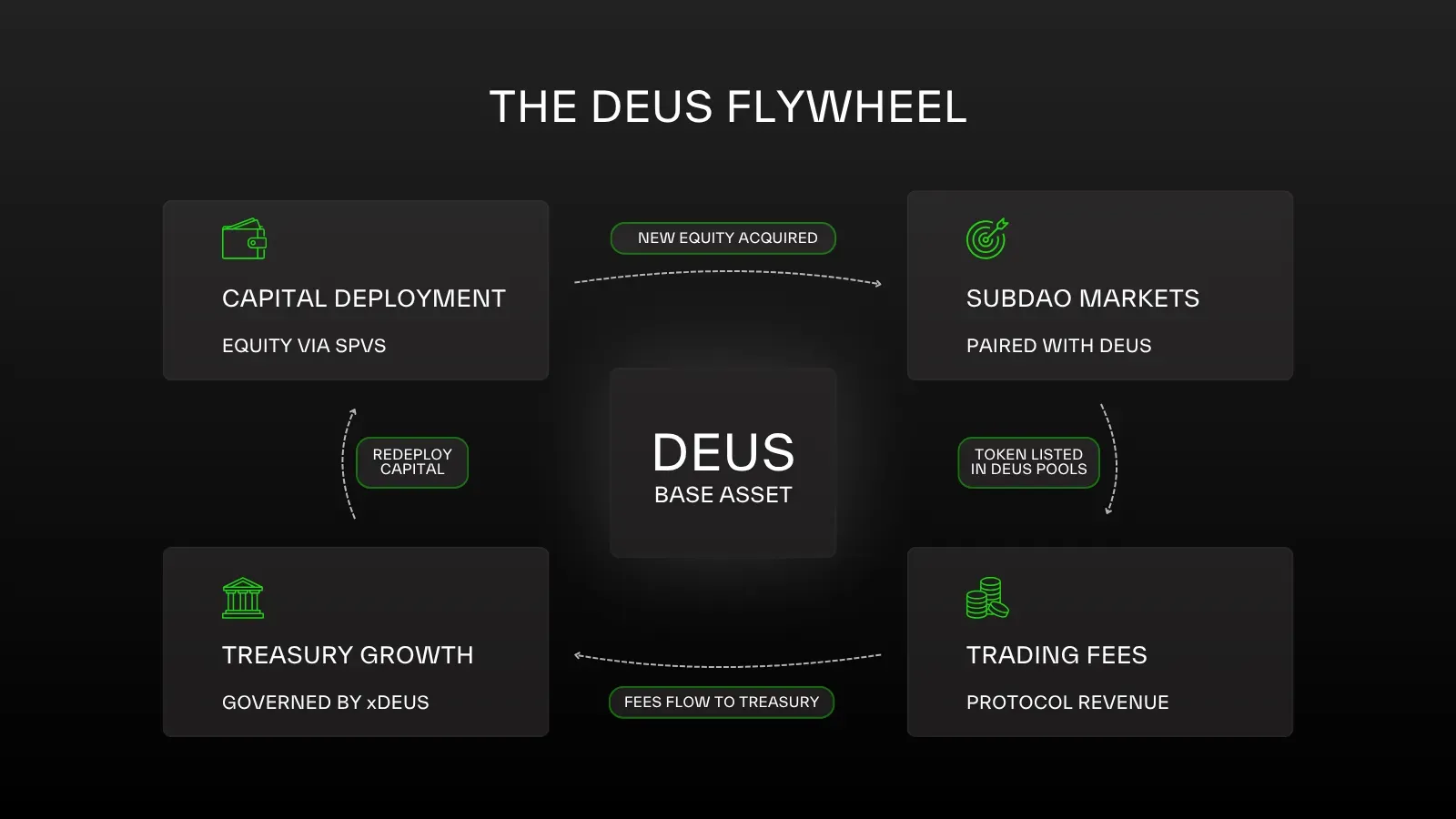
The most important concept in the XMAQUINA model is the self-reinforcing cycle between capital, markets, and treasury growth.
It works like this: the DAO deploys capital into a private robotics company. That equity is held via an SPV and represented by a SubDAO token, which is paired with DEUS and launched into a liquidity pool. Trading activity on that market generates protocol-level fees, which flow back into the DAO treasury. A larger treasury enables the DAO to fund more allocations, which creates more SubDAO markets, which generates more fees. Each new investment does not just add exposure; it strengthens the infrastructure itself.
This is the flywheel that ties DEUS to the growth of the entire ecosystem. The more the system expands, the more central DEUS becomes to its liquidity and governance.
Real Equity, Not Synthetic Exposure
XMAQUINA is not building a wrapper around price feeds or speculation. The DAO acquires direct equity through dedicated SPVs. These are real cap table entries. The current portfolio includes positions in Apptronik (up 103% on preferred shares), 1X Technologies (up 119%), Figure AI, Agility Robotics, NEURA Robotics and Sanctuary AI. Portfolio companies collectively represent over $60 billion in combined valuation.
Capital for these investments was raised through five public Genesis Auctions that brought in over $10 million. Both VCs and retail participants entered on identical terms, with no preferential pricing or insider allocations. All treasury activity, portfolio positions, and governance decisions are publicly visible through the DAO Portal.
Tokenomics
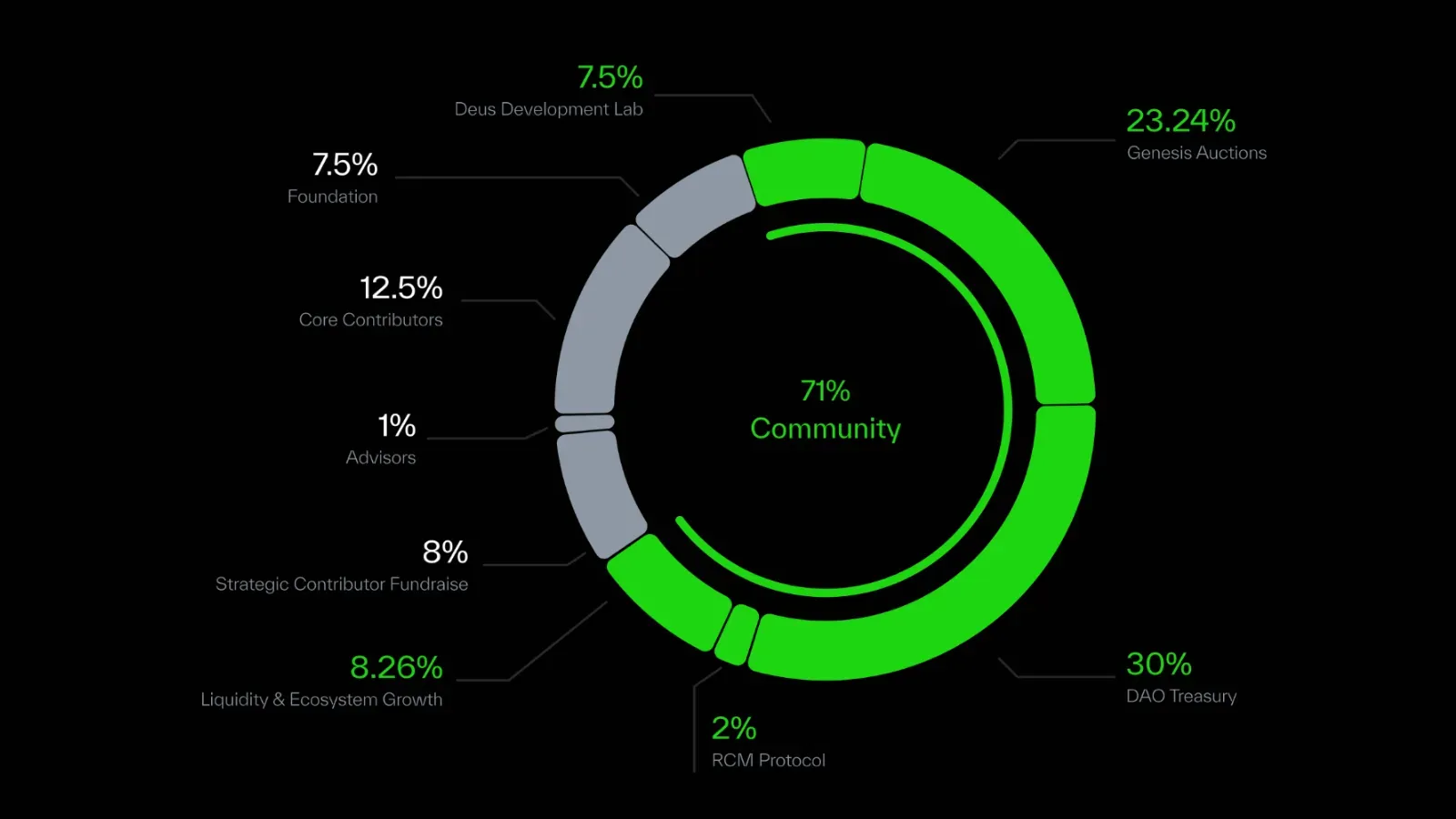
DEUS has a fixed supply of 1 billion tokens. No additional tokens can be minted. The allocation is designed to prioritize long-term alignment: the Genesis Auction (30%) and DAO Treasury (30%) make up the majority, with core contributors, strategic fundraise participants, advisors, and ecosystem/liquidity allocations covering the rest. Most supply is either locked or governance-controlled, limiting early sell pressure and keeping decision-making power with committed participants. Full details on vesting schedules and unlock mechanics are available in the official tokenomics documentation.
DEUS Labs and Ecosystem Expansion
XMAQUINA is not limiting itself to external investments. Through DEUS Labs, its internal incubation unit, the DAO builds and launches its own ventures at the intersection of robotics and crypto. The first project, Robotico, is developing an intelligence platform for the humanoid robotics sector. The DAO holds equity in these ventures from day one, capturing value at the earliest possible stage and expanding ecosystem reach beyond external allocations.
As new ventures scale, DEUS may take on additional functional roles within its product architecture, deepening the token's integration across the broader ecosystem. The DAO holds equity positions in these independent companies, with any resulting outcomes governed by xDEUS holders alongside broader treasury activity.
Where to Trade DEUS
DEUS will be available through a mix of onchain and centralized options. Onchain traders on Base will find it on Aerodrome and via the Virtuals Protocol, while Solana users are expected to access it on Solana-based DEXs. For those who prefer centralized platforms, trading pairs are expected to be listed across several exchanges and can be tracked on aggregators such as CoinMarketCap, CoinGecko, or CryptoRank.
For a sector where access has historically been gated behind accredited investor requirements, high minimums, and relationship-driven dealflow, XMAQUINA's approach represents a structural experiment worth watching closely. The foundation, real equity, transparent governance, and a fixed-supply coordination token, is already in place. And in a market crowded with tokens attached to little more than a whitepaper, that distinction matters.
Read Next...


Disclaimer
Disclaimer: The views expressed in this article do not necessarily represent the views of BSCN. The information provided in this article is for educational and entertainment purposes only and should not be construed as investment advice, or advice of any kind. BSCN assumes no responsibility for any investment decisions made based on the information provided in this article. If you believe that the article should be amended, please reach out to the BSCN team by emailing [email protected].
Author
 BSCN
BSCNBSCN's dedicated writing team brings over 41 years of combined experience in cryptocurrency research and analysis. Our writers hold diverse academic qualifications spanning Physics, Mathematics, and Philosophy from leading institutions including Oxford and Cambridge. While united by their passion for cryptocurrency and blockchain technology, the team's professional backgrounds are equally diverse, including former venture capital investors, startup founders, and active traders.
(Advertisement)
Latest News
July 9, 2026

Trust Wallet Adds Native Support for Robinhood Chain, Opening Stock Tokens to 220 Million Users
July 9, 2026
Robinhood Chain Explodes Post-Mainnet Launch
July 9, 2026
Is Avalanche AVAX Bringing Hyundai On Chain?
July 9, 2026

Stop Tokenizing Assets You Don't Control
July 9, 2026

What Is Cash Cat Memecoin?
July 9, 2026

What Makes Hedera's Enterprise Adoption Strategy Different From Ethereum's?
July 8, 2026
XRP Ledger's v3.2.0 Upgrade Explained
July 8, 2026

Big News for Morpho and Ethena: What is Robinhood Earn?
(Advertisement)

Crypto Project & Token Reviews
Project & Token Reviews
Comprehensive reviews of crypto's most interesting projects and assets
Learn about the hottest projects & tokens

Latest Crypto Articles
Get up to date with the latest crypto news stories and events