News
(Advertisement)


The Clock Is Ticking on U.S. Crypto Law, and Banks Just Hit Snooze

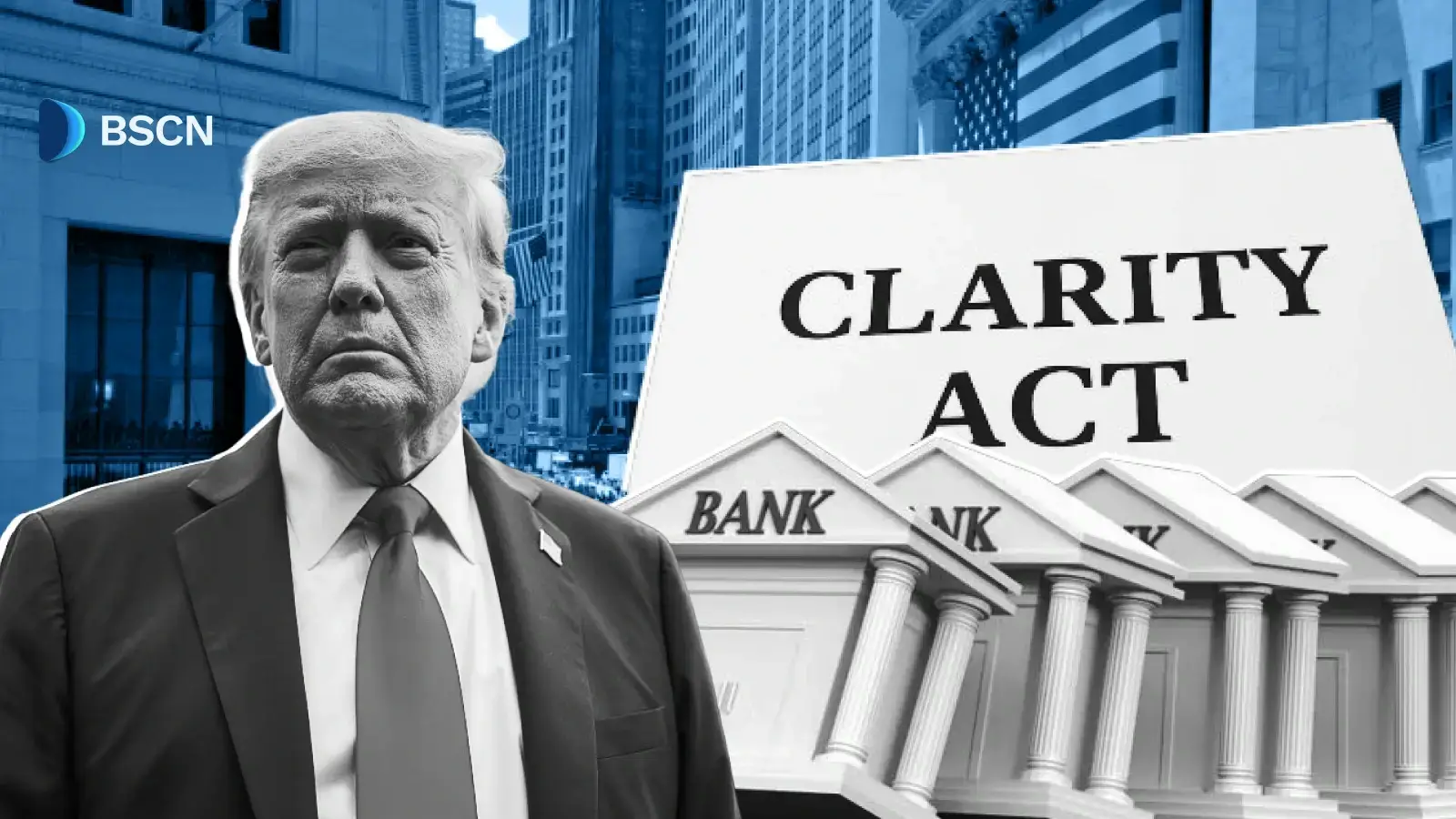
Banks have rejected the White House's stablecoin rewards compromise, stalling the CLARITY Act. Here's what it means for crypto regulation in 2025 and beyond.

Soumen Datta
March 6, 2026

(Advertisement)
Table of Contents
U.S. banks have refused to back a White House-brokered compromise on stablecoin rewards, throwing the CLARITY Act into fresh doubt and drawing sharp public criticism from President Donald Trump.
According to Reuters, the standoff has prompted real questions about whether Congress can pass crypto market structure legislation before mid-term election season narrows the legislative window.
Why Are Banks Blocking The Stablecoin Rewards Deal?
The dispute centers on whether crypto platforms should be allowed to offer rewards, sometimes called yield, to users who hold stablecoins. Banks say this creates a direct threat to their deposit base.
Stablecoins are digital tokens pegged to a stable asset, usually the U.S. dollar, at a 1:1 ratio. Popular examples include USDC (issued by Circle) and USDT (issued by Tether). Unlike volatile cryptocurrencies such as Bitcoin or Ether, stablecoins are designed to hold their value and are widely used for payments and trading on crypto exchanges.
The conflict dates back to the GENIUS Act, which became law and explicitly banned stablecoin issuers from paying interest or yield directly to holders. Banks argued at the time that the law still contained a loophole: third-party exchanges and affiliates could offer "rewards" instead of interest, achieving the same economic effect without technically violating the prohibition.
The banking industry is not treating this risk as theoretical. The U.S. Treasury Borrowing Advisory Committee has estimated that stablecoin adoption could redirect as much as $6.6 trillion in deposits away from traditional banks. Standard Chartered put a narrower number on it, estimating roughly $500 billion in deposit outflows from U.S. banks by the end of 2028.
What The White House Compromise Actually Proposed
Last month, the White House stepped in to negotiate a middle-ground position. According to four people familiar with the private talks, the compromise would allow stablecoin rewards in specific situations, including peer-to-peer payments, but would prohibit rewards on idle or passively held balances.
Crypto companies, including major players like Coinbase and Ripple, accepted that framework. Banks did not.
According to a senior White House official, banks still want to sharply restrict the range of activities for which any rewards can be issued. A banking industry source said lenders believe even the limited activities permitted under the White House deal could still trigger deposit flight.
Some senators have sided with the banks, and the banking industry believes it can negotiate a more favorable outcome with their support.
The OCC's Proposed Rule: Clearer Than It Looks?
While Congressional talks stalled, the Office of the Comptroller of the Currency (OCC) published a proposed rule implementing the GENIUS Act that attempts to define which rewards arrangements are and are not permitted. The OCC is the federal agency that charters and regulates national banks.
The proposed rule establishes what it calls a "rebuttable presumption." This means the OCC would presume that a stablecoin issuer is paying prohibited yield if it has a contract with an affiliate or related third party to pay interest or yield to stablecoin holders, whether directly or through a linked arrangement.
In plain terms: if a stablecoin issuer controls the payment infrastructure while a partner brands and distributes the rewards, the OCC would still treat that as a violation. The proposal specifically targets so-called white label arrangements, where a stablecoin issuer and a third-party marketer are effectively the same economic unit under different names.
Gibson Dunn lawyers Rosemary Spaziani and Jason J. Cabral noted in an analyst note that the prohibition is deliberately broad. It potentially covers balance-based rewards, rebates, loyalty tokens, profit-sharing arrangements, or other economic benefits tied to holding stablecoin balances. The formal legal separation between an issuer and a third-party partner will not be decisive, they wrote, if the economic substance suggests compensation for passive holding.
The "Looks Like A Duck" Test
Former CFTC Acting Chairman Caroline Pham, now Chief Legal Officer at crypto firm MoonPay, offered a simpler framing at the Milken Institute's 2026 Future of Finance conference. She described the proposal as establishing what she called a "looks like a duck" test.
If a rewards arrangement looks like a merchant loyalty program tied to actual stablecoin use, that is likely acceptable under the draft rule. If it looks like a deposit account, a savings account, or a money market fund, it is not.
Pham said the OCC, under Comptroller of the Currency Jonathan Gould, is taking a pro-innovation stance and that the comment period is the right venue to work out the remaining ambiguities.
Not everyone reads the proposal the same way, however. Todd Phillips, an assistant professor at Georgia State University and former FDIC attorney, said the language remains contested. He noted that the crypto industry reads the proposal as broadly prohibiting yield, while the banking industry reads it as leaving the door open.
Policy analyst Jaret Seiberg at TD Cowen warned that the OCC's rule alone may not resolve the dispute even after the comment period closes. Issuers and platforms could adjust their contract structures to avoid being captured by the rebuttable presumption. And if the CLARITY Act eventually passes with different language, it could override the OCC rule entirely.
Is The CLARITY Act Running Out Of Time?
The CLARITY Act, a market structure bill that would establish whether crypto tokens are legally classified as securities, commodities, or something else, has been under Congressional discussion for over a year. The crypto industry spent more than $119 million backing pro-crypto candidates in 2024, with passing this bill among its top priorities.
But the bill faces more than just the stablecoin rewards dispute. Several other issues remain unresolved:
- Some Democratic senators want the bill to prohibit elected officials from profiting from crypto ventures, a provision aimed at the Trump family's World Liberty Financial project. Trump is unlikely to sign such a measure.
- Other lawmakers want stronger anti-money laundering provisions included.
- The Senate Banking Committee draft must eventually be reconciled with a separate draft from the Senate Agriculture Committee.
- The bill needs at least seven Democratic votes in the Senate to pass, and Democratic lawmakers are more divided on crypto reform than Republicans.
Senate floor time is also limited. Lawmakers are expected to leave Washington for the summer ahead of mid-term campaigning, and the Iran conflict is adding further pressure on the legislative schedule.
"The calendar is becoming the enemy of this bill," wrote Brian Gardner, chief Washington strategist at Stifel, in a Tuesday analyst note.
Adrian Wall, managing director of the Digital Sovereignty Alliance, put it more directly. If the bill is not in front of the President's desk by July, he said, the window will effectively close because of mid-term dynamics. A shift in the balance of Congress toward Democrats in November would make passage even harder, since Democrats are more divided on comprehensive crypto reform.
What Coinbase CEO Brian Armstrong's Withdrawal Signaled
One of the clearest signals that the CLARITY Act is in trouble came in January, when Coinbase CEO Brian Armstrong withdrew his support for the market structure bill specifically over the stablecoin yield issue. A planned markup session in the Senate Banking Committee was subsequently canceled.
Coinbase has argued that barring platforms from offering rewards to recruit stablecoin users would be anticompetitive. Robin Cook, Director of U.S. Policy at Coinbase, said at the Milken panel that the GENIUS Act banned issuer-paid interest, not third-party incentives, and that the distinction was debated and decided on the Senate floor.
"In order for a stablecoin to actually come to being, you have to provide an incentive for them to be able to do that," Cook said.
Ian Katz, managing director at Capital Alpha Partners, noted that the OCC proposal appears more negative than the crypto industry expected, but that a divergence of opinions remains on how restrictive it actually is. He also noted the rule can be changed during its 60-day comment period, or overridden entirely by CLARITY Act language if Congress passes it.
What Happens Next For Crypto Legislation?
The stablecoin rewards fight is a single piece of a larger regulatory puzzle. Crypto companies have long operated without clear rules about how their tokens are legally classified, which executives say has made it difficult to build compliant businesses in the United States.
The American Bankers Association, in a statement, said lenders had offered constructive ideas to move the bill forward without creating risks to deposits. The risks to economic growth and financial stability are real if policymakers get this wrong, the group said.
The Blockchain Association's CEO, Summer Mersinger, offered a more optimistic read, saying the path to a workable agreement is clearer than it was a month ago.
Whether Congress can convert that clarity into actual legislation before the mid-term window closes remains the central question.
Resources
Report by Reuters: Crypto bill hits new impasse, raising doubts over its future
Report by American Banker 1: OCC's GENIUS implementation draft rule keeps yield on the table
Report by American Banker 2: OCC proposes comprehensive stablecoin framework
Report by Bloomberg: Coinbase CEO Brian Armstrong Pulls Support for Crypto Market-Structure Bill
Donald Trump on Truth Social: Post on March 3
Report by CoinDesk: Trump urges passage of U.S. Clarity Act, attacks banks for 'undercutting' GENIUS
Congressional bill text: Digital Asset Market Clarity Act of 2025 (H.R. 3633)
Senate Banking Committee discussion draft: Responsible Financial Innovation Act of 2025
Read Next...





Frequently Asked Questions
What is the CLARITY Act and why does it matter?
The CLARITY Act is a proposed U.S. law that would establish clear legal definitions for crypto tokens, determining whether they are securities, commodities, or something else. Without it, many crypto companies operate in a regulatory gray area. The bill has stalled in the Senate over a dispute about whether stablecoin platforms can offer rewards to users.
Why do banks oppose stablecoin rewards?
Banks argue that allowing crypto platforms to offer rewards on stablecoin holdings effectively creates a competing product that functions like a bank deposit but outside traditional banking regulation. They fear this could pull large amounts of customer deposits away from banks, reducing the funds available for lending. Estimates range from $500 billion to $6.6 trillion in potential deposit outflows.
What is the OCC's rebuttable presumption rule on stablecoin yield?
The OCC's proposed rule presumes that a stablecoin issuer is paying prohibited interest or yield if it has any contractual arrangement with an affiliate or third party that results in stablecoin holders receiving economic benefits tied to holding that stablecoin. The presumption can be challenged, but critics say issuers could also restructure contracts to avoid it. The rule is open to a 60-day public comment period and could be changed or overridden by Congressional legislation.
Disclaimer
Disclaimer: The views expressed in this article do not necessarily represent the views of BSCN. The information provided in this article is for educational and entertainment purposes only and should not be construed as investment advice, or advice of any kind. BSCN assumes no responsibility for any investment decisions made based on the information provided in this article. If you believe that the article should be amended, please reach out to the BSCN team by emailing [email protected].
Author
 Soumen Datta
Soumen has been a crypto researcher since 2020 and holds a master’s in Physics. His writing and research has been published by publications such as CryptoSlate and DailyCoin, as well as BSCN. His areas of focus include Bitcoin, DeFi, and high-potential altcoins like Ethereum, Solana, XRP, and Chainlink. He combines analytical depth with journalistic clarity to deliver insights for both newcomers and seasoned crypto readers.
(Advertisement)
Latest News
July 24, 2026

Analysis: Ondo Finance's 2026 In Numbers
July 24, 2026

Is Circle Planning to Launch a Korean Won Stablecoin?
July 24, 2026

What Is Ripple Mint?
July 23, 2026

Can Injective's New Mint Platform Bring Institutions to INJ?
July 23, 2026

What is RippleX & Why Does it Matter for XRP Ledger?
July 23, 2026

What Is Dfinity's Caffeine?
July 22, 2026

How Much Funding Has Canton Developer Digital Asset Raised?
July 22, 2026

What is Aptos' AIP-146 and Is It Good News for APT?
(Advertisement)

Crypto Project & Token Reviews
Project & Token Reviews
Comprehensive reviews of crypto's most interesting projects and assets
Learn about the hottest projects & tokens

Latest Crypto Articles
Get up to date with the latest crypto news stories and events