

Brian Armstrong Issues Positive Clarity Act Update Live From Senate Office In Dc

Coinbase CEO Brian Armstrong confirms the Digital Asset Market Clarity Act is closer to passage following a successful Senate Banking Committee markup, praising bipartisan efforts and the 3.7 million Stand With Crypto advocates.
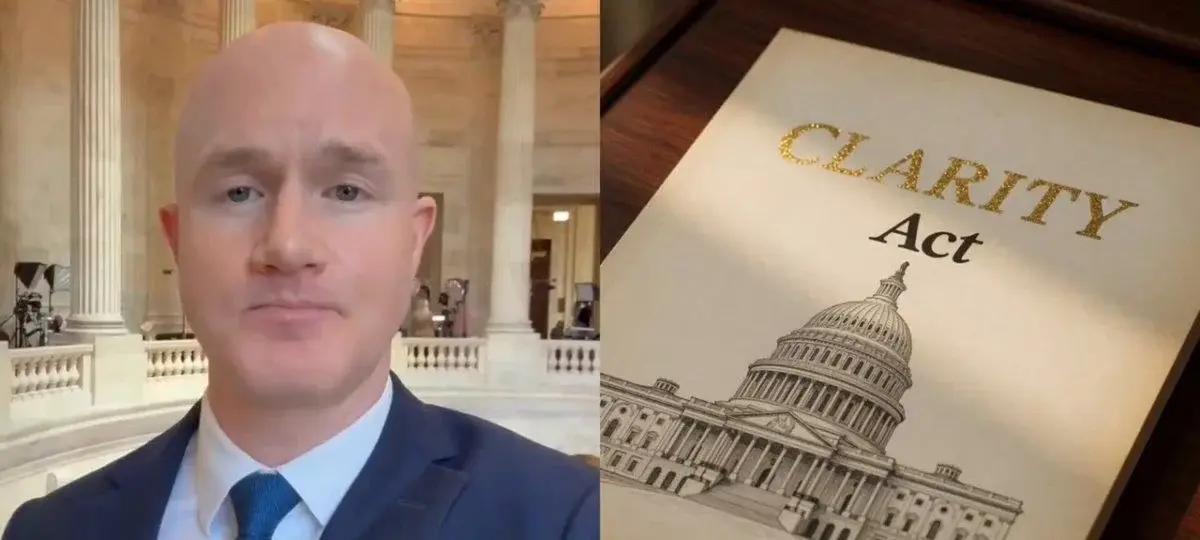
Armstrong Backs Clarity Act After Months of Turbulence
@Coinbase CEO Brian Armstrong (@Brian_Armstrong) emerged from the Senate Banking Committee's Dirksen Office Building in Washington, D.C. with a bullish assessment of the Digital Asset Market Clarity Act, telling followers the bill is stronger than ever after completing a key committee markup.
"The bill is stronger than ever. It's bipartisan, it's ready to go to markup, and I'm incredibly bullish on what this could mean for American innovation and ordinary Americans benefiting from this technology," Armstrong said. He credited months of hard work by Senate staff, lawmakers, and the 3.7 million @standwithcrypto advocates for getting the legislation to this point.
The markup clears one of the most significant procedural hurdles the bill has faced. The Senate Banking Committee's consideration of the Digital Asset Market Clarity Act has been described as the most consequential piece of cryptocurrency legislation ever to reach this stage in Congress. The House passed the bill 294-134 in July 2025, but the Senate Banking Committee postponed its own markup session in January 2026 on the very day it was scheduled to begin.
Armstrong's upbeat tone marks a sharp turn from earlier this year. In January, Armstrong announced Coinbase's surprise withdrawal of support for the Clarity Act, criticizing various elements of the bill, primarily its treatment of stablecoin yields. That move had immediate consequences: the Senate Banking Committee canceled its planned January markup at the last minute after Coinbase pulled its support, and the exchange rejected another draft in late March.
What the Bill Would Do
The revised bill reflects months of negotiation on several contested fronts. Under the legislation, the CFTC would receive exclusive jurisdiction over spot and cash markets for digital commodities, while the SEC retains authority over investment contract assets and primary market fundraising. The Senate version expanded well beyond the House text, adding nine titles covering decentralized finance protections, illicit finance provisions, bankruptcy safeguards for crypto customers, and safe harbors for software developers.
A key sticking point over stablecoin yield was resolved ahead of the markup. Senators Thom Tillis and Angela Alsobrooks finalized a compromise, ending a fight that had pulled in the White House, the banking lobby, and the broader digital asset sector since the start of the year. The compromise text allows activity-based rewards to be paid in stablecoin assets for transactions such as gas fees or platform utility, while banning passive yield, meaning platforms are prohibited from paying customers simply for holding stablecoins.
Armstrong said the bill will modernize the US financial system, making it faster and more accessible. For the broader digital asset industry, a positive Senate floor outcome would provide the long-awaited legal framework needed to support the next generation of financial infrastructure and institutional $BTC adoption. The markup gives the Senate Banking Committee another shot at moving the bill before the White House's July 4 target for Clarity Act passage.
Sources:
Bitcoin Magazine: Senate Schedules CLARITY Act Markup
CoinDesk: Clarity Act Unveiled by Senate Banking Committee
The Block: Coinbase Says Deal Reached on Clarity Act Stablecoin Yield
Latest News



Read More...





(Advertisement)
Author
 UC Hope
UC holds a bachelor’s degree in Physics and has been a crypto researcher since 2020. UC was a professional writer before entering the cryptocurrency industry, but was drawn to blockchain technology by its high potential. UC has written for the likes of Cryptopolitan, as well as BSCN. He has a wide area of expertise, covering centralized and decentralized finance, as well as altcoins.