SPONSORED CONTENT
Paid press release. BSCN does not endorse this content.
(Advertisement)


Maczo's Lucky Spin Opens the Math Behind a Weighted Crypto Game

An open-source verifier, published wheel weights and offline checking turn a promotional spin into a reproducible result.

BSCN
July 17, 2026

(Advertisement)
Weighted wheels are easy to understand on screen: press a button, watch the pointer move and see which segment wins. Proving that the result was generated correctly is more demanding. A verifier must show that the operator committed to its randomness before the spin and that the accepted random value landed on the same weighted segment under public rules.
Maczo has built that verification path around Lucky Spin. Its Provably Fair help page connects users to a browser tool, source code, documentation and the exact wheel weights. Together, those resources allow a settled spin to be reconstructed instead of merely marked as fair.
The Three Inputs Behind a Lucky Spin
Each spin is determined from three core values:
- Server seed: generated by Maczo and kept secret while active. Its SHA-256 hash is shown as a commitment before the spin.
- Client seed: visible to the player and editable from the Lucky Spin interface.
- Nonce: a counter that advances for each spin under the current seed pair.
When the player rotates the seed, the previous server seed is retired and revealed. Anyone can hash the revealed value and confirm that it matches the commitment published earlier. If the seed had been changed after the spin, the hash would no longer match.
The revealed server seed, client seed and nonce are then combined through HMAC-SHA256. This produces the deterministic digest used to select the wheel segment.
Why a Weighted Wheel Needs More Than HMAC
HMAC output is not the final prize. Lucky Spin must map cryptographic data across segments with different relative weights. A small-value segment may occupy more of the cumulative weight range, while a larger-value segment may occupy less.
That means verification requires two public ingredients: the selection algorithm and the weights used for that particular spin. Publishing only the HMAC formula would prove the random digest but leave the probability-to-segment mapping incomplete.
64-Bit Words and Rejection Sampling
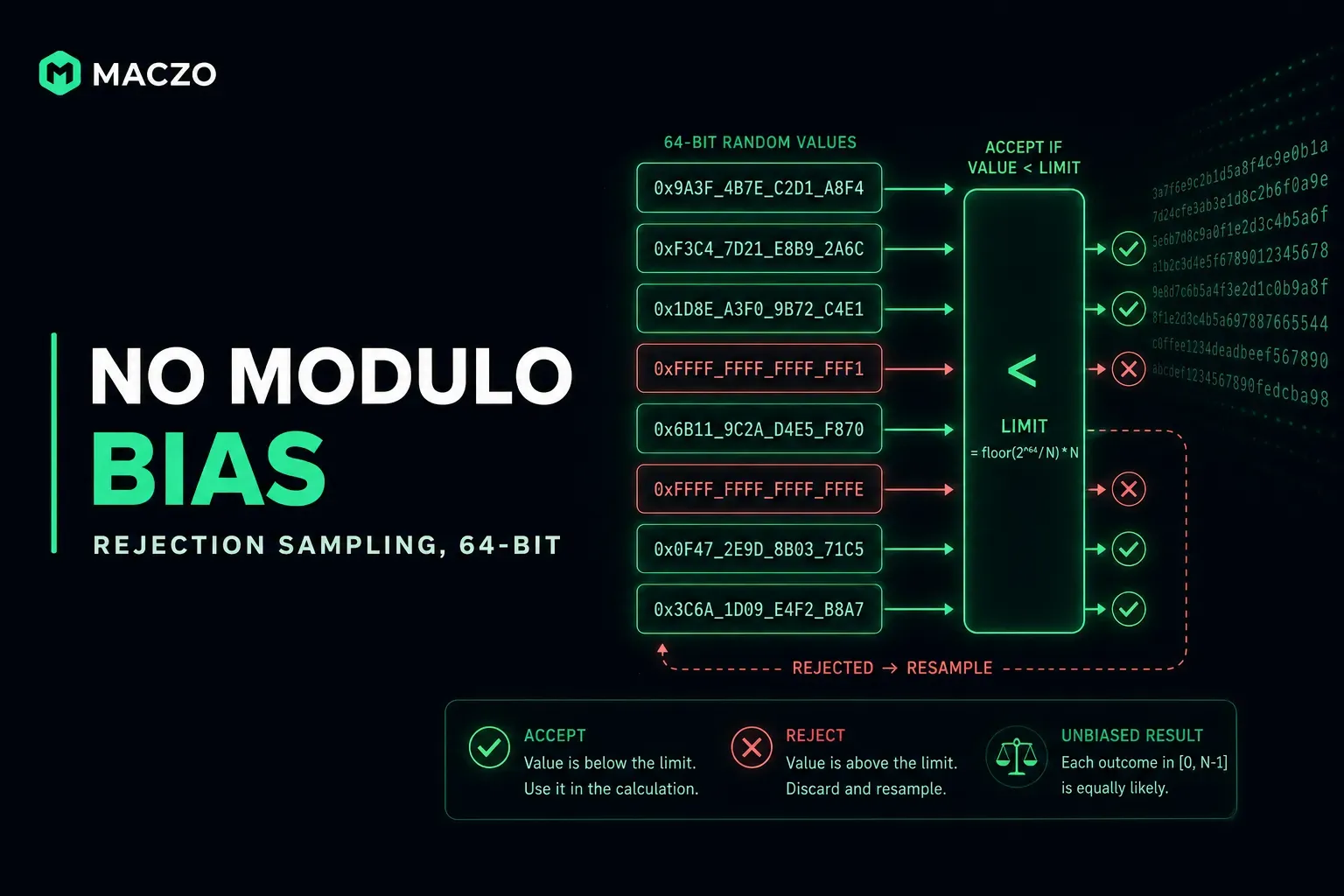
The Lucky Spin verifier reads the 32-byte HMAC digest as four big-endian unsigned 64-bit values. It then applies rejection sampling before reducing an accepted value by the total weight.
Rejection sampling avoids a subtle problem known as modulo bias. If the size of the 64-bit number space is not exactly divisible by the total wheel weight, a direct modulo operation can give some remainders a tiny structural advantage. The verifier rejects values above the largest evenly divisible range and moves to the next word.
If all four words were rejected, the cursor would advance and HMAC would run again. The source documentation describes this as extremely rare, but the fallback remains part of the public recipe. Once a word is accepted, the verifier reduces it by the total weight and walks the cumulative segment ranges to identify the result.
Published Weights Complete the Proof
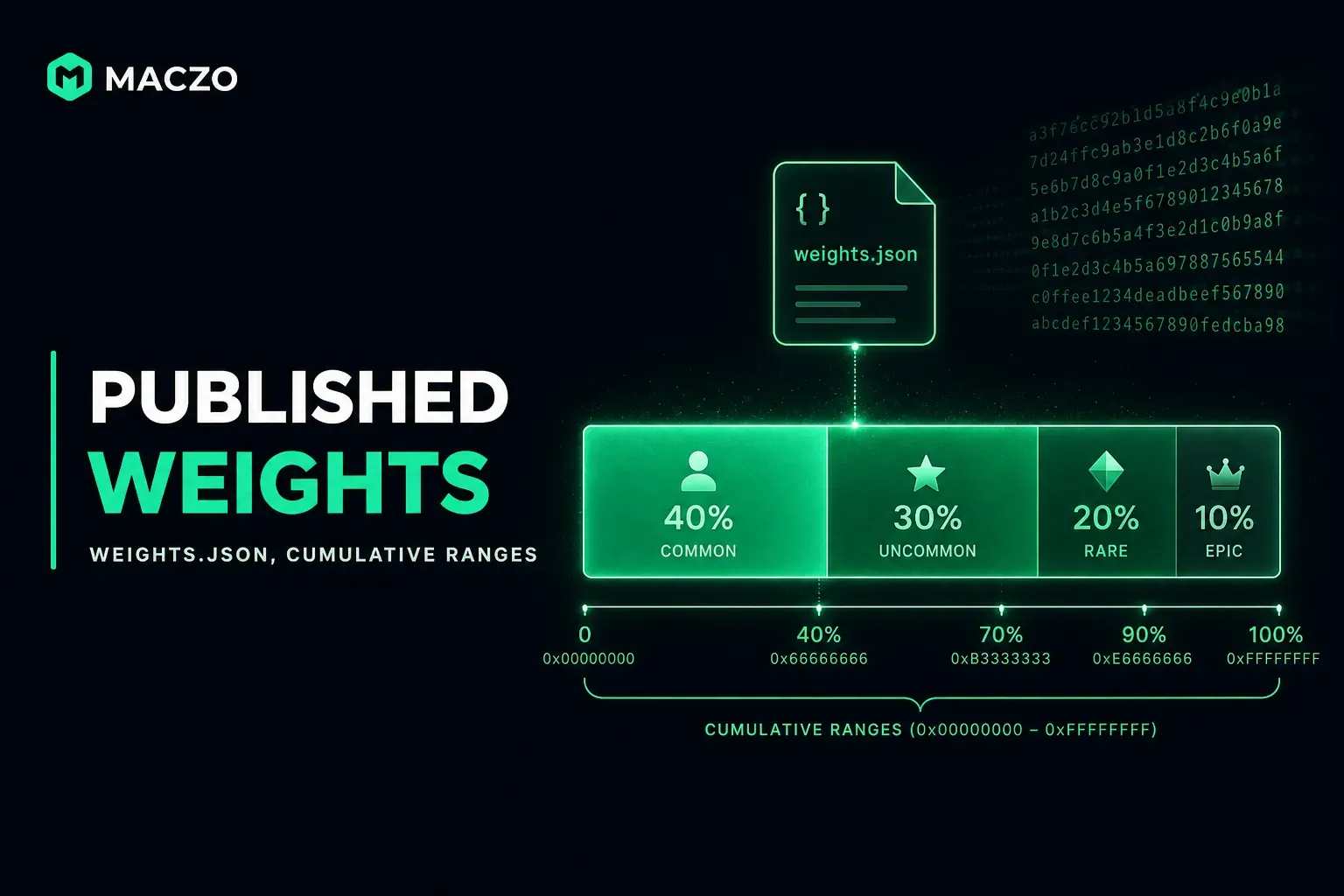
Maczo publishes the wheel configuration in weights.maczo.json. The file lists each displayed value and its relative weight, including repeated segments. A verifier can sum those weights, rebuild the cumulative ranges and reproduce the exact segment index selected by the accepted 64-bit word.
Every verification link generated from the Lucky Spin page can also carry the weights used for that spin. This matters because wheel configurations may evolve. A historical result should be checked against the table that applied when it was created, not a later configuration.
Four Public Resources for Independent Checking
Maczo exposes the complete Lucky Spin verification path through the following resources:
- Lucky Spin browser verifier
- Lucky Spin source code on GitHub
- Lucky Spin documentation and Wiki
- Published Lucky Spin wheel weights
The browser verifier can run offline, so the values used for checking do not need to be sent back to Maczo. Developers can instead open the repository, run the zero-dependency Node.js verifier and execute the bundled self-test against known-answer vectors.
What the Test Vectors Check
Test vectors pair fixed server seeds, client seeds, nonces and wheel weights with expected segment indexes. Running the verifier against those cases checks whether the public implementation reproduces answers generated by an independent reference implementation.
This gives reviewers a practical way to detect accidental changes. If an edit to the JavaScript breaks compatibility with the documented recipe, the self-test should stop reproducing the expected results.
Lucky Spin Is One Part of a Larger Open Library
Maczo's public GitHub organization also contains the shared engine and per-game resolver repositories for Maczo Originals. The Help selector currently covers Lucky Spin plus 31 Originals, including Dice, Mines, Plinko, Crash, Roulette, Blackjack and themed titles.
The Originals library intentionally uses a different 32-bit engine and game-specific resolvers. A Mines verifier rebuilds a hidden board, while a Plinko verifier derives a left-or-right path. Lucky Spin remains separate because a weighted wheel needs 64-bit selection and rejection sampling.
Why the Model Fits a Crypto-Native Audience
Crypto users are already familiar with inspecting transactions, contract addresses and open repositories. Lucky Spin extends that habit to game results. A non-technical player can paste values into a browser, while a developer can check the same result from source.
For Maczo's Asia and Southeast Asia focus, open verification also provides evidence that is not tied to one language or marketing channel. Interfaces may be localized, but the commitment, seeds, nonce, weights and resulting segment remain mathematically reproducible.
What a Successful Verification Actually Proves
A matching result can show that the revealed server seed fits the earlier commitment and that the documented inputs and weights reproduce the settled segment. It does not guarantee a win, remove the house edge or replace licensing, platform security, local rules and responsible-play measures.
The scope is also specific to Lucky Spin and Maczo-developed Originals. External studio games use their own proprietary systems and should not be described as open source merely because they appear in the same broader game catalog.
Final Assessment
Lucky Spin's strongest transparency feature is not the wheel animation or a fairness badge. It is the ability to leave the game interface and reproduce the result elsewhere.
By publishing the commitment model, 64-bit selection algorithm, rejection-sampling rule, wheel weights, source code and test vectors, Maczo exposes the full route from seed data to segment. That turns a weighted spin into something a player or researcher can independently check.
Read Next...




Disclaimer
Disclaimer: This is a paid press release. BSC.News does not endorse and is not responsible for or liable for any content, accuracy, quality, advertising, products, or other materials on this page. Readers should do their own research before taking any actions related to the company. BSC.News is not responsible, directly or indirectly, for any damage or loss caused or alleged to be caused by or in connection with the use of or reliance on any content, goods, or services mentioned in the press release.
This PR may contain links to online sports betting and gambling websites that are not affiliated with BSCN. Recognizing that the laws and regulations involving online gambling and online sports betting are different everywhere, you expressly acknowledge and agree that it is your sole responsibility and obligation to ensure that any online gambling or sports betting activities that you undertake are legal in your relevant jurisdiction.
⚠️ Responsible Gambling Warning
Gambling can be addictive. Never bet more than you can afford to lose.
If you or someone you know has a gambling problem:
- Gambling Therapy: www.gamblingtherapy.org
- Gamblers Anonymous: www.gamblersanonymous.org
You must be 18+ (21+ in some jurisdictions) to participate in gambling activities.
Author
 BSCN
BSCNBSCN's dedicated writing team brings over 41 years of combined experience in cryptocurrency research and analysis. Our writers hold diverse academic qualifications spanning Physics, Mathematics, and Philosophy from leading institutions including Oxford and Cambridge. While united by their passion for cryptocurrency and blockchain technology, the team's professional backgrounds are equally diverse, including former venture capital investors, startup founders, and active traders.
(Advertisement)
Latest News
0h : 50m ago

Insights from CoinGecko's Q2 Crypto Report
3h : 5m ago

Why Is Sui's Approach to Storing Data On Chain Different From Most Blockchains?
5h : 20m ago

Why Does XRP Move Faster Than Bitcoin, And What Makes It Possible?
5h : 35m ago

Top 8 Prediction Markets in Crypto Today
July 16, 2026

Grayscale Picks Its Most Promising Tokenization Blockchains
July 16, 2026

Crypto's Top Five Centralized Exchanges
July 16, 2026

How Is Polygon Trying to Connect Every Blockchain Into a Single Network?
July 16, 2026
What Does It Really Mean To Host A Website On The Internet Computer?
(Advertisement)

Crypto Project & Token Reviews
Project & Token Reviews
Comprehensive reviews of crypto's most interesting projects and assets
Learn about the hottest projects & tokens

Latest Crypto Articles
Get up to date with the latest crypto news stories and events