News
(Advertisement)


White House Advisor Slams Jamie Dimon's Stablecoin Comments


White House crypto advisor Patrick Witt publicly rebuked JPMorgan CEO Jamie Dimon over his claim that yield-bearing stablecoins should be regulated like banks.

Crypto Rich
March 5, 2026

(Advertisement)
Table of Contents
White House crypto advisor Patrick Witt called out JPMorgan Chase CEO Jamie Dimon on X on March 4, 2026, accusing him of "deceit" after Dimon argued that stablecoins paying yield should face full bank-level regulation. The Trump administration is not backing down.
What Did Jamie Dimon Actually Say?
During a CNBC interview on March 2, 2026, Dimon made the case that yield on stablecoin balances is functionally the same as interest on deposits, and should be treated accordingly.
"Rewards are the same as interest," Dimon said. "If you're going to be holding balances and paying interest, that's the bank. You should be regulated like a bank."
He argued that platforms offering yield need to meet the same capital requirements, liquidity standards, and AML controls that traditional banks face. He floated transaction-based "rewards" as a possible middle ground, but said balance-based interest crosses into deposit territory. For JPMorgan, a bank sitting on record profits and a massive deposit base, the argument is not exactly hard to follow.
What Was Witt's Response?
Patrick Witt, Executive Director of the President's Council of Advisors for Digital Assets, wasn't buying it.
"The deceit here is that it is not the paying of yield on a balance per se that necessitates bank-like regulations, but rather the lending out or rehypothecation of the dollars that make up the underlying balance," Witt wrote. "The GENIUS Act explicitly forbids stablecoin issuers from doing the latter. Stablecoins ≠ Deposits."
His post on X zeroed in on what he sees as a deliberate mischaracterization: the risk in traditional banking comes not from paying yield, but from lending out depositors' funds. Stablecoins under the GENIUS Act don't do that.
Why the GENIUS Act Changes the Argument
The GENIUS Act (Guiding and Establishing National Innovation for U.S. Stablecoins Act), signed into law by President Trump on July 18, 2025, is the first major federal stablecoin framework. It directly addresses the risks Dimon is citing by banning the practices that create them.
Key provisions:
- 100% reserve backing required (cash, short-term U.S. Treasuries, or government money-market funds)
- Lending, rehypothecation, and fractional-reserve activities are explicitly prohibited
- Monthly public reserve disclosures are mandated
- Full AML and Bank Secrecy Act compliance required
- Stablecoin holders get priority claims in insolvency
- Issuers cannot claim government backing or FDIC insurance
The model is fully reserved. Any yield passed to users comes from Treasury income, not leverage. There is no bank-run risk because there is no lending. Dimon is applying a bank-regulation argument to a structure that legally cannot operate like a bank.
Trump Piles On
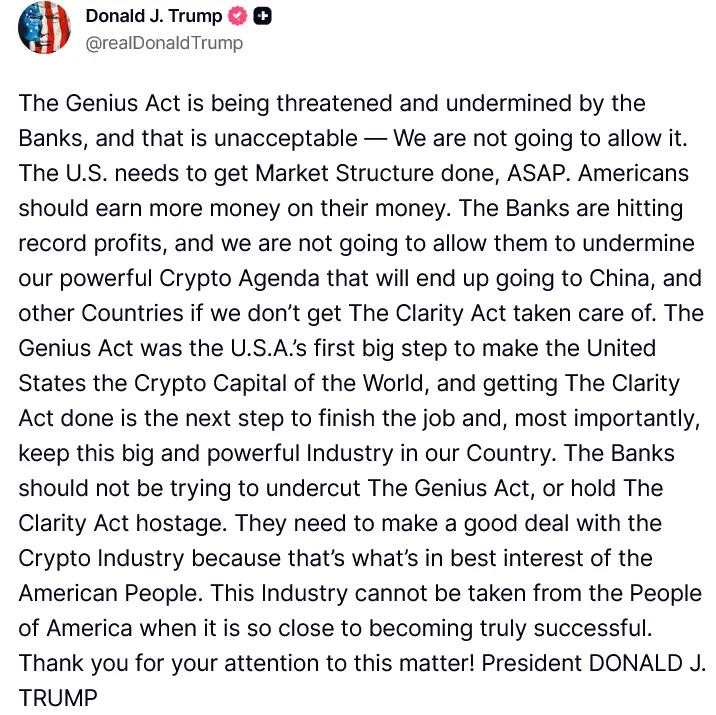
President Trump didn't stay quiet. On Truth Social, on March 3, he went after banks directly:
"The Genius Act is being threatened and undermined by the Banks, and that is unacceptable... The Banks are hitting record profits, and we are not going to allow them to undermine our powerful Crypto Agenda that will end up going to China... The Banks should not be trying to undercut The Genius Act, or hold The Clarity Act hostage."
The CLARITY Act, the Digital Asset Market Structure bill, is currently stalled in the Senate. Stablecoin yield rules are a central sticking point. Banks, including JPMorgan, oppose broad yield allowances. The crypto industry and the White House back them under the GENIUS Act framework. Coinbase previously withdrew support over draft restrictions that would have limited yield-bearing stablecoins.
Trump's framing is direct: if banks block progress on the CLARITY Act, the crypto industry moves to China and other countries, and the U.S. loses it.
What This Means Going Forward
Banks are protecting their deposit base. If stablecoins can offer yield-bearing accounts without the overhead of a bank charter, they become a direct competitor for everyday savers. Dimon is framing a competitive threat as a regulatory concern. The White House is calling it out in public.
With the CLARITY Act stalled and the administration now openly challenging one of Wall Street's most prominent CEOs, the fight over stablecoin yields has moved well past a policy debate. It's a straight-up confrontation. The White House has picked a side, and it's not Wall Street's.
Sources:
- Patrick Witt on X — White House crypto advisor's direct rebuttal to Dimon, posted March 4, 2026
- CoinDesk — Dimon original comments — JPMorgan CEO argues yield-bearing stablecoins should face bank-level regulation
- CoinDesk — Witt response coverage — Full reporting on the White House rebuttal
- The Block — Detailed analysis of the White House vs. Dimon exchange on stablecoin yield
- White House GENIUS Act Fact Sheet — Official summary of the GENIUS Act signed July 18, 2025
- Congress.gov GENIUS Act overview — Legislative text and CRS overview of the stablecoin framework
Read Next...




Disclaimer
Disclaimer: The views expressed in this article do not necessarily represent the views of BSCN. The information provided in this article is for educational and entertainment purposes only and should not be construed as investment advice, or advice of any kind. BSCN assumes no responsibility for any investment decisions made based on the information provided in this article. If you believe that the article should be amended, please reach out to the BSCN team by emailing [email protected].
Author
 Crypto Rich
Rich has been researching cryptocurrency and blockchain technology for eight years and has served as a senior analyst at BSCN since its founding in 2020. He focuses on fundamental analysis of early-stage crypto projects and tokens and has published in-depth research reports on over 200 emerging protocols. Rich also writes about broader technology and scientific trends and maintains active involvement in the crypto community through X/Twitter Spaces, and leading industry events.
(Advertisement)
Latest News
3h : 57m ago

Analysis: Ondo Finance's 2026 In Numbers
5h : 38m ago

Is Circle Planning to Launch a Korean Won Stablecoin?
7h : 39m ago

What Is Ripple Mint?
July 23, 2026

Can Injective's New Mint Platform Bring Institutions to INJ?
July 23, 2026

What is RippleX & Why Does it Matter for XRP Ledger?
July 23, 2026

What Is Dfinity's Caffeine?
July 22, 2026
How Much Funding Has Canton Developer Digital Asset Raised?
July 22, 2026

What is Aptos' AIP-146 and Is It Good News for APT?
(Advertisement)

Crypto Project & Token Reviews
Project & Token Reviews
Comprehensive reviews of crypto's most interesting projects and assets
Learn about the hottest projects & tokens

Latest Crypto Articles
Get up to date with the latest crypto news stories and events