Deepdive
(Advertisement)


Kaisar Network Explained: Earn From Your Idle Hardware

Kaisar Network lets users contribute idle CPUs and GPUs to power AI workloads and earn rewards. Here's how this DePIN project works.

Crypto Rich
January 19, 2026
(Advertisement)
Table of Contents
Kaisar Network is a DePIN (Decentralized Physical Infrastructure Network) project that lets anyone contribute spare computing power to run AI workloads in exchange for token rewards. The platform connects idle CPUs, GPUs, and memory from users worldwide to create a decentralized AI infrastructure layer.
With over 100,000 hardware providers now connected (up from around 8,000 in mid-2025), Kaisar has quietly built one of the larger compute-sharing ecosystems in crypto. The project operates under a simple premise: AI development requires massive compute resources that most builders can't afford. Decentralized networks offer an alternative path.
How Does the Compute Sharing Work?
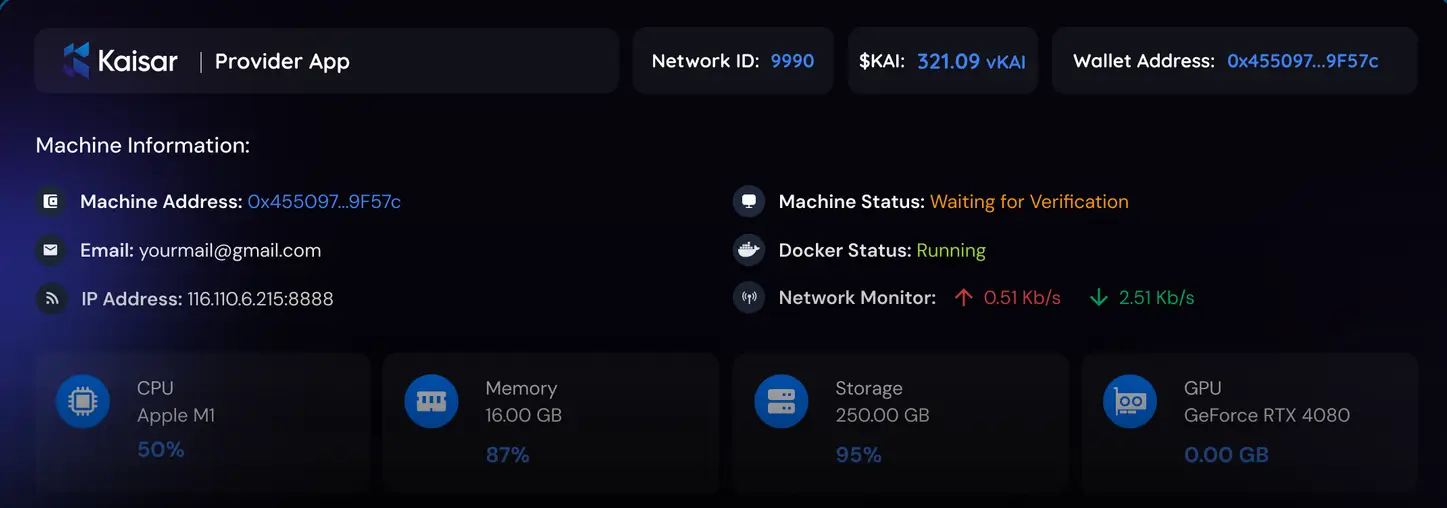
The network runs on a provider model. Users download the Kaisar Provider App (available for Windows, macOS, and Linux), connect their hardware, and start contributing resources. In return, they earn vKAI tokens for their contributions. vKAI functions as a voucher token during the pre-mainnet phase, with the token converting to the native KAI token at TGE.
A 7-day infrastructure snapshot from January 19, 2026, shows the current scale:
100,101 connected providers contributing 1,529,306 CPU cores and 2,657 TB of total memory supporting AI workloads. At the time of the snapshot, approximately 384 GPUs were available to accept new jobs, suggesting the network's GPU capacity was running near full utilization.
The Provider App has gone through several updates focused on stability and energy efficiency. During maintenance periods, user balances remain secured, which addresses a common concern in DePIN projects where downtime can mean lost rewards.
What Can You Build on Kaisar?
The main product for developers is Kaisar AI Ops, a platform designed to simplify AI deployment. Instead of managing clusters, GPUs, scheduling, and monitoring yourself, the platform handles infrastructure while you focus on building.
The pitch is straightforward: most AI teams don't struggle with models. They struggle with operations. Kaisar AI Ops aims to reduce deployment to three steps: build, deploy, scale.
Permissionless deployment allows users to launch AI agents on decentralized compute without needing their own data centers. The hybrid compute model combines distributed community hardware with high-performance clusters, including setups powered by NVIDIA Blackwell GPUs for heavier workloads.
This hybrid approach matters because pure peer-to-peer compute networks often struggle with consistency. By mixing community resources with professional-grade clusters, Kaisar can handle both casual projects and enterprise-level AI tasks.
Who Is Actually Using This?
Kaisar has landed at least one notable enterprise client. They delivered a GPU cluster powered by NVIDIA H200s to CMC OpenAI, enabling them to pre-train, fine-tune, and deploy foundation models. This type of client suggests the infrastructure works beyond just test cases.
The project has also appeared in Outlier Ventures updates and maintains connections with other DePIN projects. The ecosystem relationships help validate the technical approach, even if mainstream adoption remains early.
On the community side, Kaisar has built a following of over 194,000 on X (verified as an organization). Posts regularly pull thousands of views. The team responds to provider issues through in-app support and regular updates, though some users have reported intermittent login and earnings visibility challenges, particularly during maintenance periods.
What Is the AI Sovereignty Angle?
Kaisar leans heavily on the concept of "AI sovereignty," which means keeping AI infrastructure in community hands rather than concentrated with a few large companies.
Whether this vision scales to meaningfully compete with centralized cloud providers remains an open question. But the framing resonates with the broader crypto ethos of decentralization and permissionless access.
The practical benefit for individual users is simpler: if you have hardware sitting idle, you can put it to work earning tokens instead of collecting dust.
Should You Pay Attention to Kaisar?
For hardware owners, Kaisar offers a way to monetize idle compute without selling equipment. The Provider App makes onboarding relatively simple compared to running your own mining operation or node infrastructure.
For AI developers, the value proposition depends on your needs. If you're building AI agents or workflows and want to avoid AWS or Google Cloud bills, decentralized alternatives like Kaisar deserve a look. The hybrid model means you're not purely relying on inconsistent peer hardware.
For investors and observers, Kaisar represents one approach to the intersection of DePIN and AI. The sector has grown crowded, but projects with actual enterprise clients and six-figure provider networks stand apart from those still pitching concepts.
The network continues expanding, with the team pushing monthly momentum campaigns to keep builders engaged. Enterprise partnerships appear ongoing. Whether Kaisar becomes foundational infrastructure or remains a niche alternative depends on execution over the next year.
For more information, visit the official Kaisar Network website or follow @KaisarNetwork on X.
Sources:
- Kaisar Network X Profile Official social media account with network updates and community announcements
- Kaisar Network Official website with platform documentation and Provider App download
Read Next...




Frequently Asked Questions
What is Kaisar Network?
Kaisar Network is a DePIN project that creates decentralized AI infrastructure by connecting community-contributed CPUs, GPUs, and memory. Users share idle hardware to power AI workloads and earn vKAI tokens as rewards.
How do you earn from Kaisar Network?
Download the Kaisar Provider App, connect your hardware, and contribute computing resources to the network. You earn vKAI tokens based on the resources you provide. The app monitors performance and tracks your earnings.
How big is Kaisar Network?
As of January 2026, Kaisar has over 100,000 connected providers contributing more than 1.5 million CPU cores and 2,657 TB of memory to support AI workloads across its decentralized network.
Disclaimer
Disclaimer: The views expressed in this article do not necessarily represent the views of BSCN. The information provided in this article is for educational and entertainment purposes only and should not be construed as investment advice, or advice of any kind. BSCN assumes no responsibility for any investment decisions made based on the information provided in this article. If you believe that the article should be amended, please reach out to the BSCN team by emailing [email protected].
Author
 Crypto Rich
Rich has been researching cryptocurrency and blockchain technology for eight years and has served as a senior analyst at BSCN since its founding in 2020. He focuses on fundamental analysis of early-stage crypto projects and tokens and has published in-depth research reports on over 200 emerging protocols. Rich also writes about broader technology and scientific trends and maintains active involvement in the crypto community through X/Twitter Spaces, and leading industry events.
(Advertisement)
Latest News
July 24, 2026

Analysis: Ondo Finance's 2026 In Numbers
July 24, 2026

Is Circle Planning to Launch a Korean Won Stablecoin?
July 24, 2026

What Is Ripple Mint?
July 23, 2026

Can Injective's New Mint Platform Bring Institutions to INJ?
July 23, 2026
What is RippleX & Why Does it Matter for XRP Ledger?
July 23, 2026

What Is Dfinity's Caffeine?
July 22, 2026

How Much Funding Has Canton Developer Digital Asset Raised?
July 22, 2026

What is Aptos' AIP-146 and Is It Good News for APT?
(Advertisement)

Crypto Project & Token Reviews
Project & Token Reviews
Comprehensive reviews of crypto's most interesting projects and assets
Learn about the hottest projects & tokens

Latest Crypto Articles
Get up to date with the latest crypto news stories and events