Deepdive
(Advertisement)


How Does Dogecoin Benefit From Merged Mining With Litecoin?

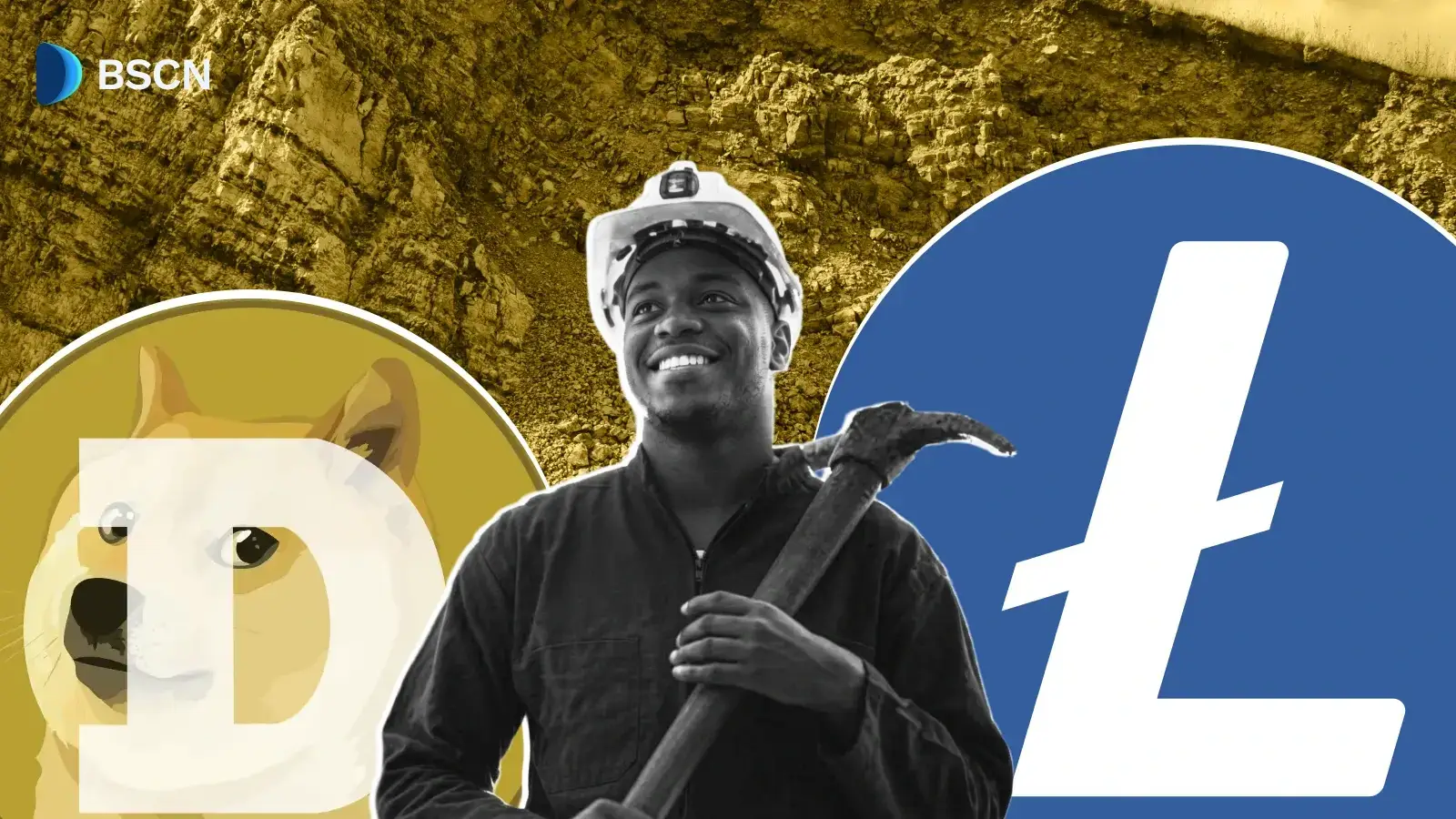
Learn how Dogecoin and Litecoin merged mining works using AuxPoW, why miners earn both coins from one device, and what makes this dual-reward system worth using in 2026.

Soumen Datta
June 9, 2026

(Advertisement)
Table of Contents
Dogecoin merged mining with Litecoin works by letting miners submit the same proof-of-work calculation to both blockchains at once, earning rewards in both DOGE and LTC without using extra electricity or hardware. This is made possible by a protocol called Auxiliary Proof-of-Work (AuxPoW), which Dogecoin adopted in August 2014.
Today, according to OKX, more than 70% of Dogecoin's hashpower comes from merged mining with Litecoin, making it the dominant method for securing the DOGE network.
Why Do Dogecoin and Litecoin Work Together?
The short answer is that both coins use the same hashing algorithm: Scrypt. This shared foundation is what makes merged mining technically possible. When a miner's hardware generates a hash to solve a Litecoin block, that same hash can also satisfy Dogecoin's proof-of-work requirements, provided it meets Dogecoin's difficulty target.
This is not a coincidence. Dogecoin was forked directly from Litecoin's source code in December 2013. Both chains were already running on Scrypt ASICs (Application-Specific Integrated Circuits), which meant their mining communities overlapped from day one.
Think of it like submitting one exam paper to two different professors who accept the same format. The work happens once, but the credit flows in two directions.
What Is AuxPoW and How Does It Actually Work?
AuxPoW, short for Auxiliary Proof-of-Work, is the mechanism that allows a secondary blockchain (the auxiliary chain) to accept proof-of-work validated on a primary chain (the parent chain). In this setup, Litecoin acts as the parent chain and Dogecoin acts as the auxiliary chain.
Here is what the process looks like in practice:
- A miner assembles transaction sets for both the Litecoin and Dogecoin blockchains.
- The hash of the Dogecoin (AuxPoW) block header is embedded into the coinbase transaction of the Litecoin block, specifically in a field called the coinbase field.
- The miner then works to solve the Litecoin block by hashing repeatedly until a valid solution is found.
- If the resulting hash meets Litecoin's difficulty target, a valid LTC block is found. If it also meets Dogecoin's (usually lower) difficulty target, a valid DOGE block is found simultaneously.
- The miner submits the completed proof to both networks. Each network broadcasts its respective block.
- Both coinbase transactions carry their own mining rewards, so the miner collects LTC block rewards and DOGE block rewards from a single computation.
Importantly, the Litecoin network does not need to know about AuxPoW logic. It simply processes a valid block. All the coordination happens at the mining pool or software layer, which means most miners using supported pools never need to configure anything manually.
Why Did Dogecoin Switch to Merged Mining in 2014?
Before August 2014, Dogecoin and Litecoin competed for the same Scrypt miners. This created a problem: miners would hop between the two networks based on short-term profitability, causing Dogecoin's hashrate to fluctuate wildly. A low hashrate makes any proof-of-work blockchain vulnerable to a 51% attack, where a single actor controls enough mining power to rewrite transaction history.
Dogecoin's developers and community recognized this risk. The network was still new, its dedicated miner base was small, and its block reward structure was not compelling enough to hold miners long-term. To solve this, the team implemented AuxPoW and enabled merged mining with Litecoin in August 2014.
The results were immediate. Within one month of the switch, Dogecoin's hashrate and mining difficulty increased by more than 1,500% as large Litecoin mining pools folded DOGE into their operations. Since then, Dogecoin's hashrate has tracked Litecoin's with a correlation of approximately 0.95, meaning the two networks rise and fall together almost in lockstep.
What Do Miners Actually Earn From Both Coins?
Each Dogecoin block currently carries a fixed reward of 10,000 DOGE. Dogecoin produces one block roughly every one minute, making it one of the faster proof-of-work blockchains. With DOGE trading at approximately $0.084 to $0.09 as of early June 2026, block rewards add a steady stream of income on top of LTC earnings.
On the Litecoin side, block rewards follow a halving schedule, meaning they decrease over time. Miners running Scrypt ASICs are directly motivated to activate merged mining because it adds DOGE income at zero marginal cost.
According to analysis from MEXC, mining pools that support both LTC and DOGE simultaneously typically add roughly 20 to 30% in additional daily revenue with no additional power draw. For miners paying electricity bills, that gap matters.
Popular Scrypt ASIC hardware such as the Bitmain Antminer L9 is designed with this dual-reward setup in mind. Mining pools including ViaBTC, F2Pool, and Prohashing have supported LTC/DOGE merged mining for years and handle all the AuxPoW block coordination automatically.
Does Merged Mining Affect Network Security?
For both Dogecoin and Litecoin, merged mining has a clear security benefit. More miners participating means a higher combined hashrate, which raises the cost of mounting a 51% attack.
As of mid-2026, Dogecoin's network hashrate has been running between approximately 2.7 and 3.4 PH/s (petahashes per second), having peaked as high as 8.72 PH/s in February 2026 before consolidating. Litecoin's hashrate has tracked in a similar range, sitting around 2.7 PH/s as of early June 2026 per CoinWarz. Both networks saw significant hashrate expansion driven by the rollout of newer high-powered Scrypt ASICs, such as the Bitmain Antminer L9 and the Goldshell DG Max, which have displaced older hardware across major pools.
There is, however, a known tradeoff. Because merged mining concentrates hashpower in large pools, it introduces a degree of mining centralization. Historical data shows that F2Pool alone was responsible for generating more than 33% of Dogecoin blocks for significant periods, and even exceeded 50% around late 2016. This level of pool dominance is a known concern in merged-mined networks and is worth monitoring.
How to Start Merged Mining LTC and DOGE
Getting started with merged mining does not require any special hardware beyond a Scrypt-compatible ASIC. The setup process is straightforward:
- Choose an ASIC miner that supports the Scrypt algorithm, such as the Bitmain Antminer L7 or L9.
- Select a mining pool that supports both Litecoin and Dogecoin simultaneously, such as ViaBTC, F2Pool, or Prohashing.
- Connect your miner to the pool using the pool's provided configuration settings. No separate Dogecoin configuration is typically needed.
- The pool handles all AuxPoW coordination. Rewards in both LTC and DOGE are paid out to your respective wallet addresses.
Mining software such as CGMiner or EasyMiner also supports Scrypt merged mining for those running their own nodes rather than joining a pool.
Conclusion
Dogecoin and Litecoin merged mining is a well-established, technically sound arrangement built on a shared Scrypt algorithm and the AuxPoW protocol. Since 2014, it has secured the Dogecoin network by tying it to Litecoin's larger mining base, and it has given Scrypt miners a reliable way to earn two coins from one machine.
With Dogecoin's hashrate running between 2.7 and 3.4 PH/s as of mid-2026, fixed block rewards of 10,000 DOGE, and pools adding roughly 20 to 30% additional daily revenue at no extra power cost, the dual-reward model remains a practical consideration for any miner running Scrypt ASIC hardware.
Resources
- OKX Learn – What Is Dogecoin Merge Mining? AuxPoW and How It Works
- Binance Research – Case Study: Merged Mining in Dogecoin and Litecoin
- ViaBTC Blog – Merged Mining DOGE and LTC: How It Works and Benefits
- ViaBTC Blog – LTC/DOGE Mining Profitability 2026: Difficulty Trends and Power Costs
- MEXC Learn – Dogecoin Mining: How DOGE Is Mined, Merge Mining, and Miner Economics
- MEXC Learn – Is Dogecoin Mining Still Profitable in 2026? Hardware and ROI Analysis
- Tari Labs – Merged Mining Introduction: AuxPoW Technical Overview
- Bitdeer Learn – Merge Mining: How It Works and Why It Matters
- CoinDesk – Dogecoin (DOGE) Live Price Data
- CoinWarz – Dogecoin Hashrate Chart: Live and Historical Network Data
- KuCoin Blog – Is Dogecoin Mining Still Profitable? A 2026 Essential Guide
Read Next...


Frequently Asked Questions
What is merged mining in Dogecoin?
Merged mining in Dogecoin means miners can validate Dogecoin blocks using the same proof-of-work computation they perform for Litecoin. This is enabled by AuxPoW (Auxiliary Proof-of-Work), a protocol Dogecoin adopted in August 2014. Miners earn rewards in both DOGE and LTC from a single mining session without extra electricity use.
Why do miners mine Dogecoin and Litecoin at the same time?
Because both coins use the Scrypt hashing algorithm, the same hardware and energy expenditure can secure both networks simultaneously. Mining pools that support LTC and DOGE together typically add 20 to 30% in additional daily revenue with no increase in power costs, making merged mining a straightforward income boost for Scrypt ASIC operators.
Does merged mining make Dogecoin less secure?
Merged mining significantly increased Dogecoin's security by linking its hashrate to Litecoin's larger mining ecosystem. Within one month of enabling AuxPoW in 2014, Dogecoin's difficulty increased by more than 1,500%. The main ongoing concern is pool centralization, where a small number of large pools control a disproportionate share of the merged hashrate.
Disclaimer
Disclaimer: The views expressed in this article do not necessarily represent the views of BSCN. The information provided in this article is for educational and entertainment purposes only and should not be construed as investment advice, or advice of any kind. BSCN assumes no responsibility for any investment decisions made based on the information provided in this article. If you believe that the article should be amended, please reach out to the BSCN team by emailing [email protected].
Author
 Soumen Datta
Soumen has been a crypto researcher since 2020 and holds a master’s in Physics. His writing and research has been published by publications such as CryptoSlate and DailyCoin, as well as BSCN. His areas of focus include Bitcoin, DeFi, and high-potential altcoins like Ethereum, Solana, XRP, and Chainlink. He combines analytical depth with journalistic clarity to deliver insights for both newcomers and seasoned crypto readers.
(Advertisement)
Latest News
July 17, 2026

What is the Nakamoto Coefficient & Why Does it Matter?
July 17, 2026

How to Trade on Robinhood Chain, Crypto's Busiest New Memecoin Market
July 17, 2026
Insights from CoinGecko's Q2 Crypto Report
July 17, 2026
Why Is Sui's Approach to Storing Data On Chain Different From Most Blockchains?
July 17, 2026

Why Does XRP Move Faster Than Bitcoin, And What Makes It Possible?
July 17, 2026

Top 8 Prediction Markets in Crypto Today
July 16, 2026

Grayscale Picks Its Most Promising Tokenization Blockchains
July 16, 2026

Crypto's Top Five Centralized Exchanges
(Advertisement)

Crypto Project & Token Reviews
Project & Token Reviews
Comprehensive reviews of crypto's most interesting projects and assets
Learn about the hottest projects & tokens

Latest Crypto Articles
Get up to date with the latest crypto news stories and events