Deepdive
(Advertisement)


Teneo Pays You to Power AI Agents


Teneo Protocol lets users run browser nodes to feed AI agents real-time data while earning rewards. Here's how the DePIN project works.

Crypto Rich
January 21, 2026

(Advertisement)
Table of Contents
Teneo Protocol is a decentralized network that powers AI agents with real-time public data, letting anyone run a node and earn rewards for contributing. The project sits at the intersection of DePIN and agentic AI, two sectors drawing serious attention as the crypto industry evolves beyond simple token speculation.
The timing makes sense. Major platforms like X have tightened API access, creating bottlenecks for developers building AI applications that need fresh data. Teneo's answer is straightforward: turn users into the infrastructure. Instead of relying on expensive APIs or centralized data providers, the protocol taps into a distributed network of community-run nodes that fetch, structure, and deliver public web data to AI agents.
By January 2026, Teneo had reached Phase 3 of its roadmap with notable adoption: over 6 million community-run nodes processed 18 billion data points in a single week. For a project that raised just $3 million in seed funding from backers including Generative Ventures and RockawayX, that growth curve is steep.
How Does Teneo Work?
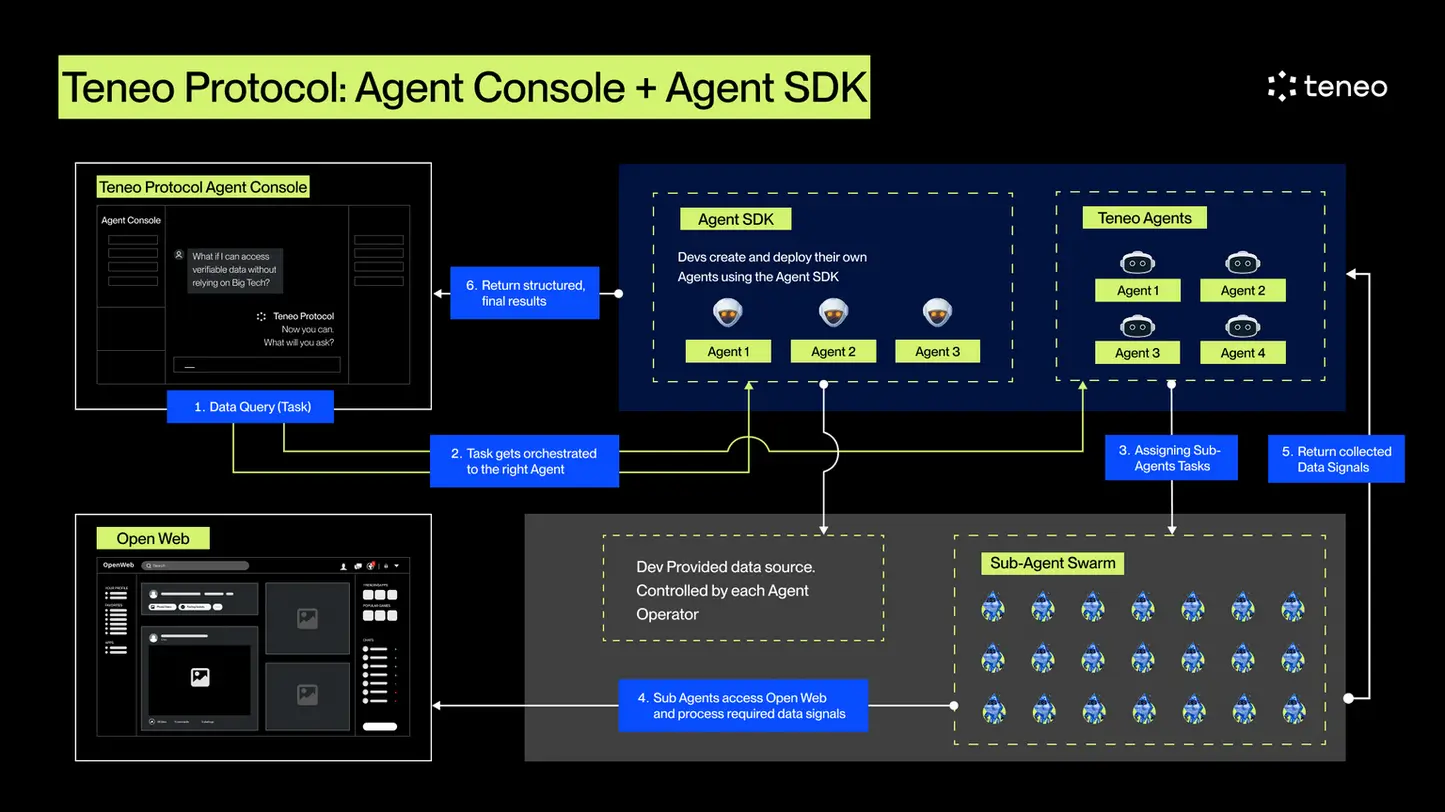
The technical foundation centers on what Teneo calls Autonomous Information Retrieval (AIR) tasks. These break down into three core functions: Search, Structure, and Deliver. AI agents running on the network can handle everything from simple data fetches to complex analyses using the Model Context Protocol (MCP) for better LLM performance.
Users participate through the Teneo Community Node, a lightweight Chrome extension. No specialized hardware required. After installation, the extension runs in the background, contributing unused bandwidth to process public web data. The DePIN model rewards contributions through "heartbeats" (points) that boost multipliers for future token rewards.
This approach differs from energy-intensive mining operations. Rewards tie directly to contribution levels rather than computational power, making participation accessible to anyone with a browser.
What Can Developers Build?
The Agent SDK stands out as a key feature. Developers can build, deploy, and monetize custom AI agents that get minted as NFTs on the peaq blockchain, making them transferable and ownable assets. The SDK includes CLI tools, templates, and orchestration through Teneo Rooms, chat-like interfaces designed for multi-agent collaboration.
Practical applications include a "CryptoSentinel AI" agent delivering real-time sentiment analysis, price tracking, and wallet alerts. The SDK provides the scaffolding to build and deploy these tools without starting from scratch.
In January 2026, Teneo launched the Agent Console, a live testnet environment where users interact with deployed agents in real-time. Users create a one-time Session Key, fund it with USDC on peaq, and query agents without repeated wallet popups. Early developers have already started deploying working agents through this system.
How Do Payments Work?
Teneo's economic model introduces x402, a standard for real-time micropayments. Agents earn USDC directly to their wallets for each successful query. No fees, no banks, no KYC requirements. Agent owners set transparent pricing, and settlements happen automatically in the background.
As of mid-January 2026, live x402 payments are active in the Agent Console. This reinforces that Teneo has moved beyond theoretical concepts into functioning infrastructure.
This "pay-as-you-go" approach contrasts with subscription models. Rather than paying monthly fees for access you may not fully use, users pay per query. The model enables what Teneo calls "true agent autonomy," where AI agents can operate and earn independently.
Golden Ticket holders (early supporters) received airdropped USDC to test the x402 system end-to-end. Once deployed, agents appear in the Console and become accessible to anyone with a connected wallet.
What Are the Tokenomics?
The native $TENEO token has a planned total supply of 10 billion. Allocation breaks down as follows:
- Community incentives: 33% (3.3 billion)
- Public/private sales: 25% (2.5 billion)
- Team: 13% (1.3 billion)
- Treasury: 10% (1 billion)
- Early backers: 6% (600 million)
- Marketing: 5% (500 million)
- Advisors: 4% (400 million)
- CEX/DEX liquidity: 4% (400 million)
Post-TGE, $TENEO will power governance, staking, data queries, and reward distribution. Node runners currently earn points that convert to tokens after the Token Generation Event, anticipated in Q1 2026. Points farming runs through late February 2026 before conversion.
The Echo Board waitlist is now live, offering early access to a 1 million $TENEO rewards pool for genuine contributions. The program aims to combat AI-generated spam by incentivizing human-curated content.
How Strong Is Community Adoption?
Teneo's growth appears community-driven. The project claims over 300,000 followers on X and millions of active nodes. Referral codes boost rewards, encouraging organic spread through existing networks.
The Genesis Program showcased early builder momentum, rewarding top agent creators with $1,000 USDC and 20,000 peaq tokens. Winning projects included wallet inspectors and sentiment analyzers, demonstrating practical applications.
Partnerships with peaq (the underlying layer-1 blockchain focused on machine economy infrastructure) provide the technical foundation. Teneo Academy offers educational content, unlocking Discord roles and deeper engagement opportunities for participants willing to learn the system.
What Challenges Does Teneo Face?
The project isn't without risk. Regulatory scrutiny of data privacy remains an open question for any protocol that scrapes public web data. Platform blocks pose another concern. If major sites actively prevent data extraction, the network's utility could diminish.
Competition from established API providers and other DePIN projects adds pressure. Traditional players have resources and relationships that a young protocol must work to match.
That said, decentralization provides some built-in resilience. A distributed network of millions of nodes proves harder to block than centralized scraping operations. The approach may not be bulletproof, but it offers advantages over single-point-of-failure alternatives.
What's Next?
The roadmap includes on-chain badges, gamified leaderboards, and developer grants to accelerate ecosystem growth. As AI agents proliferate across crypto and traditional tech, permissionless data access becomes increasingly valuable.
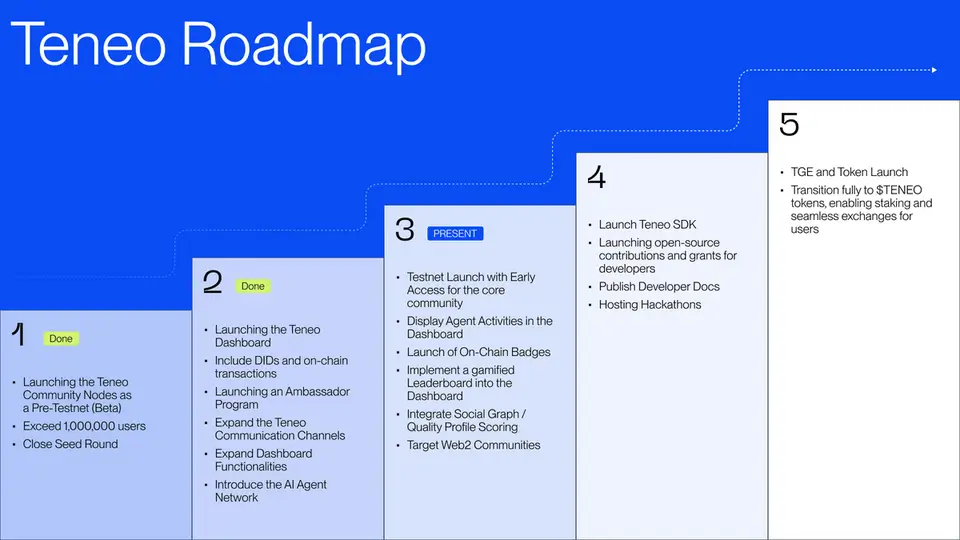
With TGE approaching, early participants position themselves for potential airdrops and staking yields. The project has moved beyond whitepaper promises to functioning infrastructure, putting it ahead of many competitors still in development.
For those interested in DePIN and agentic AI, Teneo offers a low-barrier entry point through the browser extension. Building custom agents requires more technical skill but carries potentially higher rewards through the monetization system.
Check out the official website at teneo-protocol.ai and follow @teneo_protocol on X for updates.
Sources:
- Teneo Docs (official documentation and protocol details)
- CryptoRank (funding round information)
- DePIN Hub (node mechanics and rewards system)
- Chrome Web Store (Teneo Community Node extension)
Read Next...

Frequently Asked Questions
What is Teneo Protocol used for?
Teneo Protocol provides real-time public web data to AI agents through a decentralized network. Users run lightweight browser nodes that fetch and structure data, earning rewards while powering AI applications without relying on centralized APIs.
How do you earn rewards with Teneo?
Install the Teneo Community Node Chrome extension and connect a wallet like MetaMask. The extension runs in the background, contributing bandwidth to process data. You earn "heartbeats" (points) based on contributions, which convert to $TENEO tokens after the Token Generation Event.
When is the $TENEO token launching?
The Token Generation Event is anticipated in Q1 2026. Points farming continues through late February before conversion, with additional rewards available through referrals and the Echo Board waitlist.
Disclaimer
Disclaimer: The views expressed in this article do not necessarily represent the views of BSCN. The information provided in this article is for educational and entertainment purposes only and should not be construed as investment advice, or advice of any kind. BSCN assumes no responsibility for any investment decisions made based on the information provided in this article. If you believe that the article should be amended, please reach out to the BSCN team by emailing [email protected].
Author
 Crypto Rich
Rich has been researching cryptocurrency and blockchain technology for eight years and has served as a senior analyst at BSCN since its founding in 2020. He focuses on fundamental analysis of early-stage crypto projects and tokens and has published in-depth research reports on over 200 emerging protocols. Rich also writes about broader technology and scientific trends and maintains active involvement in the crypto community through X/Twitter Spaces, and leading industry events.
(Advertisement)
Latest News
July 15, 2026

REAL Joins Blockchain for Europe to Shape EU Tokenisation Rules
July 15, 2026

Which Crypto Companies and Protocols Make The Most Money?
July 15, 2026
How SBI Built Japan's Largest Crypto Business
July 15, 2026
Elon Musk And Dogecoin: How One Man Shaped A Memecoin’s Price And Reputation
July 15, 2026
DTCC Tokenization Platform: How Does Wall Street's Blockchain Pilot Actually Work?
July 14, 2026
Report: Cardano's Biggest Updates from H1 2026
July 14, 2026

What is an XDC Network Masternode Validator?
July 13, 2026

Telebiz Goes Live With an Open-Source CRM Built Directly Into Telegram
(Advertisement)

Crypto Project & Token Reviews
Project & Token Reviews
Comprehensive reviews of crypto's most interesting projects and assets
Learn about the hottest projects & tokens

Latest Crypto Articles
Get up to date with the latest crypto news stories and events