

Ripple Ties XRP Future To CLARITY Act

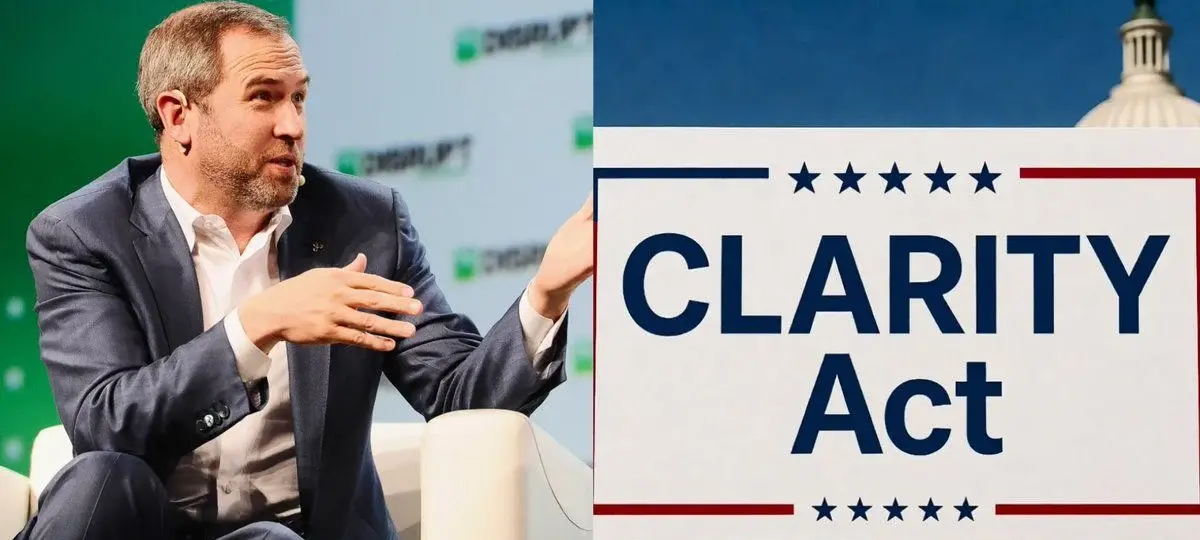
Ripple CEO Brad Garlinghouse is backing the CLARITY Act as the best path to lasting crypto regulation in the US, arguing that clearer rules are essential for $XRP, token markets, and blockchain payment infrastructure.
Garlinghouse Backs Permanent Framework
Ripple CEO Brad Garlinghouse has made the CLARITY Act central to the company's regulatory push, arguing that the legislation is critical not just for $XRP but for the broader US crypto market. His comments came against a backdrop of President Trump's vocal criticism of anti-crypto policies and former SEC Chair Gary Gensler, whose tenure Garlinghouse and others in the industry have long blamed for stifling innovation.
Garlinghouse's core argument is about permanence. He has said the importance of the CLARITY Act lies in locking in the crypto-friendly policies already being established at the SEC by Chairman Paul Atkins, because without a law, Atkins' successor can simply reverse those policies. "There will be another Paul Atkins after Paul who we don't know which side of this argument they're going to fall on," he warned.
The bill would clarify which digital assets fall under securities law versus Commodity Futures Trading Commission oversight, addressing long-standing regulatory uncertainty that Garlinghouse says has weighed on innovation. On $XRP specifically, Garlinghouse has framed the bill as imperfect but necessary, noting that Ripple already secured a federal court ruling that XRP is not a security, giving the company clarity that much of the industry still lacks. He has said Ripple is supporting the bill not because it needs it, but because a healthy US crypto regulatory environment benefits everyone in the space.
A Bill Moving Forward, But Not a Done Deal
The crypto industry scored a key win when the Senate Banking Committee approved the CLARITY Act in a 15-9 bipartisan vote, with Democratic Senators Ruben Gallego of Arizona and Angela Alsobrooks of Maryland joining all Republicans on the panel. Garlinghouse has repeatedly stressed that imperfect legislation would still mark a major improvement over the current regulatory environment, saying "perfection is the enemy of progress."
The measure has a long way to go before becoming law, given both powerful opposition and the fact that it would need to clear the full Senate as well as the House before heading to President Trump's desk. Analysts note the bill needs to clear the Senate by the end of July, and that failure to pass before the August recess would cause its prospects to deteriorate materially. The bill will also need at least eight Democratic votes on the Senate floor, well beyond the two Democrats who backed it in committee.
Garlinghouse has been direct about the stakes. "If it doesn't happen then, I think the likelihood is going to drop precipitously," he said at Consensus 2026 in Miami. Despite the hurdles, he remains publicly supportive, framing the bill as imperfect but necessary: he accused the SEC of fostering "chaos" through enforcement-driven regulation, and urged the industry to unite behind the CLARITY Act despite its shortcomings.
Sources
CoinDesk: Ripple CEO Brad Garlinghouse says clarity better than chaos as Senate hits key moment
CNBC: Crypto industry scores win as Clarity Act clears Senate hurdle
The Hill: Obstacles threaten success of Clarity Act in Senate
Latest News



Read More...





(Advertisement)
Author
 Soumen Datta
Soumen has been a crypto researcher since 2020 and holds a master’s in Physics. His writing and research has been published by publications such as CryptoSlate and DailyCoin, as well as BSCN. His areas of focus include Bitcoin, DeFi, and high-potential altcoins like Ethereum, Solana, XRP, and Chainlink. He combines analytical depth with journalistic clarity to deliver insights for both newcomers and seasoned crypto readers.