

Satoshi Nakamoto Bitcoin Could Be Cracked By Quantum Computers And Paradigm Has A Fix
Paradigm's Dan Robinson has proposed PACTs, a system allowing Bitcoin holders to privately timestamp proof of wallet ownership today and use quantum-resistant STARK proofs to recover funds if the network ever freezes vulnerable addresses.
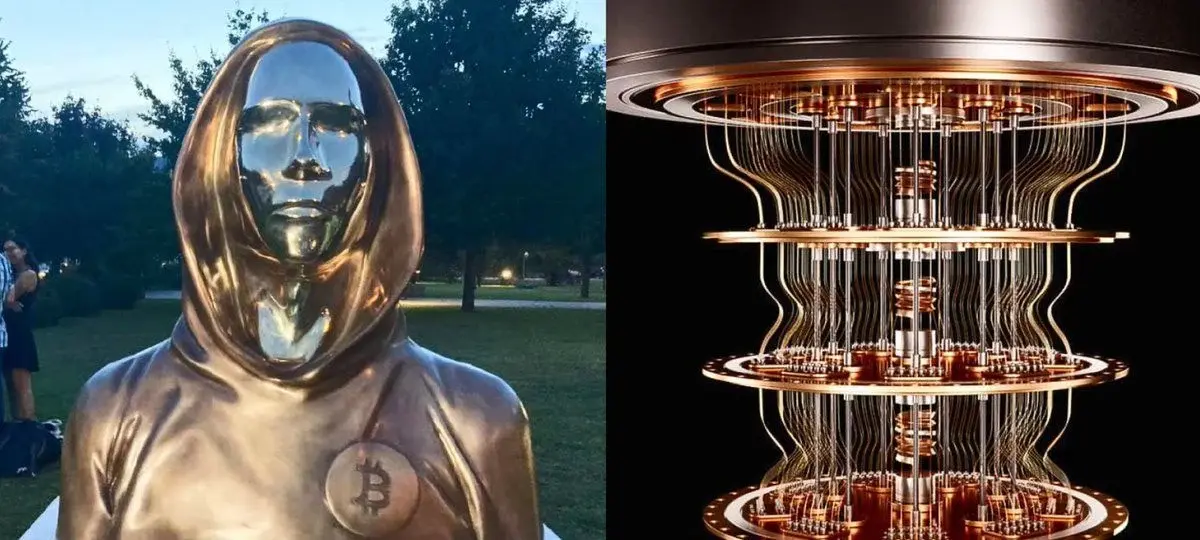
Paradigm's PACTs: A Private Path to Quantum Protection
Crypto research and investment firm Paradigm has put forward a proposal it believes could shield dormant $BTC wallets — including those linked to Bitcoin's pseudonymous creator Satoshi Nakamoto — from the growing threat posed by quantum computers.
Dan Robinson, a general partner at Paradigm, published the proposal for a system built around the concept of Provable Address-Control Timestamps, or PACTs. The core idea is not to move coins, but to timestamp proof of ownership at a specific date and reveal nothing publicly until the wallet owner actually needs to spend.
Over 1.1 million $BTC worth roughly $75 billion in Satoshi-linked wallets face exposure if cryptographically relevant quantum computers emerge. The challenge for early holders is acute: under existing proposals, proving ownership would require moving funds publicly — a step that would immediately signal activity from wallets that have been dormant for over a decade.
The proposal, titled Provable Address-Control Timestamps (PACTs), outlines a three-step method using existing Bitcoin tools to timestamp cryptographic proof of wallet ownership. A holder generates a random salt — a piece of secret data used to make a cryptographic commitment unique — and uses BIP-322 to produce a proof of ownership. The salt and proof are then bundled into a commitment and timestamped through OpenTimestamps, a free service that anchors data onto the Bitcoin blockchain via a single batched transaction. No onchain transaction is required. No public signal is broadcast.
A Counterpoint to BIP-361's Hard Deadline
If Bitcoin later activates a soft fork that freezes quantum-vulnerable coins, the protocol could include a rescue path that accepts a STARK proof — a type of zero-knowledge proof that remains secure against quantum computers — showing the holder created their commitment before quantum hardware existed. The holder submits that proof when they want to spend, and the network releases the coins. The redemption reveals nothing about which address, which amount, or even when the original timestamp was created.
The proposal is a direct response to BIP-361. Renowned cypherpunk and Casa CTO Jameson Lopp, along with five researchers, submitted BIP-361 — titled "Post Quantum Migration and Legacy Signature Sunset" — to the Bitcoin GitHub repository on April 14. Under BIP-361's second phase, five years after activation, legacy signatures would be invalidated entirely, effectively freezing any Bitcoin still held in vulnerable addresses. The proposal has drawn significant backlash, with critics labelling it "authoritarian" and arguing it undermines property rights.
PACTs also address a specific gap in BIP-361 by including a rescue path for wallets derived through BIP-32, the deterministic key generation standard introduced in 2012. Pre-2012 wallets, including most of Satoshi's known addresses, do not use BIP-32 and cannot be rescued through that path.
PACTs require no Bitcoin fork today but need future STARK verification support and community consensus to activate a rescue path. Robinson acknowledged the design is illustrative and needs review from cryptographers, Bitcoin developers, and the broader community. Crucially, the protocol only protects Satoshi if whoever currently controls those keys makes the commitment. If Satoshi is genuinely gone, no PACT can be retroactively created.
For now, PACTs offer a way to act early without forcing any immediate decision on the network — a low-cost option for holders who want to preserve their ability to claim funds, whatever the future of Bitcoin's quantum debate turns out to be.
Sources:
Paradigm — PACTs: Protecting Your Bitcoin From a Quantum Sunset
CoinDesk — New Bitcoin Quantum Proposal Offers Satoshi Nakamoto a Way to Prove Control Without Moving BTC
Cointelegraph — Bitcoin BIP-361 Targets Quantum Security Threat
Related News:
BSCN — Bitcoin Recent Updates: Institutional Access, Payment Growth, and Renewed Market Activity

(Advertisement)
Author
 Soumen Datta
Soumen has been a crypto researcher since 2020 and holds a master’s in Physics. His writing and research has been published by publications such as CryptoSlate and DailyCoin, as well as BSCN. His areas of focus include Bitcoin, DeFi, and high-potential altcoins like Ethereum, Solana, XRP, and Chainlink. He combines analytical depth with journalistic clarity to deliver insights for both newcomers and seasoned crypto readers.