

Blackrock Challenges Genius Act Rules On Tokenized Assets

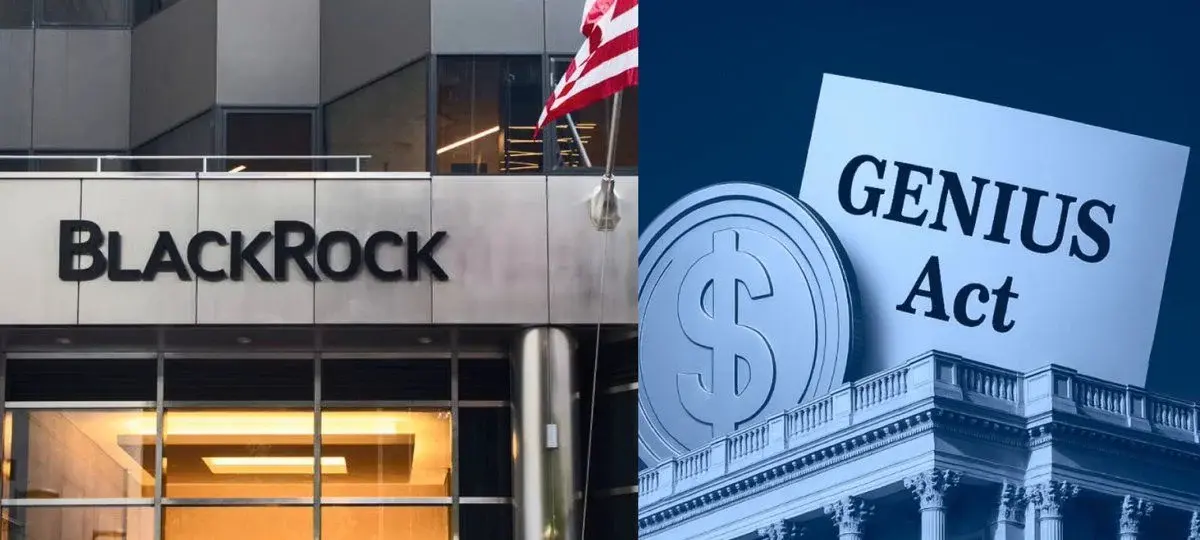
BlackRock has filed a formal comment letter urging the OCC to remove a proposed 20% cap on tokenized reserve assets under the GENIUS Act, warning the restriction could stifle growth in tokenized finance and constrain its BUIDL fund.
(Advertisement)

BlackRock has formally pushed back against a key provision in draft rules tied to the GENIUS Act, urging the Office of the Comptroller of the Currency (OCC) to remove a proposed 20% cap on tokenized reserve assets held by federally chartered stablecoin issuers.
The world's largest asset manager filed a 17-page comment letter on the final day of the OCC's 60-day comment window, which opened when the proposal was published in the Federal Register on March 2. The letter, signed by Roland Villacorta and Benjamin Tecmire on behalf of the firm, challenges several of the OCC's proposed reserve asset restrictions.
Why the Cap Matters for BUIDL
BlackRock's central objection is the potential 20% ceiling on tokenized reserves. The firm called the proposed limit "extraneous" to the OCC's objectives, arguing that reserve risk is determined by credit quality, duration, and liquidity — not by whether an asset is held or transferred on a distributed ledger.
The pushback carries real commercial weight. BlackRock's BUIDL fund holds nearly $2.6 billion in assets under management, according to RWA.xyz data, and currently provides over 90% of the reserves backing Ethena's USDtb and Solana-based Jupiter's JupUSD. A hard cap on tokenized reserves would directly limit BUIDL's ability to scale as a primary reserve asset under the incoming federal framework.
On the question of reserve diversification, BlackRock backed the OCC's "Option A" — a principles-based standard paired with an optional quantitative safe harbor — rather than "Option B," which would make concentration limits and maturity ceilings mandatory daily requirements for all issuers.
Broader Asks on Eligible Assets
Beyond the tokenization cap, BlackRock asked the OCC to formally confirm that Treasury ETFs qualify as eligible reserve assets under Section 4 of the GENIUS Act. The firm warned that without clear guidance, stablecoin issuers are unlikely to hold ETFs even where those funds invest exclusively in eligible instruments. It also recommended adding two-year U.S. Treasury floating-rate notes to the eligible asset list, citing their limited price volatility and weekly coupon resets.
The OCC's 376-page proposal is one of several federal rulemakings converging on a January 2027 compliance deadline. The FDIC advanced its own proposed rules in early April, while Treasury, FinCEN, and OFAC have put forward separate measures covering anti-money-laundering programmes, sanctions compliance, and state-level oversight. The Brookings Institution also submitted comments on the final day of the window, calling for higher capital charges on uninsured demand deposits held as reserves.
How the OCC resolves the tokenization question will go a long way toward determining whether tokenized Treasury funds become a fixture in bank-issued stablecoin reserves — or remain on the margins of a tightly regulated new market.
Sources:
The Block – BlackRock urges OCC to drop tokenized reserve cap, expand eligible assets in GENIUS Act comment letter
FinanceFeeds – BlackRock Urges OCC to Drop 20% Cap on Tokenized Reserves in GENIUS Rules
Related News:
BSCN – BlackRock Takes $2.2B Treasury Fund Live on Uniswap in DeFi First
(Advertisement)
Latest News




Read More...




Author
 Soumen Datta
Soumen has been a crypto researcher since 2020 and holds a master’s in Physics. His writing and research has been published by publications such as CryptoSlate and DailyCoin, as well as BSCN. His areas of focus include Bitcoin, DeFi, and high-potential altcoins like Ethereum, Solana, XRP, and Chainlink. He combines analytical depth with journalistic clarity to deliver insights for both newcomers and seasoned crypto readers.